

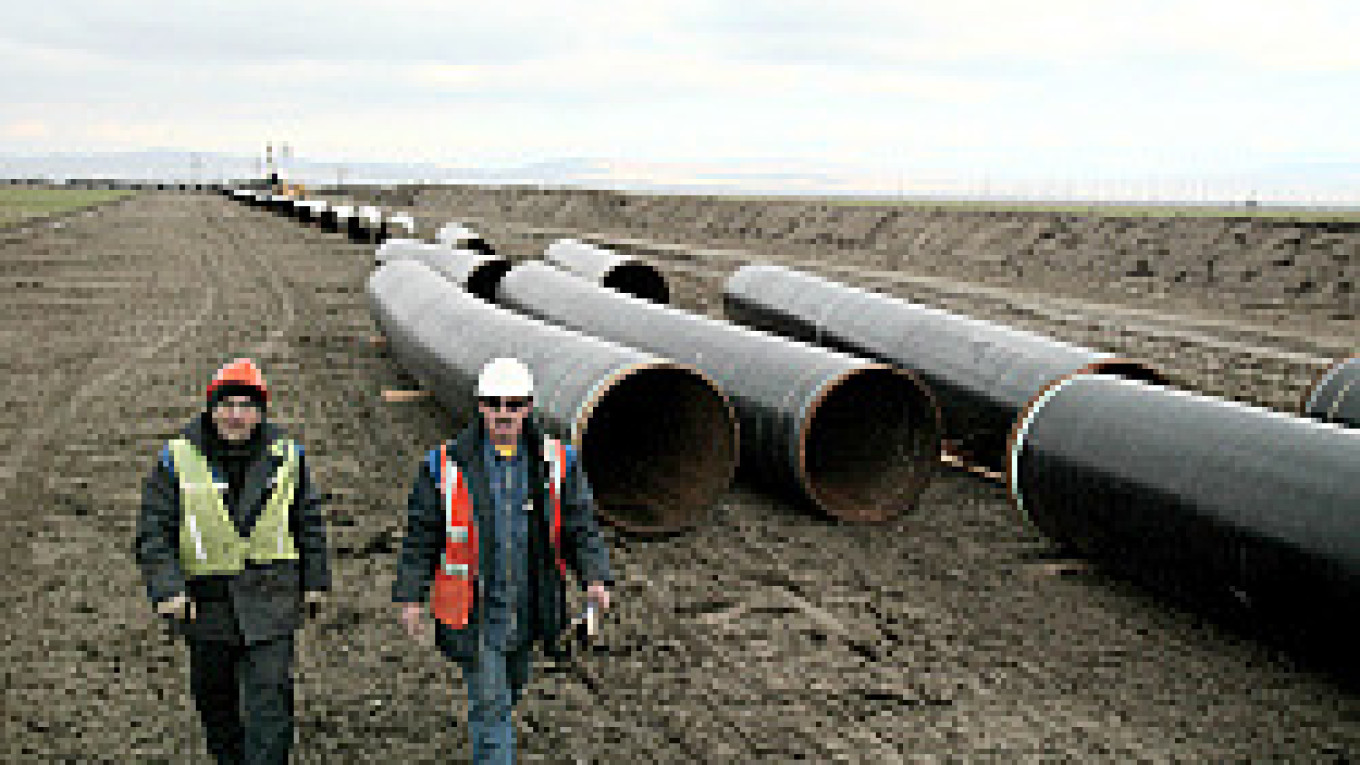
Georgia has been a key conduit of oil and gas from Central Asia to the West that bypasses Russia, and Europe has been hoping to build another pipeline to bring more gas from the area.
That pipeline project, called Nabucco, has long been on the drawing board, but potential investors had trouble contracting enough gas for it from Azerbaijan or Turkmenistan.
Shipping the gas from Turkmenistan would require building a separate pipeline across the Caspian Sea bed, which has yet to be divided by the sea's five littoral states, Russia, Azerbaijan, Kazakhstan, Turkmenistan and Iran.
Now, Georgia's vulnerability may have dealt a lethal blow to Nabucco and plans for a trans-Caspian pipeline.
"A trans-Caspian gas pipeline can be considered a forever buried chimera," said Pavel Baev, an energy expert at the International Peace Research Institute in Oslo. "It became clear for all the participants of these energy games that nothing will go through the Caspian Sea."
Europe was "shocked" by the instability and realized that "hardly anyone would invest money in new projects" associated with Georgia, said Konstantin Simonov, director of the Fund for National Energy Security.
When asked about the impact of the war on Nabucco prospects, European Commission energy spokesman, Martin Selmayr, said none of the pipelines going through Georgia was affected. The commission was in regular contact with energy companies in the region, he said.
Russian air strikes did not hit any of the three international oil and gas pipelines crossing the country or any oil ports, but they forced BP, which is an operator of Azerbaijan's two biggest energy projects, to stop oil and gas shipments through Georgia as a precautionary measure Tuesday.
The BP-operated Baku-Tbilisi-Ceyhan pipeline, which carries oil from Azerbaijan to the Turkish Mediterranean, was already out of commission because of an explosion in Turkey last week that Kurdish separatists claimed responsibility for.
Kazakh Prime Minister Karim Masimov on Monday ordered KazMunaiGaz, the national energy company, to study whether it could absorb domestically the exports envisaged for transit via Georgia.
Russia's Black Sea Fleet patrolled Georgia's coast, potentially making it harder to transport the crude from ports to international markets.
Azerbaijan's state oil company, SOCAR, said business was as usual at its Georgian port terminal of Kulevi, with the latest tanker leaving Tuesday.
In potential or existing new oil-related projects, Kazakhstan is looking to invest in Georgian railways that serve the Black Sea port of Batumi that it already controls. Azerbaijan is putting money into the construction of a railway running through Georgia to the Turkish border as an additional oil export route.
The war with Georgia could backfire on Russia by creating difficulties for its own project to supply Europe with gas, South Stream. The project's partners, Gazprom and Italy's Eni, have enlisted the support of Bulgaria, Serbia and Greece as transit countries for their route.
The initial stretch of the pipeline would cross the Black Sea, leaving Russia the task of winning approval from NATO member Turkey or Western-leaning Ukraine.
These countries could deny permission for the pipeline to cross their territory in an attempt to punish Russia for its military campaign in Georgia, Baev said. "One could expect movements in that direction," he said.
Simonov warned that there was another potential source of instability in the region in addition to Georgia's separatist regions. Azerbaijan, he pointed out, has a dormant conflict with Armenia that controls the disputed Nagorno-Karabakh enclave.
"I think it will flare up," he said.
A Message from The Moscow Times:
Dear readers,
We are facing unprecedented challenges. Russia's Prosecutor General's Office has designated The Moscow Times as an "undesirable" organization, criminalizing our work and putting our staff at risk of prosecution. This follows our earlier unjust labeling as a "foreign agent."
These actions are direct attempts to silence independent journalism in Russia. The authorities claim our work "discredits the decisions of the Russian leadership." We see things differently: we strive to provide accurate, unbiased reporting on Russia.
We, the journalists of The Moscow Times, refuse to be silenced. But to continue our work, we need your help.
Your support, no matter how small, makes a world of difference. If you can, please support us monthly starting from just $2. It's quick to set up, and every contribution makes a significant impact.
By supporting The Moscow Times, you're defending open, independent journalism in the face of repression. Thank you for standing with us.

Remind me later.