

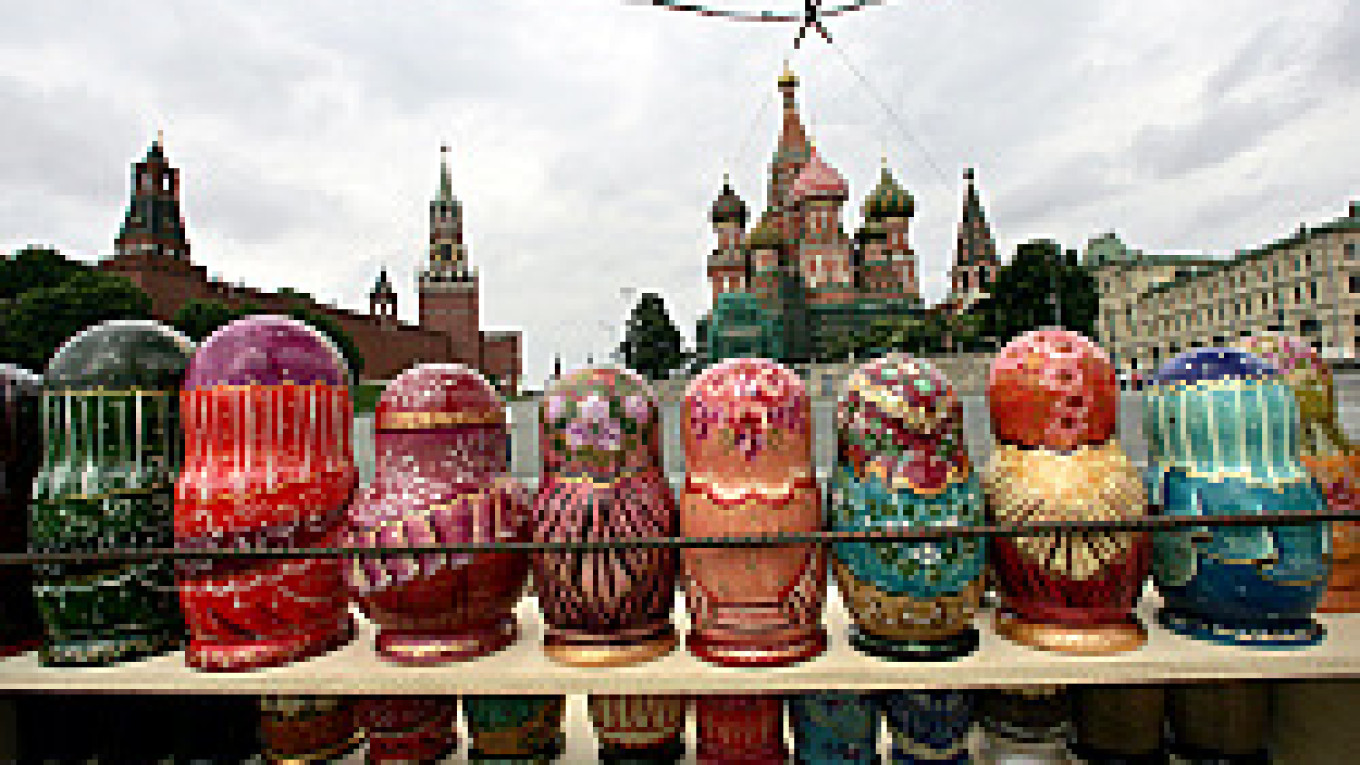
Ministries, state agencies, the White House and the Kremlin will all make large purchases of matryoshki and khokhloma dishes to be used mainly for gifts, a spokeswoman for the ministry said.
The measures were announced at a meeting on Wednesday between Industry and Trade Minister Viktor Khristenko and 20 souvenir makers.
One of the main measures of support should be state orders, Khristenko said at the meeting, according to a statement on the ministry's web site Thursday. "We still have to work out the regulatory documents ... and draw up a list of the products the state will buy," he said.
The state will also help the producers sell their crafts at crafts fairs both at home and abroad.
There are about 240 craft makers in Russia, employing 30,000 people.
Khristenko also said Wednesday that he supported "reasonable innovations in the taxation system for the craft makers," according to the ministry's web site. The ministry's spokeswoman said she could not elaborate.
Many craft makers were reliably happy with the results of the meeting.
"This way, the government shows us it tries to help us at least some way," Nikolai Korotkov, general director of the Khokhloma Painting Plant, said Thursday by telephone from the town of Semyonov in the Nizhny Novgorod region.
Korotkov's plant, the country's largest matryoshka producer, has been loss-making this year.
Korotkov, who attended the meeting with Khristenko, said he hoped for an order of 10 million rubles for matryoshki and khohkloma tableware, which he also makes. "That would be great," he said.
Others were more skeptical. "I got the impression that they didn't even want to listen to us," said Alexander Zubkov, general director of Palekh Painters workshop, which produces objects with miniature Russian folk paintings, on Thursday.
"The only goal of the state orders is to create more corruption, which would only result in the illusion of help," Zubkov said by telephone from the village Palekh in the Ivanovo region.
The artisan said, however, that he wouldn't mind if the state helped him sell his jewelry boxes and broaches abroad.
Zubkov, who also attended the meeting, said he hadn't seen a drop in demand but that his biggest problem was red tape. "We have to constantly prove that we produce traditional crafts to a dozen commissions to have certain taxes waived. It's humiliating," he said.
A spokeswoman for the Industry and Trade Ministry said a specialized department responsible for crafts would choose which producers are eligible for state orders.
"The main criteria would be how well they represent Russia as a brand," the spokeswoman explained.
A Message from The Moscow Times:
Dear readers,
We are facing unprecedented challenges. Russia's Prosecutor General's Office has designated The Moscow Times as an "undesirable" organization, criminalizing our work and putting our staff at risk of prosecution. This follows our earlier unjust labeling as a "foreign agent."
These actions are direct attempts to silence independent journalism in Russia. The authorities claim our work "discredits the decisions of the Russian leadership." We see things differently: we strive to provide accurate, unbiased reporting on Russia.
We, the journalists of The Moscow Times, refuse to be silenced. But to continue our work, we need your help.
Your support, no matter how small, makes a world of difference. If you can, please support us monthly starting from just $2. It's quick to set up, and every contribution makes a significant impact.
By supporting The Moscow Times, you're defending open, independent journalism in the face of repression. Thank you for standing with us.

Remind me later.