

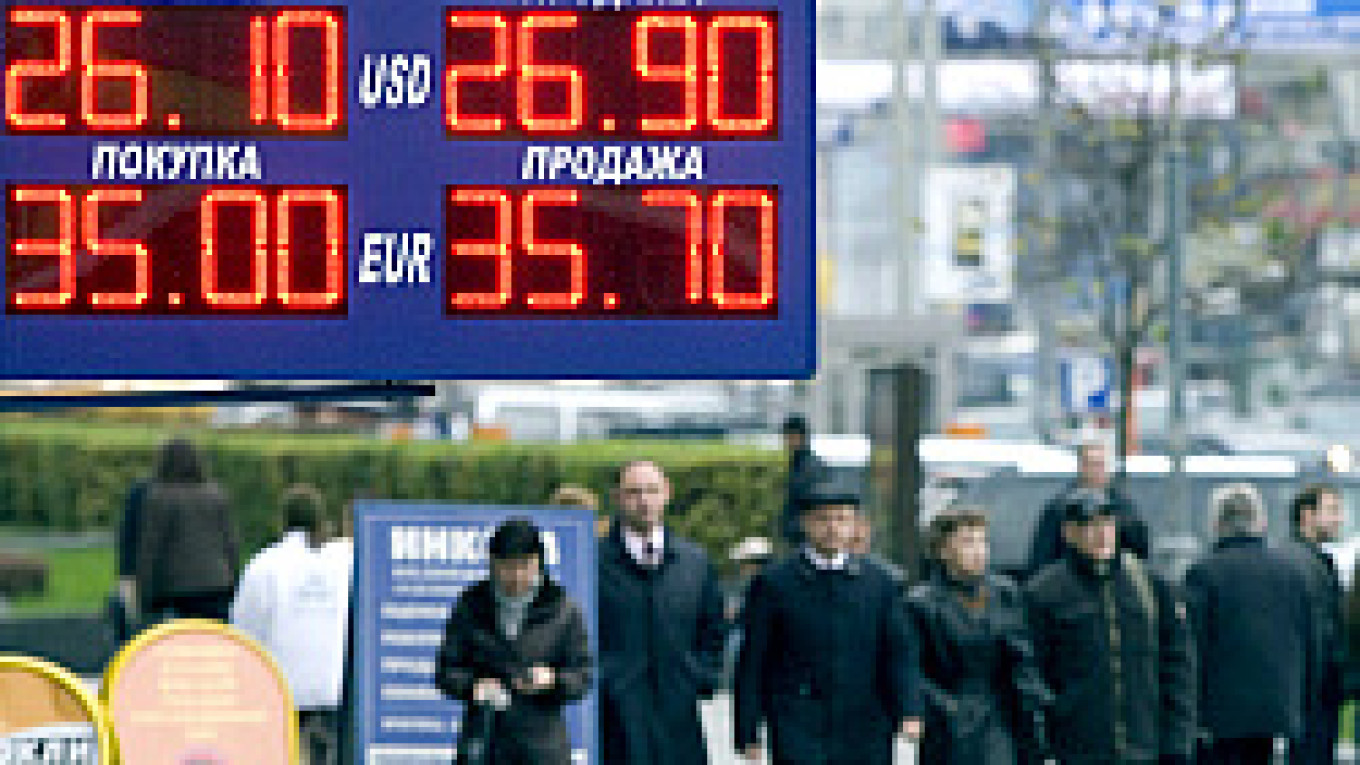
The Central Bank data showed that reserves fell $31 billion in the week to Oct. 24 to stand at $484.7 billion. Traders said the Central Bank spent only $13 billion propping up the ruble during the last week.
"A stunning one-week drop, more than twice the fall in the previous weeks," said Anna Zadornova from Goldman Sachs.
The rating agencies are closely watching Russia's reserves, which are dwindling as the Central Bank burns foreign currency in daily market interventions. Many analysts say such policy is unsustainable and that Russia will soon devalue the ruble.
Credit ratings agency Standard & Poor's -- which cut Russia's outlook to negative from stable last week, warning of the costs of bailing out troubled banks and a rising risk of a budget deficit -- declined to comment.
"The drop in reserves corresponds to a potential drop in the total foreign debt, so I do not see a drama there," said Yevgeny Nadorshin, analyst at Trust Bank.
The euro, which accounts for about 40 percent of the country's reserves, weakened by 6 percent against the dollar, which accounts for about 49 percent. Sterling, which makes up about 10 percent of reserves, also weakened versus the U.S. unit.
That also contributed to the fall of reserves, whose total value is calculated in dollars.
Russia also plans to use $50 billion of its reserves to help corporations redeem their foreign debt. United Company RusAl, owned by Oleg Deripaska, on Wednesday became the first beneficiary, securing a $4.5 billion loan.
The Central Bank plans to transfer the cash in small tranches to state-owned Vneshekonombank, also known as Development Bank, which is tasked with administering the package.
The Central Bank has also spent tens of billions of dollars of its reserves since August to prevent the ruble from weakening beyond the 30.41 level against a euro-dollar basket.
Several of the Western banks investing in Russia said last week that they expected the Central Bank at some stage to allow the ruble to depreciate.
"We expect the Central Bank to continue to support the currency in the near term by defending the ruble in an effort to calm the population's fears ... and because it perceives itself to be under speculative attack from the markets," Goldman's Zadornova said.
Starting last week, the bank introduced daily limits on currency swap operations in a further bid to deter speculators from betting on a fall in the ruble. On Thursday, the day's swap limit was set at zero for the first time.
The Central Bank also told commercial banks to keep a lid on growth in their foreign currency-denominated assets in a bid to stop currency speculation and a flight from ruble deposits, which accelerated sharply in October.
The Central Bank warned that it would monitor the banks' compliance with the instruction and make decisions to grant individual banks collateral-free loans based on the results of the monitoring.
"We believe the currency is mainly under attack by the Russian population," said Zadornova.
A Message from The Moscow Times:
Dear readers,
We are facing unprecedented challenges. Russia's Prosecutor General's Office has designated The Moscow Times as an "undesirable" organization, criminalizing our work and putting our staff at risk of prosecution. This follows our earlier unjust labeling as a "foreign agent."
These actions are direct attempts to silence independent journalism in Russia. The authorities claim our work "discredits the decisions of the Russian leadership." We see things differently: we strive to provide accurate, unbiased reporting on Russia.
We, the journalists of The Moscow Times, refuse to be silenced. But to continue our work, we need your help.
Your support, no matter how small, makes a world of difference. If you can, please support us monthly starting from just $2. It's quick to set up, and every contribution makes a significant impact.
By supporting The Moscow Times, you're defending open, independent journalism in the face of repression. Thank you for standing with us.

Remind me later.