

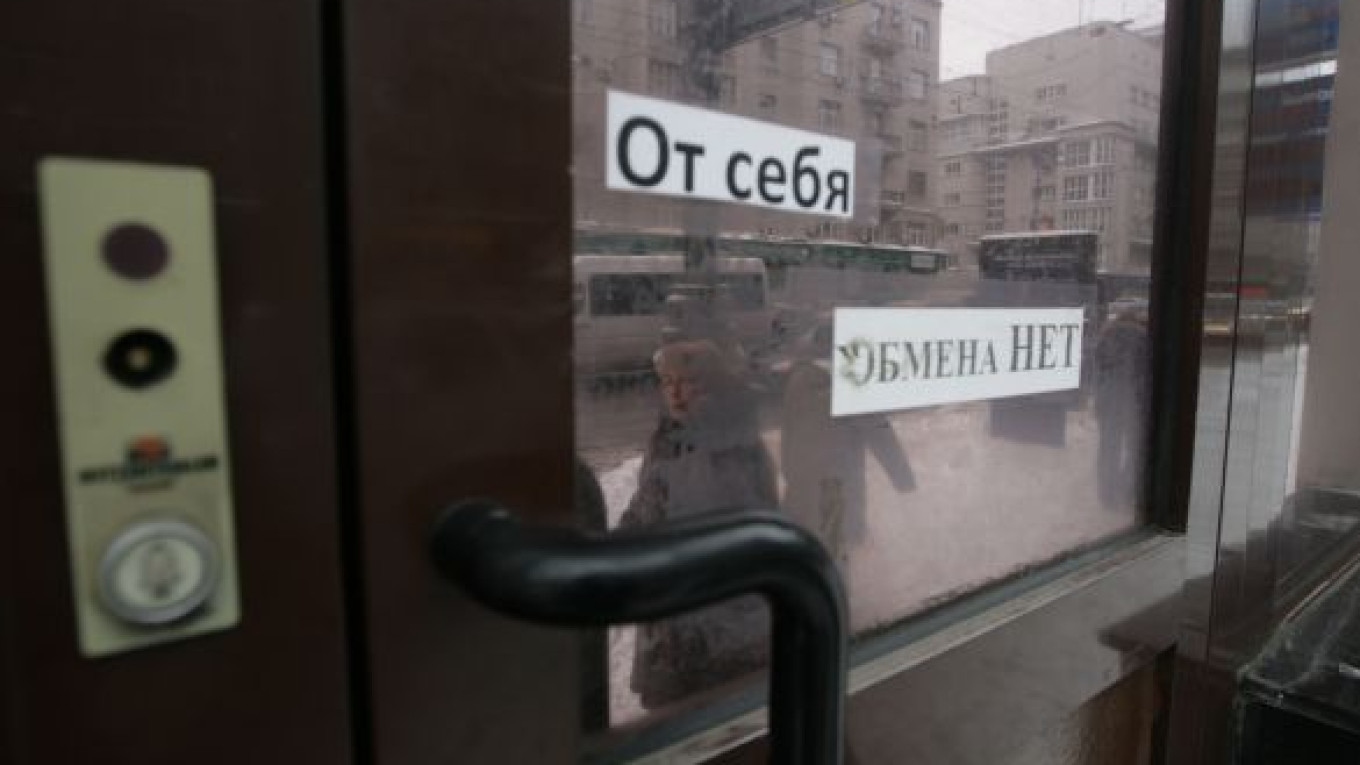
Beginning in October, stand-alone currency exchange booths could vanish under a Central Bank plan, but the same facilities could remain open as banks' transaction windows if they employ a second person and can provide additional financial services.
Street exchange points will be required to become cash-transaction desks or full-fledged bank branches, otherwise the Central Bank will close them Oct. 1. Under draft proposals published by the regulator, no new currency exchange booths could be opened, also effective Oct. 1.
Banks already have a variety of office formats, such as service branches, cash-transaction offices, lending and payments offices. Currencies can be exchanged in a regular bank branch, and the stand-alone exchange points must disappear, the Central Bank has told bankers.
The regulator made the decision amid falling demand for exchange points and frequent complaints that consumers are cheated by the exchange-booth tellers.
In January 2010, the public's total demand for foreign currencies — the sum purchased at exchange points, received through conversions and withdrawn from foreign-currency bank accounts — fell by 39 percent to $4.6 billion compared with a month earlier. The figure is also 69 percent lower than at the start of least year, when the dollar rose 20.5 percent against the ruble and the euro gained 10.2 percent.
The closure of exchange points will mean better service for consumers, since universal banks have much stricter oversight of their cashiers, said Sergei Leontyev, director of Binbank's sales network.
He warned, however, that the cost to consumers could also increase. Universal banks cannot offer competitive exchange rates because of their higher costs compared with "specialized players" on the market, he said.
The Federal Anti-Monopoly Service has already decided to look into the matter.
Exchange booths that are not breaking the law and not cheating customers should not have to suffer, said Yulia Bondaryova, director of the anti-monopoly service's financial oversight department.
She said a compromise must be found so that the booths' clients do not suffer, either. For example, banks could be required to have currency exchange windows in all branches that work with individuals.
Consumers should have a choice, otherwise the cost of a service — in this case, currency exchange commissions — will rise sharply, Bondaryova said. The anti-monopoly service is ready to discuss the matter with the Central Bank, both before Oct. 1 and after, when the effects of the ban will be clearer.
Leontyev said Binbank would only have to inform the Central Bank that it was reclassifying exchange points, which would not require any major expenses.
Reclassifying exchange booths as stand-alone, cash-transaction desks would mean that the bank would, at the very least, have to expand the operations to include deposits and withdrawals and transactions with traveler's checks, one banker said. Such an office would require at least two employees, the banker said.
Permission to conduct the operations would have to be received from the Central Bank, a bank manager noted. He recalled how his bank's exchange booths stopped working once for three months while waiting for Central Bank clearance to conduct additional transactions.
Many exchange points will have to move, however, since they are located in premises that are "basically bird houses that would be too small for two," another banker said.
A Message from The Moscow Times:
Dear readers,
We are facing unprecedented challenges. Russia's Prosecutor General's Office has designated The Moscow Times as an "undesirable" organization, criminalizing our work and putting our staff at risk of prosecution. This follows our earlier unjust labeling as a "foreign agent."
These actions are direct attempts to silence independent journalism in Russia. The authorities claim our work "discredits the decisions of the Russian leadership." We see things differently: we strive to provide accurate, unbiased reporting on Russia.
We, the journalists of The Moscow Times, refuse to be silenced. But to continue our work, we need your help.
Your support, no matter how small, makes a world of difference. If you can, please support us monthly starting from just $2. It's quick to set up, and every contribution makes a significant impact.
By supporting The Moscow Times, you're defending open, independent journalism in the face of repression. Thank you for standing with us.

Remind me later.