

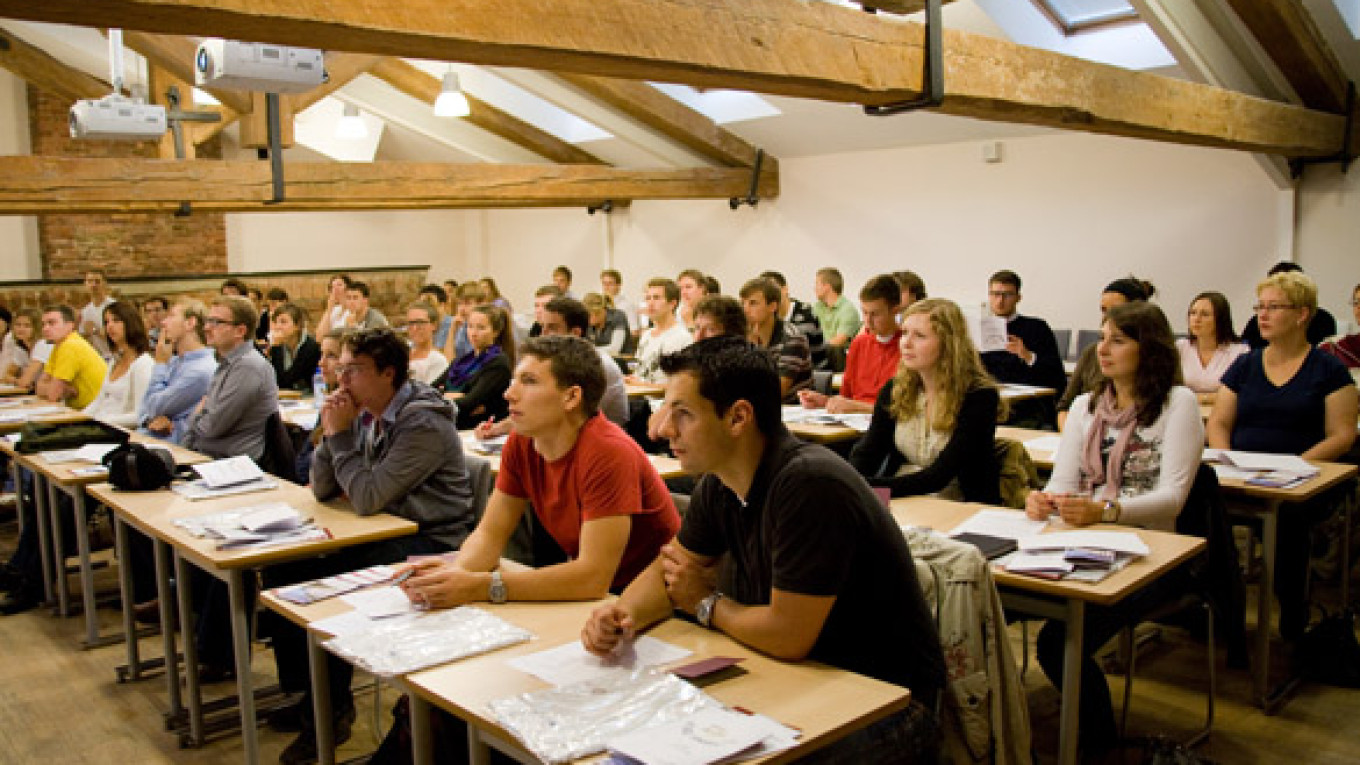
Business schools have begun an anti-crisis upgrade of their programs. They are introducing new classes on economic crises and Islamic finance, and they are seriously considering what to do with their case-study method — now that many of the companies on which the system was based have collapsed.
The bigger the world financial crisis grew, the more economists were talking about the inadequacy of prevailing economic theory.
“The basic error of modern macroeconomics is the belief that the economy is simply the sum of microeconomic decisions of rational agents,” Paul De Grauwe, a professor at the University of Leuven and the Centre for European Policy Studies, wrote in an op-ed piece for the Financial Times. “To paraphrase Isaac Newton, macroeconomists can calculate the motions of a lonely rational agent but not the madness of the crowds. Yet if macroeconomics wants to become relevant again, its practitioners will have to start calculating this madness.”
The crisis has turned more attention toward business schools and their responsibility for its aftermath. As a result, they will have to adjust to the fundamental changes in world economics and finance — primarily through the introduction of new classes.
New classes at the University of Chicago’s Booth School of Business include Introductory Finance; Business, Politics, and Ethics; the Firm and the Nonmarket Environment; and the Analytics of Financial Crises.
“The course work goes over the decisions made by companies’ management during the crisis, the political steps taken by various governments and how they influenced the duration and depth of the economic paralysis,” said Bill Kooser, associate dean for the school’s executive MBA programs. “We’re also drawing from experience with previous crises.”
Paul Danos, dean of Dartmouth’s Tuck School of Business, said he regretted that schools put such a focus on free markets before the crisis. “Previously, when studying risk management you had, for example, concepts like the ratio of borrowed capital to own capital. Now we’ve also introduced systemic risks — not how much you can borrow, but whether you can borrow at all. The financial crisis has brought changes to lot of classes. More attention is being paid to state regulation of markets, especially financial markets,” Danos said.
“We need to reconsider the foundations of the financial system and to understand how to reconcile globalization with stricter regulation around the world,” said Arnoud De Meyer, director of Cambridge University’s Judge Business School. “We must help students understand how business can pursue its strategy while taking into account the interests of the rest of society.”
Bernard Ramanantsoa, dean of HEC Paris, agreed that it was time for MBA students to look beyond achieving just career and financial success. Students no longer believe what they were taught before, following the accounting scandals and bankruptcies of recent years, so now it’s time to return to simple human values, said Laurent Bibard, director of the MBA program at French school Essec, referring to his institution’s and others’ decision to introduce classes studying business ethics.
A study by International Financial Services London showed that certain developing markets suffered less from the crisis. Economist Nouriel Roubini arrived at the same conclusion after a study of statistical indicators. “These countries … tended to have lower financial vulnerabilities due to more restrictive regulation and less developed financial markets,” he wrote in his column in Forbes magazine.
Business schools are increasingly looking toward Russia and other developing countries. Companies that work in those countries have invaluable experience functioning in unstructured markets, said Peter Lorange, the former president of IMD and owner of the GSBA Zurich business school.
He supported the idea of a global modular program for managers, starting in South Africa and then going to India and Russia. There are already modules in Russia for the EMBA programs at ESADE, Duke University’s Fuqua School of Business, and Thunderbird School of Global Management.
Another geographic trend is the attention to Islamic countries, where sharia law imposes a number of restrictions on financial activity, including a ban on interest.
In Islamic finance, money cannot itself be a good, and therefore must be invested in actual projects. Starting this year, classes on this nontraditional financial system will be available at Cass Business School, Erasmus University’s Rotterdam School of Management, Reims Management School, Manchester Business School, and Russia’s Mirbis.
“The Islamic finance system is spreading around the world because you can use it regardless of your faith,” Mirbis rector Stanislav Savin said.
The majority of Islamic banks suffered less from the crisis than Western banks, said Mohamed Djeddour, who specializes in strategy and international business at the Manchester Business School. But Sergei Guriev, rector of the New Economic School, said he was sure Western finance would nonetheless come out on top. “Liquidity continues to decrease, and Islamic financial institutions are tougher about giving out loans. Besides, Western finance is more developed,” he said.
Savin said he had no simple answer for whether it was right to study companies that have collapsed. Such cases can be considered for studying the boundaries of corporate stability and developing skills for problem solving in difficult situations.
From an educational point of view, both positive and negative examples can be instructive, but the emphasis so far has been on positive cases. “It’s unlikely that the mistakes will be reconsidered as bad advice, since no one wants to expound upon his own miscalculations,” Guriev said.
Nonetheless, there is a real problem with business cases now, he said. There aren’t too many successful companies, and the people who work at them are too busy to talk about it.
Participants in the two-week Leading Change program at St. Petersburg State University’s Graduate School of Management and Fuqua will need to develop a plan with concrete steps to bring about changes in an actual company. Mirbis wants to use a similar method as part of its global modular program for managers, with Lorange’s GSBA Zurich.
But business cases won’t be able to solve all the problems of management education, said Andrei Volkov, rector of Skolkovo. The world’s leading business schools have long been using modeling, simulations and projections, and that’s where the future lies, he said.
A Message from The Moscow Times:
Dear readers,
We are facing unprecedented challenges. Russia's Prosecutor General's Office has designated The Moscow Times as an "undesirable" organization, criminalizing our work and putting our staff at risk of prosecution. This follows our earlier unjust labeling as a "foreign agent."
These actions are direct attempts to silence independent journalism in Russia. The authorities claim our work "discredits the decisions of the Russian leadership." We see things differently: we strive to provide accurate, unbiased reporting on Russia.
We, the journalists of The Moscow Times, refuse to be silenced. But to continue our work, we need your help.
Your support, no matter how small, makes a world of difference. If you can, please support us monthly starting from just $2. It's quick to set up, and every contribution makes a significant impact.
By supporting The Moscow Times, you're defending open, independent journalism in the face of repression. Thank you for standing with us.

Remind me later.