

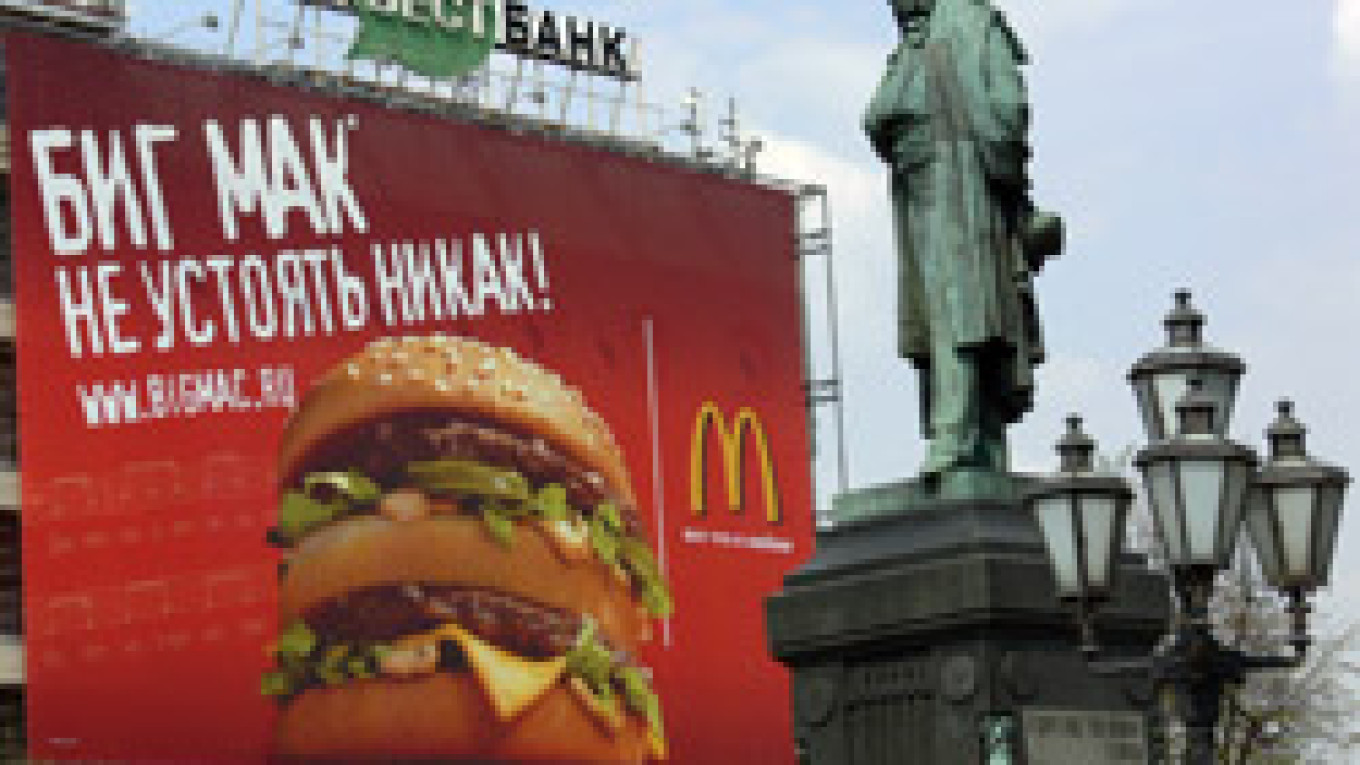
If the price of a Big Mac is any indication, Russia could have one of the world’s most undervalued currencies.
For the past 20 years, The Economist has been publishing its Big Mac Index, which uses the cost of a McDonald’s Big Mac in various countries to determine the relative values of different currencies to the dollar.
The index is based on the theory of purchasing power parity — the notion that in similar markets identical goods should have the same price. For its basket of goods, the theory uses a Big Mac, which is produced in about 120 different countries.
The cost of a Big Mac in any individual country depends on a variety of factors, including production volume, prices for raw materials, manpower and rent. Comparing the dollar price of a Big Mac in different countries is a good estimate for gauging how overvalued or undervalued a country’s currency is, The Economist said.
The world’s cheapest Big Mac can be found in Hong Kong, where it sells for the equivalent of $1.72, followed by Sri Lanka, China and Ukraine, where the burger costs $1.83 — almost half of the U.S. price. Norway’s Big Mac is the world’s most expensive, selling for $6.15.
The Russian Big Mac has become 13 percent more expensive and now sells for 67 rubles ($2.04). The index showed Russia closing the gap in purchasing power with the United States — in 2008, the ruble was 29 percent undervalued, while this year the currency is undervalued by 43 percent, the index showed.
But the ruble is no longer undervalued if one compares the cost of a Big Mac with the income levels in Russia and the United States, said Vladimir Tikhomirov, chief economist at UralSib. World Bank data show that gross domestic product per person measured by purchasing power parity is three times higher in the United States than in Russia, he said.
A Message from The Moscow Times:
Dear readers,
We are facing unprecedented challenges. Russia's Prosecutor General's Office has designated The Moscow Times as an "undesirable" organization, criminalizing our work and putting our staff at risk of prosecution. This follows our earlier unjust labeling as a "foreign agent."
These actions are direct attempts to silence independent journalism in Russia. The authorities claim our work "discredits the decisions of the Russian leadership." We see things differently: we strive to provide accurate, unbiased reporting on Russia.
We, the journalists of The Moscow Times, refuse to be silenced. But to continue our work, we need your help.
Your support, no matter how small, makes a world of difference. If you can, please support us monthly starting from just $2. It's quick to set up, and every contribution makes a significant impact.
By supporting The Moscow Times, you're defending open, independent journalism in the face of repression. Thank you for standing with us.

Remind me later.