

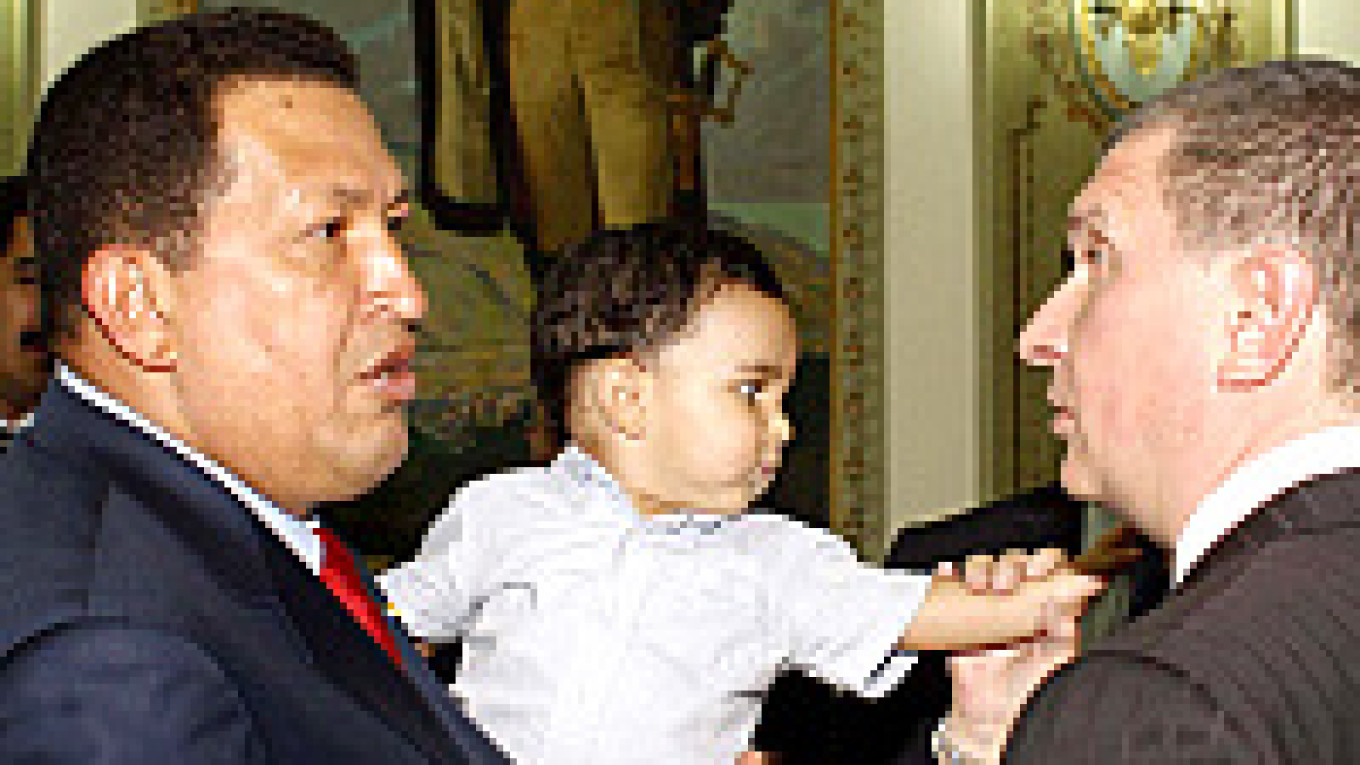
Sechin held two hours of talks Tuesday with President Hugo Chavez that also focused on energy, manufacturing, shipbuilding, education, science, car production and culture, RIA-Novosti reported Wednesday.
"As part of a high-level intergovernmental commission, we reviewed projects currently under development and agreed that the next meeting would be held in October in Caracas," Sechin told reporters.
He touted Venezuela as "one of Russia's most reliable partners" in the defense industry.
Chavez said he would visit Russia next week during a trip that would also take him to China and Portugal. He did not give a date for the Russian stop.
Sergei Chemezov, head of state-holding company Russian Technologies and a member of Sechin's delegation, said the Russian defense industry had nearly fulfilled $4.4 billion in contracts signed with Venezuela over the past three years, including deliveries of Su-30 multipurpose fighters, Mi-17 transport helicopters and AK-103 and AK-104 assault rifles. Venezuela plans to make the assault rifles and ammunition under license. "The construction site for the plant has already been prepared. Work has already begun on its foundation," Chemezov said, Interfax reported.
He said Venezuela has shown interest in buying Su-35 fighters, which are to go into mass production in 2010.
Sechin presented Chavez with a new Russian biography of Cuban revolutionary Fidel Castro.
The Russian delegation on Monday visited Cuba to discuss commercial ties and look for ways to help the island recover from two recent hurricanes.
Federal Space Agency chief Anatoly Perminov said Wednesday after talks in Caracas with Venezuelan and Cuban officials that Moscow was prepared to help Havana develop a space center.
A Message from The Moscow Times:
Dear readers,
We are facing unprecedented challenges. Russia's Prosecutor General's Office has designated The Moscow Times as an "undesirable" organization, criminalizing our work and putting our staff at risk of prosecution. This follows our earlier unjust labeling as a "foreign agent."
These actions are direct attempts to silence independent journalism in Russia. The authorities claim our work "discredits the decisions of the Russian leadership." We see things differently: we strive to provide accurate, unbiased reporting on Russia.
We, the journalists of The Moscow Times, refuse to be silenced. But to continue our work, we need your help.
Your support, no matter how small, makes a world of difference. If you can, please support us monthly starting from just $2. It's quick to set up, and every contribution makes a significant impact.
By supporting The Moscow Times, you're defending open, independent journalism in the face of repression. Thank you for standing with us.

Remind me later.