

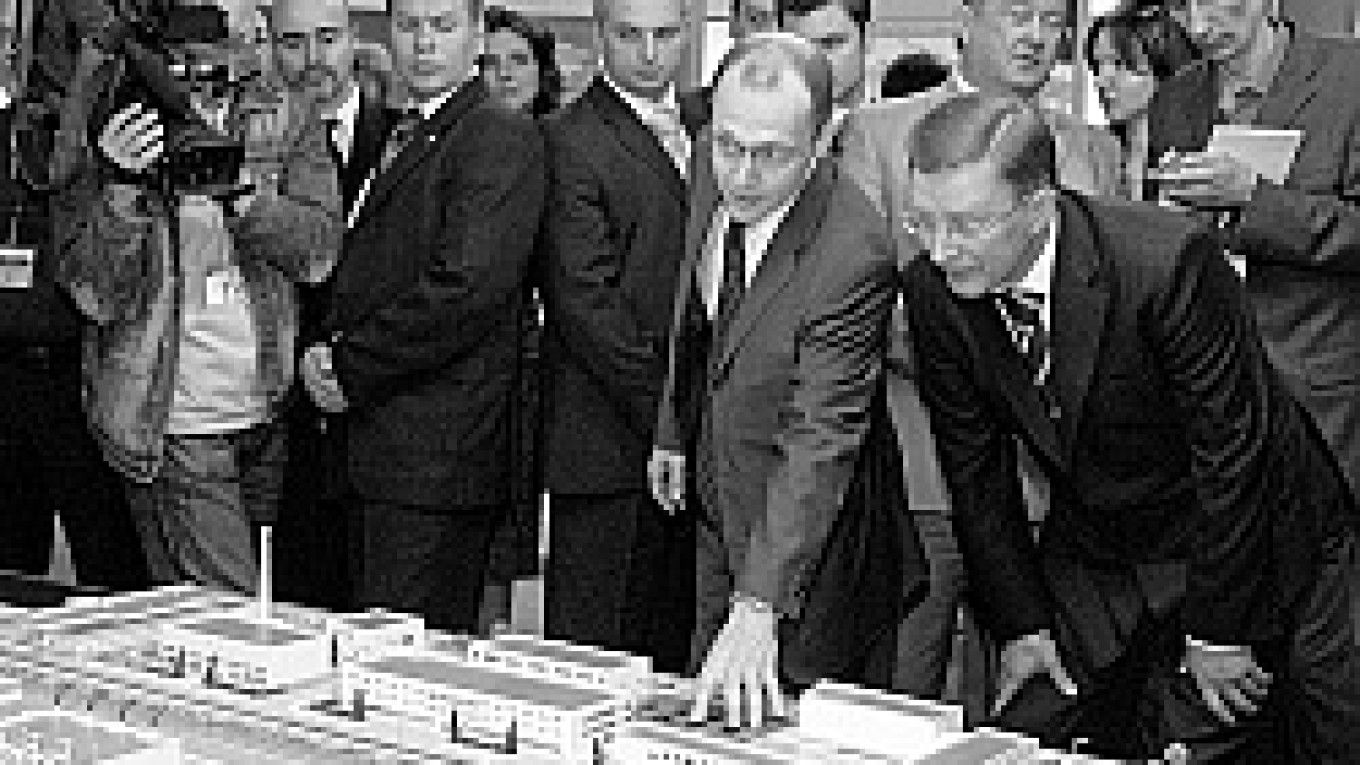
Design of the two-reactor plant is to be completed by the end of 2009, and the first of the two 1,200-megawatt reactors is to come on line in 2015, Rosatom said in a statement.
St. Petersburg's Atomenergoproyekt institute will design the facility, while construction will be carried out by Energoatom at an estimated cost of 5 billion euros ($7.4 billion).
Kaliningrad is not able to meet its own electricity needs and imports 30 percent of its power from a Soviet-era plant in Lithuania, which is scheduled to close next year as one of the conditions set for the country when it gained European Union membership in 2004.
Rosatom spokesman Sergei Novikov said that, aside from meeting the region's needs, some of the power generated by the plant would be exported, without providing figures.
"We cannot say what the region's energy needs will be by 2015," he said.
Previous efforts to meet the energy shortfall in the region of less than 1 million people have been less than successful.
The Kaliningrad natural gas power plant, completed in 2005, still operates at less than capacity because Gazprom is not supplying it with enough gas.
A second gas plant generator was scheduled to be completed by the end of the year, but construction has been frozen until an agreement with Gazprom can be reached.
It remains unclear how the region will cover the electricity shortfall between the closure of the Lithuanian plant and the opening of the Baltiiskaya unit in 2015.
The decree caught analysts and environmentalists by surprise.
The Kaliningrad plant is not mentioned in the federal plan for the power industry to 2020, developed by the Energy Ministry in 2007.
"Russian nuclear plants always appear in the federal plan first," said Vladimir Slivyak, co-chairman of Ecodefense, a Kaliningrad-based environmental organization. "The government always makes the decision to build a nuclear plant; this is the first time I've seen otherwise."
Rosatom's Novikov denied that there was anything untoward, saying the Energy Ministry's plan was not binding and only intended to provide for "mainland" Russia.
The Kaliningrad region is a western exclave separated from the rest of the country by Lithuania and Poland.
No funding for the project will come from the federal budget, Novikov said.
Foreign investors are expected to cover 49 percent of the cost, he said, with the remainder coming from Rosatom.
Novikov declined to name any prospective investors but said that talks are already under way.
There were some questions about the economic sense of the plan.
"This project seems to have a political, rather than an economic motivation," said Gennady Sukhanov, an analyst with Troika Dialog.
"Building new capacity of more than 1,000 megawatts is excessive for the Kaliningrad region, but otherwise it would continue to be dependent on European countries," he said.
In a poll conducted by Kaliningrad sociological center in 2007, 67 percent of respondents were against building a nuclear power plant in the region.
A Message from The Moscow Times:
Dear readers,
We are facing unprecedented challenges. Russia's Prosecutor General's Office has designated The Moscow Times as an "undesirable" organization, criminalizing our work and putting our staff at risk of prosecution. This follows our earlier unjust labeling as a "foreign agent."
These actions are direct attempts to silence independent journalism in Russia. The authorities claim our work "discredits the decisions of the Russian leadership." We see things differently: we strive to provide accurate, unbiased reporting on Russia.
We, the journalists of The Moscow Times, refuse to be silenced. But to continue our work, we need your help.
Your support, no matter how small, makes a world of difference. If you can, please support us monthly starting from just $2. It's quick to set up, and every contribution makes a significant impact.
By supporting The Moscow Times, you're defending open, independent journalism in the face of repression. Thank you for standing with us.

Remind me later.