

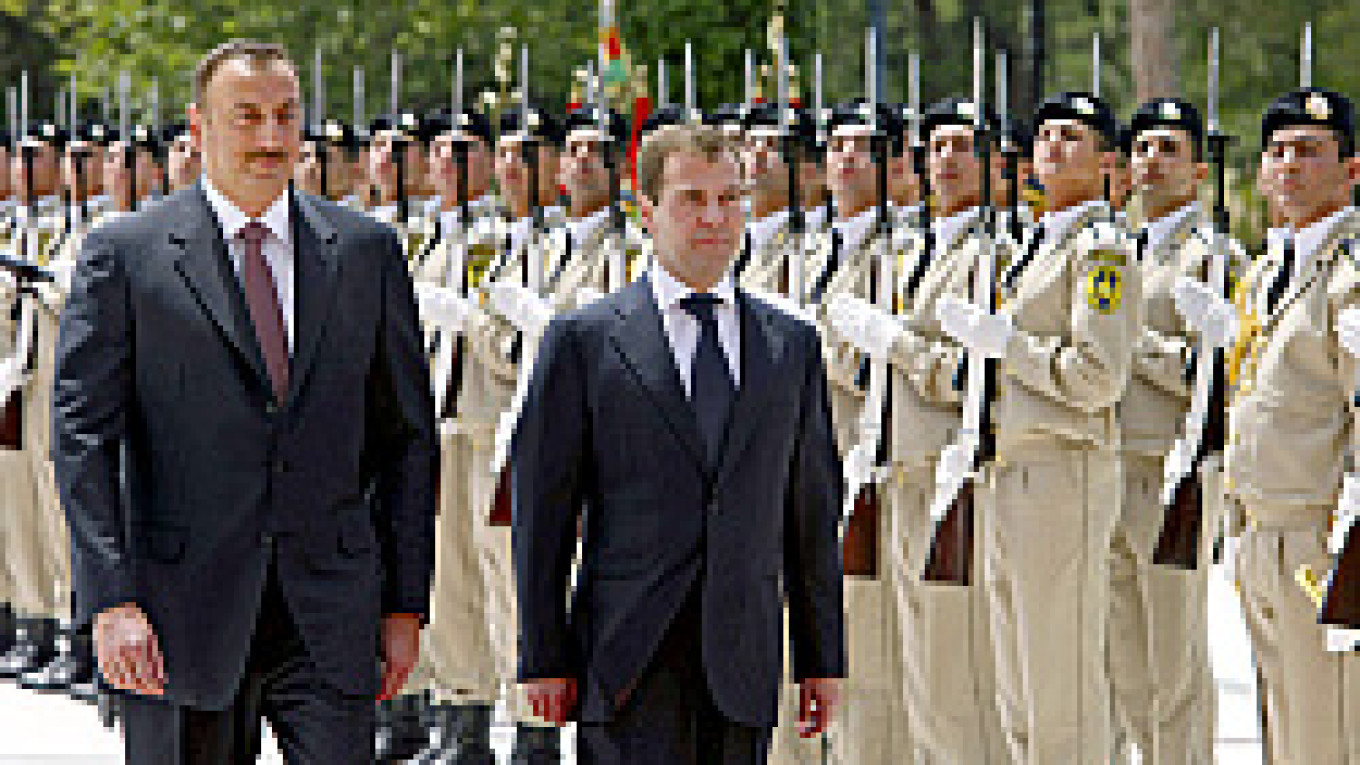
Speaking after Medvedev met with Azeri President Ilham Aliyev, Miller said Moscow would begin talks on buying gas from Baku, which could undermine a Western-backed project to bypass Russia and ship fuel from the region directly to Europe.
"There's a good chance for new agreements on trading hydrocarbons," Medvedev said after meeting Aliyev. The countries are considering a project of "mutual interest," Aliyev said, without elaborating.
Turkmenistan, which has among the world's biggest gas reserves and each year exports the equivalent of Italy's annual consumption, is the next stop on Medvedev's trip.
Before leaving, Medvedev told reporters that oil would hit $150 per barrel, causing "problems for the world's economy." U.S. light crude futures hit a record of $145.85 per barrel Thursday.
Miller said he expected gas prices to rise to $500 per 1,000 cubic meters from the current $400 by the end of the year. If oil prices were to hit $250 per barrel, gas prices would hit $1,000, he said.
Analysts and oil executives have already described Miller's predictions of an oil price rally to $250 as apocalyptic. They say attempts to talk the energy prices up are harmful ?€” especially coming from Gazprom, which supplies one-quarter of Europe's gas needs.
Miller not only repeated his prediction but said it might happen earlier than expected. "According to certain forecasts, the price of oil may reach $250 per barrel in the near future. If it does happen, the price of gas will exceed $1,000 per 1,000 cubic meters," he said.
Miller's recent bullish forecasts differ from Gazprom's usual policy of cautious and conservative estimates of gas prices, which depend on international oil-products prices and change with a lag of six to nine months.
Miller also said Russia and Azerbaijan had agreed to start talks on Gazprom's purchases of Azeri gas after agreeing on the idea in principle a month ago.
Baku is planning to supply its gas to southern Europe via Turkey, the first major project on the territory of the former Soviet Union that bypasses Russia.
Seeking to shore up his country's influence in the region, Medvedev also used his meeting with Aliyev to make an unusually explicit statement of support for Azerbaijan in its dispute with neighboring Armenia over the Nagorno-Karabakh region.
Aliyev thanked Medvedev for the support and said after the talks that he was aware of potential joint energy projects between their countries but refrained from direct comments about the sale of Azeri gas to Russia.
Gazprom spokesman Sergei Kupriyanov said the company would be ready to buy as much gas at market prices as Baku is prepared to sell.
n? Gazprom hopes to begin supplying Ireland with gas in the fourth quarter, taking the number of European countries it supplies to 23, the company said Thursday.
"We just got a license to sell gas in Ireland. ?€¦ I would hope to see shipments in the last quarter of this year," said Philip Dewhurst, spokesman for Gazprom Marketing & Trading, the company's British trading unit.
Bloomberg, Reuters
A Message from The Moscow Times:
Dear readers,
We are facing unprecedented challenges. Russia's Prosecutor General's Office has designated The Moscow Times as an "undesirable" organization, criminalizing our work and putting our staff at risk of prosecution. This follows our earlier unjust labeling as a "foreign agent."
These actions are direct attempts to silence independent journalism in Russia. The authorities claim our work "discredits the decisions of the Russian leadership." We see things differently: we strive to provide accurate, unbiased reporting on Russia.
We, the journalists of The Moscow Times, refuse to be silenced. But to continue our work, we need your help.
Your support, no matter how small, makes a world of difference. If you can, please support us monthly starting from just $2. It's quick to set up, and every contribution makes a significant impact.
By supporting The Moscow Times, you're defending open, independent journalism in the face of repression. Thank you for standing with us.

Remind me later.