

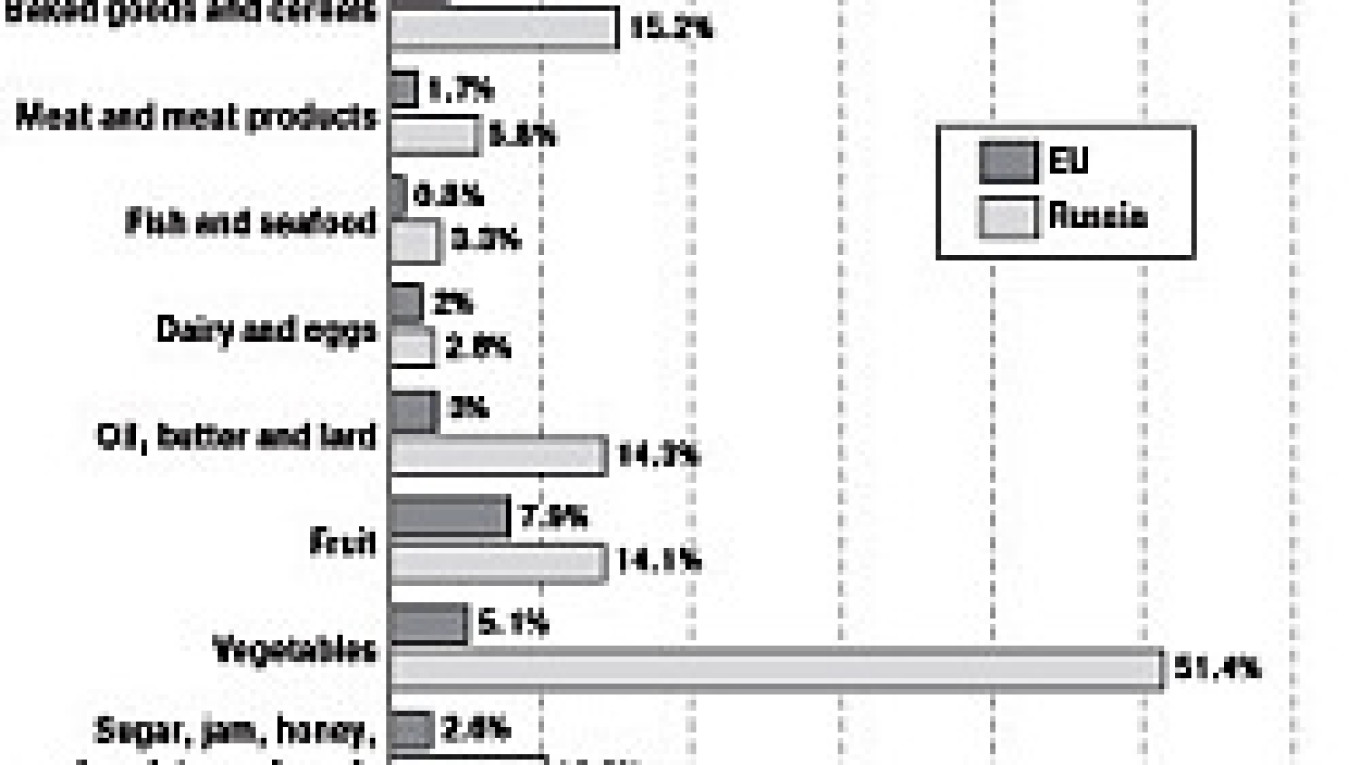
The news comes as a worrying sign that inflation may continue to hit people's grocery bills, with a basket of food jumping by 2.3 percent in May alone, compared with 0.6 percent in the European Union, the service said.
The government has been struggling to keep inflation within the current forecast of 10.5 percent for 2008, a target analysts have called out of reach. Finance Minister Alexei Kudrin said Wednesday that it was still possible for the Central Bank to hold inflation to 10.5 percent, although it would require slowing down the "overheated" economy.
Russia is seeing food prices rise faster than in Europe because a higher percentage of its food is imported, analysts said. The country "imports meat, milk, sunflower seed oil and butter -- almost everything," said Julia Tseplyayeva, an economist at Merrill Lynch.
And even with global food prices rising, the country's consumer price index has risen more rapidly than in most of Europe because Russian consumers spend more of their income on groceries.
"In Russia, 39 percent of the consumer basket is accounted for by food, 36 percent without alcohol," she said.
In Europe, she said, 15 to 25 percent of the basket is food. "The result is ... a huge spike in inflation."
Vegetables have hit the country's pocketbooks hardest, with prices rising 51.4 percent since December, compared with 5.1 percent in the EU. Baked goods and cereals saw the next-biggest hike over the period, rising 15.2 percent, compared with 3.8 percent in Europe.
Anna Kareva, director of investor relations at X5 Retail Group, which owns the Perekryostok and Pyatyorochka grocery store chains, said prices would keep rising "more than the government thinks."
The trend this year has changed, she said, adding that last year inflation was driven in part by wage increases. Earlier this month, Prime Minister Vladimir Putin said the government would seek to boost wages and social benefits as a cushion against rising prices.
"People were upgrading their basket, they were buying more expensive stuff and this trend continued into the first quarter of this year," Kareva said.
"Now that trend is changing. ... We don't know yet whether it was a problem, but we probably will in the second quarter," she said.
A Message from The Moscow Times:
Dear readers,
We are facing unprecedented challenges. Russia's Prosecutor General's Office has designated The Moscow Times as an "undesirable" organization, criminalizing our work and putting our staff at risk of prosecution. This follows our earlier unjust labeling as a "foreign agent."
These actions are direct attempts to silence independent journalism in Russia. The authorities claim our work "discredits the decisions of the Russian leadership." We see things differently: we strive to provide accurate, unbiased reporting on Russia.
We, the journalists of The Moscow Times, refuse to be silenced. But to continue our work, we need your help.
Your support, no matter how small, makes a world of difference. If you can, please support us monthly starting from just $2. It's quick to set up, and every contribution makes a significant impact.
By supporting The Moscow Times, you're defending open, independent journalism in the face of repression. Thank you for standing with us.

Remind me later.