

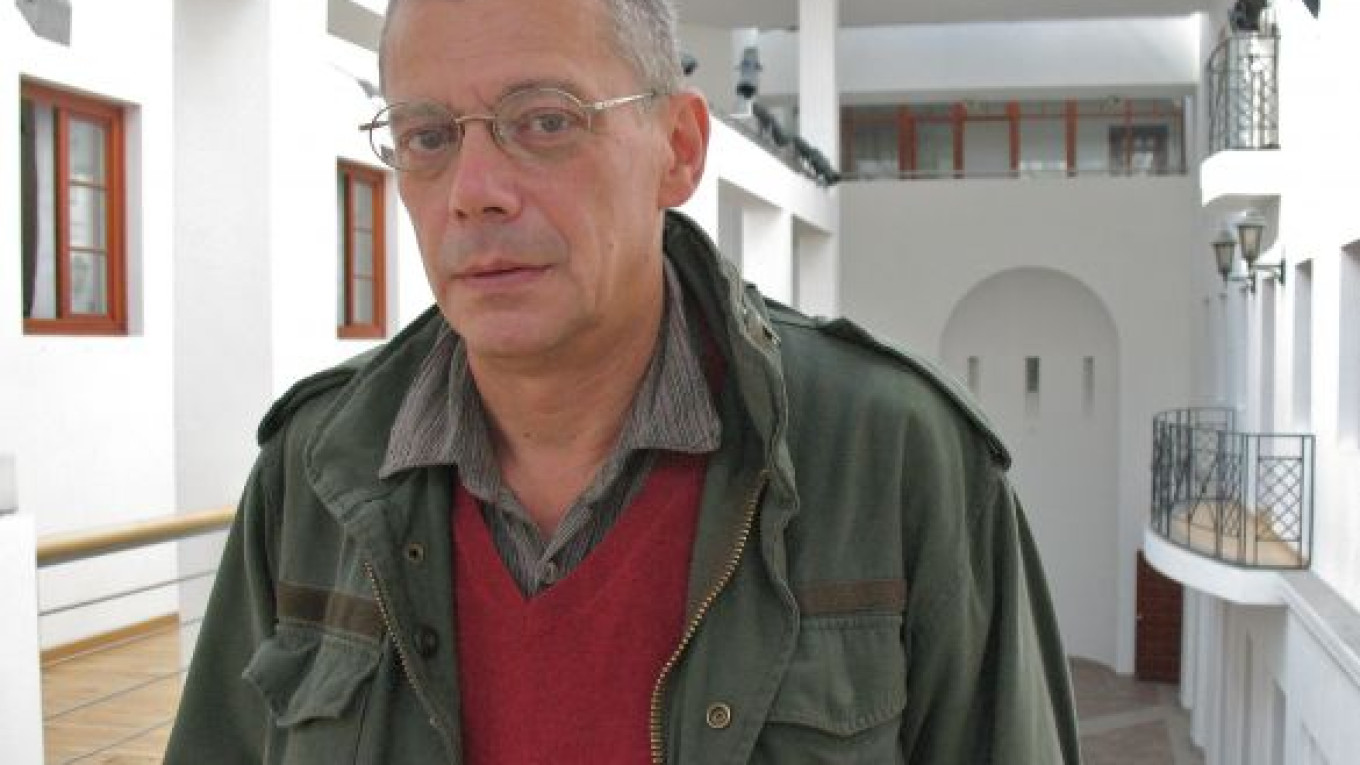
“At first these texts attract me, they’re beautifully written,” Vladimir Berzin says of theatrical scripts composed by his friend and fellow director who goes by the name of Klim. “But then they irritate me.”
Berzin knows of what he speaks. The two men have crossed paths countless times since they studied side-by-side under the legendary directors Anatoly Efros and Anatoly Vasilyev in the 1980s. Berzin, now 55, worked alongside Klim in various theatrical formations in the 1990s, and since 1999 he three times has taken it upon himself to stage texts written by Klim. The latest is “The Theater of Medea,” opening Oct. 13 at the School of Dramatic Art.
The first of the trio was a fascinating, radical reworking of Shakespeare’s “Romeo and Juliet,” which, as “Juliet and Her Romeo,” ran at the Moscow Art Theater from 1999 to 2001. Originally planned for performance in Krasnoyarsk, where from 1995 to 1998 Berzin was chief director at the city’s Young Spectator Theater, the project won a production grant from the Soros Foundation. But a shakeup in local politics, precipitated by the election of Alexander Lebed as governor of the Krasnoyarsk region, caused a parallel shakeup in the cultural world: Berzin and his experiments were out.
“I rather arrogantly said, ‘OK, if you don’t want it, I’ll stage it at the Moscow Art Theater!’ As it happened, I did,” he now recalls with a thin smile.
More recently, in 2009, Berzin staged Klim’s “Aglaya,” one of several texts written on themes drawn from Fyodor Dostoevsky’s novel “The Idiot.” “Aglaya” is one of the chapters in what Berzin calls “a textbook” on theater and acting: “When I heard Klim had written a textbook, I asked him to send me a copy. When I got it, it was a bunch of texts based on Dostoevsky.”
Berzin is careful to emphasize that there is nothing traditional about Klim’s literary compositions. “They are not plays,” he warns, “and Klim does not call them plays. He calls them texts for actors.”
If that sounds tricky, “The Theater of Medea” has more tricks in store. According to the director, the character in the tale “could be a male or a female, or Medea or Phaedra, or any other mythological figure.” The reason, he suggests, is that Klim does not explore the plot of the Medea myth, but rather spins a tale about two actresses and their thoughts about performing the role of Medea.
That, too, however, is misleading, for Berzin insists that, despite the presence of two characters in the text, the piece is actually written as a monologue. “It is Klim’s voice,” he says, “it expresses his attitude to theater.” This, in Berzin’s words, “defined the show as it now exists,” a monologue performed by the actress Oksana Mysina.
One senses that, for all his admiration for Klim, Berzin would be happy one day to put his friend’s unusual texts aside. Throughout his career he has staged numerous traditional plays — Alexander Ostrovsky’s “Talents and Admirers” in Oryol, Anton Chekhov’s “The Seagull” in Perm, Marivaux’s “False Confidences” in Orenburg, Eugene O’Neill’s “Anna Christie” in Novosibirsk, and many more. In all, he has staged more than two dozen shows since his professional debut in the city of Kirov with Alexander Galin’s “Zhanna” in 1987.
While continuing to work with regularity in various Russian cities, Berzin has led his own studio at the School of Dramatic Art since 2001. His new production there of Schiller’s “Love and Intrigue” began showing in mid-September.
As for Klim’s texts, Berzin finds that he is drawn to, and repelled by, them. “I never say, ‘I want to stage this,’” he admits. But he also recognizes that these unorthodox performance scripts require a “totally new approach” both for actors and director. That clearly fascinates him.
The desire to decipher the working mechanisms of these difficult texts may be a throwback to Berzin’s early adulthood when he studied to be an engineer at a polytechnic institute in Leningrad. Or it may be the influence of his teacher Vasilyev, who, Berzin says, is a brilliant analyst of texts who “approaches theater as if it were a science.”
Science or art, “play” or “actor’s text,” Klim’s “The Theater of Medea” is a relatively rare example of this author’s works being staged in Moscow. “Only a few directors have been able to stage him,” Berzin declares. For the third time now, he himself is one of that number.
“The Theater of Medea” (Teatr Medei) opens Oct. 13, 14 and 15 at 8 p.m. in the Tao Hall of the School of Dramatic Art, located at 19/27 Ulitsa Sretenka. Metro Sukharevskaya. Tel. 632-9377, 632-9344. . Running time approximately one hour.
A Message from The Moscow Times:
Dear readers,
We are facing unprecedented challenges. Russia's Prosecutor General's Office has designated The Moscow Times as an "undesirable" organization, criminalizing our work and putting our staff at risk of prosecution. This follows our earlier unjust labeling as a "foreign agent."
These actions are direct attempts to silence independent journalism in Russia. The authorities claim our work "discredits the decisions of the Russian leadership." We see things differently: we strive to provide accurate, unbiased reporting on Russia.
We, the journalists of The Moscow Times, refuse to be silenced. But to continue our work, we need your help.
Your support, no matter how small, makes a world of difference. If you can, please support us monthly starting from just $2. It's quick to set up, and every contribution makes a significant impact.
By supporting The Moscow Times, you're defending open, independent journalism in the face of repression. Thank you for standing with us.

Remind me later.