

Russian literature is no exception. Perhaps the first attempt at portraying a scientist is Ivan Turgenev's nihilist, Yevgeny Bazarov in "Fathers and Sons," a seminal novel that to this day is part of school curricula. While Bazarov is a deep and moving character, his scientific views are somewhat extreme. Apart from dissecting frogs, shocking the rest of the novel's characters, he advises his friend Arkady to study the anatomy of the eye to get rid of silly notions such as "mysterious glances."
Still, Russian science benefited from the inspiration of characters such as Bazarov. His views might have been radical to the point of being laughable, but by the beginning of the 20th century, Russian experts in physiology and medicine -- the fields Bazarov favored the most -- ranked among the best in the world, a fact confirmed by Ilya Mechnikov's and Ivan Pavlov's Nobel prizes.
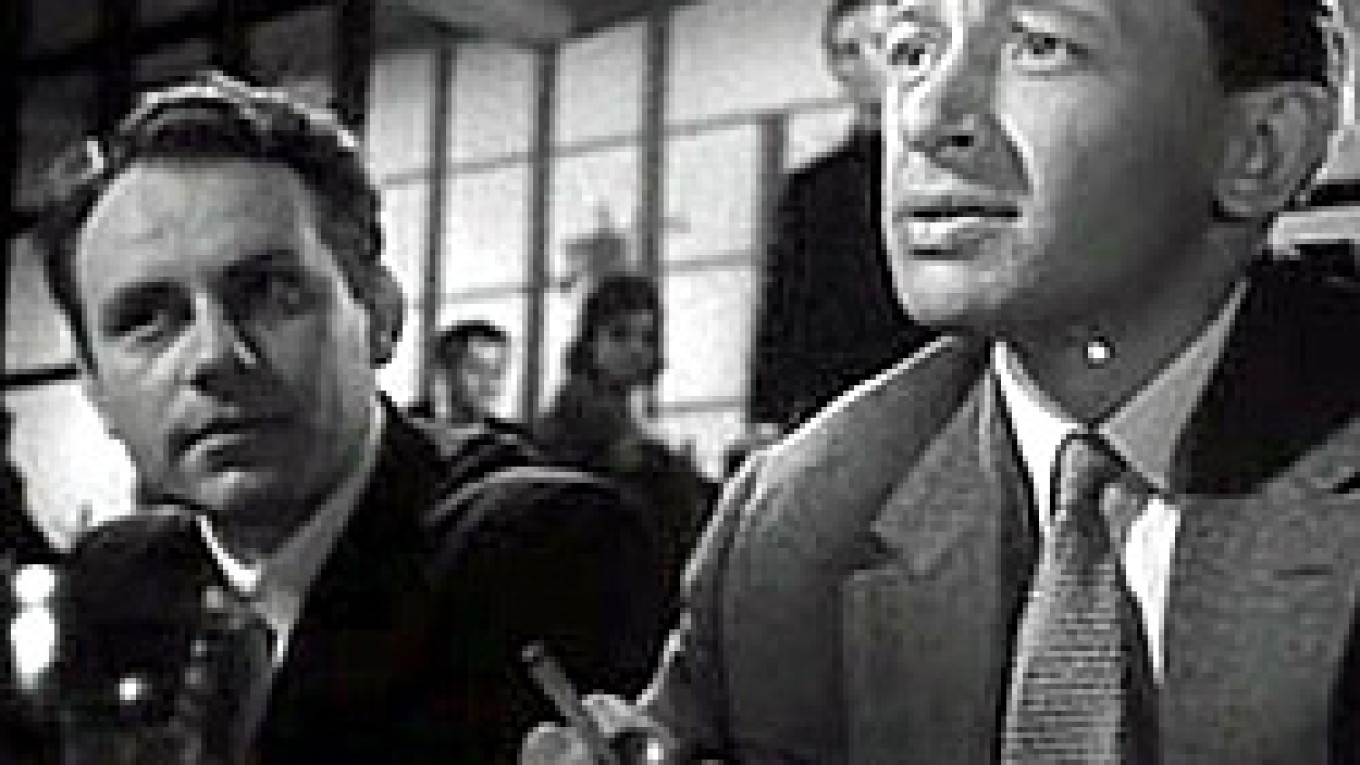
Scientists were briefly in vogue in the 1960s, when the popular fascination with progress and research was at its height. Widely discussed at the time was the rather artificial opposition of "physicists" and "lyricists," with the latter constantly on the defense. Daniil Granin, a popular author, wrote several novels where scientists and their research were described in detail. The movies did even more to glamorize science -- Mikhail Romm's "Nine Days of One Year" (pictured above) about Russia's budding nuclear research, was definitely one of the best Soviet movies ever made, not least because it did not trivialize science the way movies usually do.
Later, in the perestroika years, this school of authors produced several works in the same vein -- Granin wrote "Bison," a nonfiction account of the life and work of Nikolai Timofeyev-Resovsky, an influential and very unorthodox Russian biologist. Vladimir Dudintsev wrote "White Robes," a novelized account of underground work in genetics that was carried out despite the discipline being effectively outlawed in the Soviet Union.
These days, it's either back to the mad scientist stereotype or nothing at all. The principal male character of Janusz Leon Wisniewski's "Loneliness on the Net," a Polish book which became widely popular in Russia, is, indeed, a scientist, but his job is not directly relevant to the plot. There might be a new surge of interest in the topic, but with Russia's current educational policies, that seems unlikely.
A Message from The Moscow Times:
Dear readers,
We are facing unprecedented challenges. Russia's Prosecutor General's Office has designated The Moscow Times as an "undesirable" organization, criminalizing our work and putting our staff at risk of prosecution. This follows our earlier unjust labeling as a "foreign agent."
These actions are direct attempts to silence independent journalism in Russia. The authorities claim our work "discredits the decisions of the Russian leadership." We see things differently: we strive to provide accurate, unbiased reporting on Russia.
We, the journalists of The Moscow Times, refuse to be silenced. But to continue our work, we need your help.
Your support, no matter how small, makes a world of difference. If you can, please support us monthly starting from just $2. It's quick to set up, and every contribution makes a significant impact.
By supporting The Moscow Times, you're defending open, independent journalism in the face of repression. Thank you for standing with us.

Remind me later.