

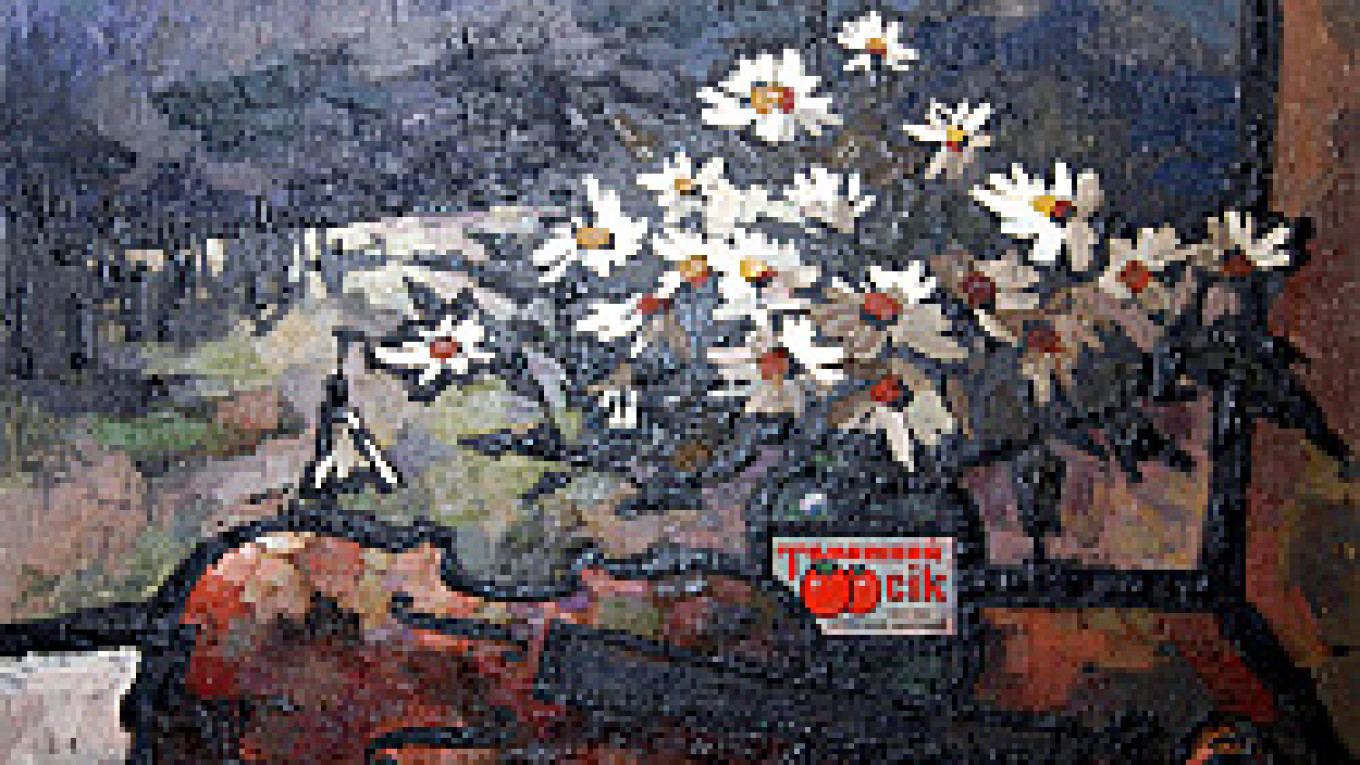
This, Rabin's first full retrospective, seems to have taken him by surprise. "I've never seen so many of my paintings in the same place at once," he said. Its title, "Three Lives," refers first to the repression of Stalinism, then to the rise of "nonconformism" in Russian art and finally to his exile in Paris, where he still lives today.
Under all three, this exhibition was, until recently, unimaginable. Rabin rose to prominence not only as a highly talented painter but also as a symbolic dissident from the rigidity of official Soviet culture. In 1958, his studio at the old Lianozovo army barracks became the epicenter of Moscow's progressive artistic intelligentsia. He remained at the forefront of "unofficial art" until his Soviet citizenship was revoked 20 years later.
This confrontation was never something Rabin actively sought. "We all wanted official recognition," Rabin explained. "But that was unavailable to us because they had a crude world for which not everybody had signed up. Everything in life depended on those three-letter organizations, and we just wanted to get our art shown."
Rabin claims that he only knows how to paint one way, making his conflict with the authorities inevitable. Remarkably, his abilities seem to have emerged fully formed, with few changes in technique or subject matter over more than 50 years. "My art is entirely subjective," he said. "I just paint what I see and feel. I stayed away from the protest exhibitions -- I didn't want to go to the gulag."
Nevertheless, it's easy to see why his work displeased the authorities. Unlike the fantasies of socialist realism, Rabin's painting is uniformly dark, recalling in particular Van Gogh and the German Expressionists of the 1920s. In his hands, stock genres of still life and landscape are unnervingly deformed with thick layers of paint and uneven brushstrokes.
 Tretyakov Gallery |  |
| |
By 1960, this brought him both denunciations in the Soviet press and recognition in the West, where he became known as "the Solzhenitsyn of painting." Rabin, however, rejects this comparison. "I'm just an artist. No painting ever changed anything, not even 'Guernica.' Misunderstanding that was the big mistake of socialist realism."
Rabin is likewise disinclined to see much horror in his paintings. "It really wasn't that bad," he said. "There weren't any monsters in Lianozovo. It was a place where people lived. I see the tragic side more as a dramatic role to play, like an actor, to bring out that tonality in the soul. But I like making people smile."
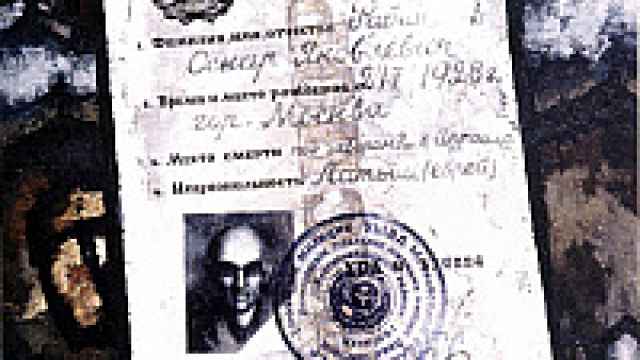
This humorous touch often comes to the fore. Rabin's ironic takes on 'Russian PopArt' show worn vodka labels, Soviet symbols set against macabre, deserted cityscapes and Christ staring in despair at an empty herring tin. Often this goes hand in hand with a wry fatalism. In the Soviet passport that recurs in several paintings, Rabin writes "nationality" as "Jew + Russian = French" and cause of death as "the will of God."
Having become French, Rabin initially made much more use of paper, wood and brighter colors. He ascribes this to the indiscretions of his third youth. "I loved walking around town and finding all sorts of things to glue to my paintings. It was like playing with toys. But eventually, I gave up on the collages. I like painting, not decorating."
Rabin's most recent works are thus much more similar to his early, Soviet-era output. He sees this as a return not to his homeland itself but to his artistic roots. "I haven't really thought about moving back," he admits. "It's my home now. I don't really mean France, or even Paris -- just our studio. I went to Lianozovo the other day, and where the barracks were they've built 30-story apartment buildings."
A Message from The Moscow Times:
Dear readers,
We are facing unprecedented challenges. Russia's Prosecutor General's Office has designated The Moscow Times as an "undesirable" organization, criminalizing our work and putting our staff at risk of prosecution. This follows our earlier unjust labeling as a "foreign agent."
These actions are direct attempts to silence independent journalism in Russia. The authorities claim our work "discredits the decisions of the Russian leadership." We see things differently: we strive to provide accurate, unbiased reporting on Russia.
We, the journalists of The Moscow Times, refuse to be silenced. But to continue our work, we need your help.
Your support, no matter how small, makes a world of difference. If you can, please support us monthly starting from just $2. It's quick to set up, and every contribution makes a significant impact.
By supporting The Moscow Times, you're defending open, independent journalism in the face of repression. Thank you for standing with us.

Remind me later.