

Titled simply "Rasputin," the opera in question finally arrived at Helikon last week, almost 20 years to the day after its world premiere -- and its only previous staging -- at the New York City Opera. Both score and libretto are the work of Jay Reise, a professor of music at the University of Pennsylvania in Philadelphia.
Translated into Russian, "Rasputin" is a well-crafted piece, both musically and dramatically, and received a staging by Bertman that must surely rank among the very best he has produced in all of Helikon's 18 years on the Moscow operatic scene.
"Rasputin" is relatively brief and fast moving by operatic standards, its seven scenes and an epilogue spread over two acts of roughly 45 minutes each.
Starting off with a bang, the opera depicts a religiously inspired orgy of the sort Rasputin allegedly presided over during his early years in Siberia. From there, it moves on to St. Petersburg, vividly capturing Rasputin's rise in influence at the imperial court and his eventual murder at the hands of Prince Felix Yusupov and a band of co-conspirators.
Bertman's staging is mercifully free of the gimmicks and obscurities that have often cluttered his productions, most recently the hash he came up with last year directing Giaochino Rossini's "The Barber of Seville." "Rasputin" is essentially played out in a naturalistic manner and slips only in the brief epilogue, which finds Vladimir Lenin haranguing a crowd of curiously well-dressed revolutionaries celebrating their victory by popping red balloons. Otherwise, the result is a superbly disciplined effort, one that vividly brings to life the final days of the Romanovs' imperial reign.
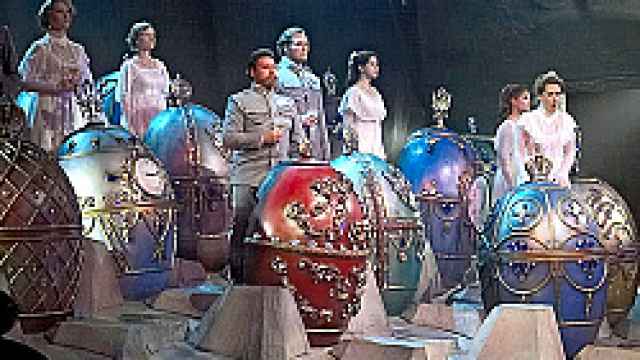 Gelikon Opera The scenes at the Imperial court are decorated with faberge-style eggs. |  |
| |
Helikon's regular design team of Igor Nezhny and Tatyana Tulubyeva have created a setting which includes elements of fantasy that compliment rather than contradict Bertman's straightforward approach to the action. Central to the d??cor is a tilted revolving platform, adorned with huge Faberge-like eggs for the initial scenes at the imperial court. Later, as the story becomes increasingly grim, the eggs give way to a mass of concrete blocks. The rear of the platform reveals a low-ceilinged room, which serves as background to the opening orgy and as the basement chamber of the Yusupov Palace in which Rasputin is murdered.
Reise's score, which often echoes the music of composers such as Richard Wagner, Richard Strauss and Alban Berg, is not a work of great originality. But it does serve quite nicely to underline and reinforce the dramatic events on stage. Especially effective is Reise's use of traditional tonality -- including quotes from Pyotr Tchaikovsky's ballet "Swan Lake" and the Russian imperial hymn -- for the music of Nicholas and Alexandra, as well as atonal dissonance to conjure up what he calls, in a program note, "the brutal and chaotic new world of the 20th century."
Outstanding, above all, among the partially different casts heard at performances last Friday and Sunday was Helikon's long time leading soprano Natalya Zagorinskaya, who brought a truly regal appearance and manner to the part of Alexandra and coped superbly with its often savagely high notes. Nearly on the same level were bass Nikolai Galin, appropriately sleazy and booming in the title role, and tenor Vasily Yefimov, who brought elegance of voice and bearing to the part of Prince Felix Yusupov.
As it has for the past two years, Helikon continues to perform this season in its temporary quarters on Novy Arbat. Meanwhile, thanks to the personal intervention last June of Mayor Yury Luzhkov, work has now begun in earnest on renovation and new construction at Helikon's home premises in the former mansion of the aristocratic Shakhovsky family on Bolshaya Nikitskaya. If all goes according to schedule, the end of 2010 will see the company not only reoccupying the mansion's ballroom, where it formerly played, but also moving into a brand new 550-seat theater, constructed partly below ground level in the adjacent rear courtyard.
"Rasputin" next plays Jan. 28, 29, 30 and 31 and Feb. 1, 2009, at 7 p.m. at Helikon Opera on Arbat, located at 11 Novy Arbat, Bldg. 2. M. Arbatskaya. Tel. 695-6584, 690-6592.
3,5 / 5
A Message from The Moscow Times:
Dear readers,
We are facing unprecedented challenges. Russia's Prosecutor General's Office has designated The Moscow Times as an "undesirable" organization, criminalizing our work and putting our staff at risk of prosecution. This follows our earlier unjust labeling as a "foreign agent."
These actions are direct attempts to silence independent journalism in Russia. The authorities claim our work "discredits the decisions of the Russian leadership." We see things differently: we strive to provide accurate, unbiased reporting on Russia.
We, the journalists of The Moscow Times, refuse to be silenced. But to continue our work, we need your help.
Your support, no matter how small, makes a world of difference. If you can, please support us monthly starting from just $2. It's quick to set up, and every contribution makes a significant impact.
By supporting The Moscow Times, you're defending open, independent journalism in the face of repression. Thank you for standing with us.

Remind me later.