


This may leave audiences watching Filipp Yankovsky's "Stonehead" (Kamennaya Bashka) somewhat bemused. Its hero Yegor, played by Valuyev, is indeed a champion in the ring, and the film does feature everyday details of boxing promotion and all their associated nastiness. But the result is a subtle film about a central character who is emotionally lost because of a tragic event.
Yankovsky is a director who has shown himself capable of handling big-scale films like "The Sword Bearer" and "The State Counselor," but "Stonehead" takes him back to one of his earliest, more dramatic works: "In Movement," a loose contemporary Russian remake of Federico Fellini's "La Dolce Vita," which captured the distinction between the public personality of its hero and the private emotional drama behind it.
There is something similar in the director's new film. Yegor was a champion boxer until his wife died in a car crash, in which he was also severely injured (more mentally than physically). His promoter Naill (Vitaly Kishchenko), a horrible character who doubles as a pimp, attempts to bring him back into the ring.
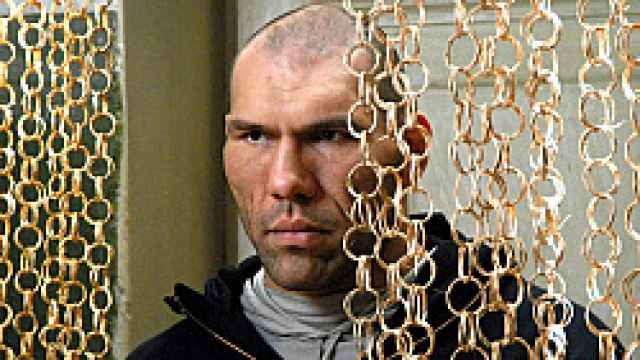 for MT Valuyev plays Yegor with a gentleness and vulnerability. |  |
| |
Naill's answer to Yegor's depression is to audition prostitutes to impersonate his dead wife. His choice falls on Tanya (Oksana Fandera, Yankovsky's wife in real life). Tanya has similar facial features, and the addition of a wig makes the resemblance closer -- enough to convince the practically amnesiac Yegor that his wife has returned. Yegor begins training with lonely sequences of running, despite the fact that his coach is completely against the fight.
Though there is action on the side, the real emotional dynamic is the relationship between Yegor and Tanya (for the record, sex doesn't feature). The two individuals with distinct problems and histories circle one another, hoping perhaps for some sort of resolution. The thoroughly cynical world that surrounds and controls them continues on its own, leading to a finale that is both dramatic and bleak. And it doesn't take place in a boxing ring but in far more nuanced conflict.
Valuyev plays Yegor convincingly for a nonprofessional actor; his huge form and brutalized face is matched by a gentleness and vulnerability; Fandera, smaller than him by almost a meter, matches him well.
It's a subtle and unexpected film. Which can't be said for another of the week's offerings, "Hitler Kaput," from director Marius Veisburg. The film is an out-and-out parody on the classic Soviet television drama "17 Moments of Spring" and its hero, Stirlitz, who has infiltrated the highest ranks of the Third Reich, reprised here by the very talented young actor Pavel Derevyanko as Shurenberg, something like Stirlitz on speed.
If you can live with the premise itself -- and clearly Russian viewers can, as the reaction to the comedy was good -- and a depiction of life in Hitler's bunker as a succession of absurd pastiches, ranging from Hitler and potatoes to an openly gay Boorman and a lesbian ending, then all is well and good. It's professionally made and reaches its audience. The question of taste, however, is another matter. And if Emir Kusturica, the Serbian-born director of films such as "Black Cat, White Cat," has not taken out a patent on his characteristic music-backed absurd burlesque style, he should be consulting his lawyers right now.
Stonehead (Kamennaya Bashka) 3.5 / 5
Hitler Kaput 2 / 5
A Message from The Moscow Times:
Dear readers,
We are facing unprecedented challenges. Russia's Prosecutor General's Office has designated The Moscow Times as an "undesirable" organization, criminalizing our work and putting our staff at risk of prosecution. This follows our earlier unjust labeling as a "foreign agent."
These actions are direct attempts to silence independent journalism in Russia. The authorities claim our work "discredits the decisions of the Russian leadership." We see things differently: we strive to provide accurate, unbiased reporting on Russia.
We, the journalists of The Moscow Times, refuse to be silenced. But to continue our work, we need your help.
Your support, no matter how small, makes a world of difference. If you can, please support us monthly starting from just $2. It's quick to set up, and every contribution makes a significant impact.
By supporting The Moscow Times, you're defending open, independent journalism in the face of repression. Thank you for standing with us.

Remind me later.