


In the 19th century, Abramstevo became the site of an artistic retreat where a virtual who's-who of Russian writers and painters congregated to relax, hone their artistic talents and pool their creativity for joint projects. It was this artists' colony that we can largely thank for the neo-Russian movement of the 1890s, in which artists probed their Slavic heritage for inspiration.
Abramtsevo's artistic heyday began with Sergei Aksakov, the prolific writer and one of the founders of Russian literary realism, who bought the estate -- then essentially a glorified dacha -- in 1843. The estate's proximity to the historic Trinity-St. Sergius Monastery in Sergiyev Posad suited Aksakov, who was passionately committed to Orthodoxy and Slavic traditions. At Abramtsevo, he consorted with Gogol, Turgenev and other literary luminaries to sow the seeds for the Slavophile movement, which battled what its proponents perceived as the Western and European tendencies in Russian culture.
In 1870, 11 years after Aksakov's death, railroad magnate and patron of the arts Savva Mamontov acquired Abramtsevo and vowed to continue in Aksakov's footsteps. Equally passionate about Russian culture and heritage, Mamontov and his wife Yelizaveta subscribed to the Narodnik, or Populist, movement, which advocated a return to peasant and folk traditions in order to infuse Russian art with a distinctly "pure" and national flavor.
While vacationing in Rome in 1874, Mamontov chanced upon the painters Ilya Repin and Vasily Polenov and sculptor Mark Antokolsky. Following a discussion about how best to create a national style of art, Mamontov hit upon the idea of turning Abramtsevo into a workshop where artists could borrow inspiration from peasant styles and techniques. The idea was a success, and soon artists of all stripes -- including Valentin Serov, Viktor Vasnetsov and Mikhail Vrubel -- enthusiastically flocked to the dacha.
Once there, Repin wrote to a friend, "Our life here is very easy -- the air is magical, and there are all kinds of pleasures for body and soul." As for Mamontov, sculptor Mark Antokolsky wrote, "He has one of the best possible artistic natures. He is simple, warm-hearted, loves music and doesn't sing badly himself."
While the colony's population has changed a bit over time -- the estate became a museum after the 1917 revolution -- nearly all the buildings there are intact, and little effort is required to feel transported to the mansion's artistic past. Once through the main gates, one crosses a sunny, open courtyard encircled by a cluster of buildings (not unlike a town common) to reach the manor.
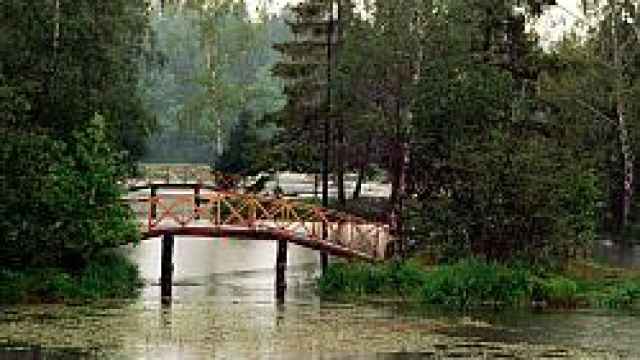 Itar-Tass Located about 60 kilometers from Moscow, Abramtsevo is surrounded by largely unspoiled natural scenery. |  |
| |
Testifying to his dedication to his predecessor's budding Slavophilism, Mamontov left half of the house as it was under Aksakov -- a then-trendy mix of French Empire -- while refurnishing the rest in a heavier Neo-Russian and Art Nouveau style.
The estate provided inspiration for numerous paintings, some of which still remain on the grounds. Abramtsevo's most famous possession was, without doubt, Serov's "Girl With Peaches," a portrait of Mamontov's daughter Vera. That, however, has long been replaced with a print, and the original is now on permanent display at the Tretyakov Gallery in Moscow.
Inside the house, decked in jubilant greens, is Aksakov's old study, which remains seemingly just as he left it -- his armchair pulled up to a mahogany writing desk, with open notebooks and hunting guides lying nearby. It was here that Gogol would get "literally quite intoxicated" from listening to the older Aksakov's stories about growing up as a colonist in Siberia. Gogol eventually encouraged Aksakov to jot down these recollections, which he did, penning "A Russian Gentleman" in 1856. The two had met in 1832, before Gogol had made a name for himself, but Aksakov noticed his ability early on, writing, "Gogol, from the very beginning, was a respected name in our household."
Once connected to the manor by a covered walkway, the log-cabin kitchen harbors an array of folk art in a "museum of the home." Here, a giant samovar rests beside the intricate wooden carvings of birds, beasts and mythical figures that adorn ladles, boards and wooden whips specially designed to beat the water out of laundry.
Next door, elegant fretwork ornaments the facade of the studio where the artists dabbled in ceramics. After Vrubel joined the colony in 1889, he made his most lasting contributions here, favoring vibrant colors and grotesque forms as he picked up the ceramic know-how he would later use when hired to design the mosaic panels of the Metropol hotel in central Moscow.
Within the studio is a lavishly decorated fireplace, lined with ceramic columns and intricately designed tiles, while the shelves on the walls feature busts of fairy-tale figures. Among the ceramic torsos are Sadko, Snegurochka, Lel and Berendei -- characters from operas by Nikolai Rimsky-Korsakov, calling to mind Mamontov's passion for the performing arts. It was at the Abramtsevo private opera theater, after all, that a young singer named Fyodor Chaliapin is said to have debuted.
One of the more unusual buildings on the grounds is architect Ivan Ropet's 1873 teremok, or small outdoor structure. Conceived as a bathhouse, the teremok features swirling, spade-like gables, intricate woodwork and a steep pitched roof, in a style reminiscent of ancient Rus.
The crown jewel of the estate's eclectic architecture, the Church of the Savior Not Made by Hands, lies a bit off the beaten path in a small clearing beyond the bathhouse. A truly cooperative effort, the whitewashed domed church was designed by Vasnetsov, who modeled it on the medieval churches of Novgorod; above the entrance is a fresco of Christ, painted by Polenov; and more paintings by Polenov, Mikhail Nesterov, Vasnetsov and Repin make up the gilt iconostasis within. Unfortunately, the building is temporarily closed for maintenance.
Finishing a visit with a stroll through the property's wooded backyard is in order, if for no other reason than to bump into the House on Chicken Legs -- a tribute by Vasnetsov to the fairy-tale witch Baba Yaga. He clearly designed the diminutive cabin, made of comically stout logs, with the colony's children in mind; a cartoonish owl, wings outstretched, joins a prostrate horse on the woodwork of the hut's roof. The house stands on hefty wooden stilts, which, if they don't exactly resemble chicken legs, still hark back to Baba Yaga's abode, which would hop full circle when trespassing children called, "Little House, Little House, turn around to face me with your back to the woods" -- before they were gobbled up alive.
To get to Abramstevo, take a Sergiyev Posad-bound train from Yaroslavsky Station to the Abramtsevo stop, but make sure it stops there, since many trains do not. At the stop, cross the tracks and continue walking straight until coming to a paved road. Turn left, and the museum entrance will be a 20-minute walk up the hill to the right. Tel. (254) 3-2470.
A Message from The Moscow Times:
Dear readers,
We are facing unprecedented challenges. Russia's Prosecutor General's Office has designated The Moscow Times as an "undesirable" organization, criminalizing our work and putting our staff at risk of prosecution. This follows our earlier unjust labeling as a "foreign agent."
These actions are direct attempts to silence independent journalism in Russia. The authorities claim our work "discredits the decisions of the Russian leadership." We see things differently: we strive to provide accurate, unbiased reporting on Russia.
We, the journalists of The Moscow Times, refuse to be silenced. But to continue our work, we need your help.
Your support, no matter how small, makes a world of difference. If you can, please support us monthly starting from just $2. It's quick to set up, and every contribution makes a significant impact.
By supporting The Moscow Times, you're defending open, independent journalism in the face of repression. Thank you for standing with us.

Remind me later.