

Airline S7 and collector Pierre Brochet launched a program of "art tourism" late last month with a trip to Novikov's hometown.
"People are now looking for new emotions, new reasons to travel, new contacts, new friends," said Brochet, a French citizen living in Moscow who began collecting Russian art almost 20 years ago. "The idea is to bring people closer to the art-scene."
Meeting artists, collectors and other members of the demi-monde "certainly beats just the hotel, the beach, and the bar," Brochet said.
Further art tourism is planned all over Russia and Europe, he said without giving details.
S7 has named an Airbus airplane after Novikov, embossing the fuselage with the distinctive image of a rising sun that figures prominently in much of his work. A party of journalists was flown to St. Petersburg on what would have been his 50th birthday to visit a series of retrospectives in his honor.
The retrospectives are on display at the Hermitage, the Marble Palace Museum and the State Museum of Urban Sculpture and will be open through Jan. 11, 2009.
Novikov was chosen for the first air tourism trip because of the huge influence he had over the Russian art scene throughout the 1980s and 1990s.
 for MT |  |
| |
"Timur didn't just busy himself with his own work. He institutionalized the underground," said Sergei Bugayev, also known as Afrika, an artist and a friend of Novikov.
Novikov collaborated with pop group Kino and director Sergei Solovyov in the '80s, appearing in the influential film Assa. He founded the Department of New Movements at the Russian Museum, which focused on new art and played a major role in the squat-based youth culture that dominated St. Petersburg.
He was the central figure in a group of artists who became transfixed with the grand motifs of ancient Greece and Rome. This so-called Neo-Academism was not a stuffy retreat to the past but a cutting edge contribution to Russian art.
Novikov founded his unofficial New Academy of Fine Arts in 1993, and it is still located in the Pushkinskaya-10 artist complex today.
Writer Bruce Sterling described the style in 1988 as "a shotgun marriage between gilt-and-marble classicism grandeur and total, poverty-stricken street-level hippie junk art."
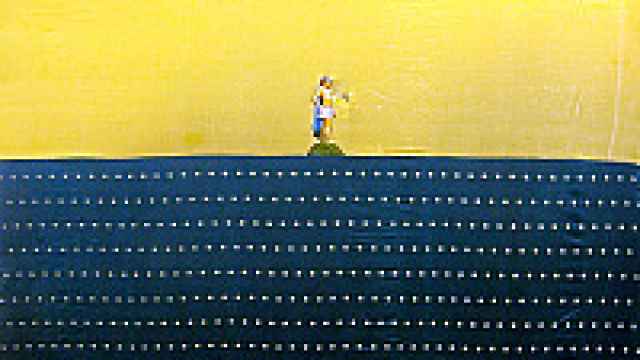
Three rooms are given over to the "Timur's Territory" exhibition in the Hermitage. The museum insists that the selection is deliberately conceptual, but as a whole it feels loose and sparse.
"Dedicated to Timur" in the Marble Palace displays a small number of rare and unseen works in the same style as most of the Hermitage retrospective but does not shine any new light on the artist. One room in the State Museum of Urban Sculpture is given over "To the Memory of Timur Novikov" and focuses not on Novikov, but his friends, colleagues, admirers and adherents.
Novikov, as one of Russia's best-known contemporary artists, deserves something more approaching the full measure of the man, rather than just an introduction.
A Message from The Moscow Times:
Dear readers,
We are facing unprecedented challenges. Russia's Prosecutor General's Office has designated The Moscow Times as an "undesirable" organization, criminalizing our work and putting our staff at risk of prosecution. This follows our earlier unjust labeling as a "foreign agent."
These actions are direct attempts to silence independent journalism in Russia. The authorities claim our work "discredits the decisions of the Russian leadership." We see things differently: we strive to provide accurate, unbiased reporting on Russia.
We, the journalists of The Moscow Times, refuse to be silenced. But to continue our work, we need your help.
Your support, no matter how small, makes a world of difference. If you can, please support us monthly starting from just $2. It's quick to set up, and every contribution makes a significant impact.
By supporting The Moscow Times, you're defending open, independent journalism in the face of repression. Thank you for standing with us.

Remind me later.