

The Bolshoi opened the Moscow operatic season last Sunday with Modest Mussorgsky's "Boris Godunov." Both the Stanislavsky and Nemirovich-Danchenko and Novaya Opera go into action Friday, the former with Pyotr Tchaikovsky's "Eugene Onegin," the latter with Richard Wagner's "Lohengrin," in what proved beyond much doubt to be last season's best new staging of opera by a local company.
Helikon Opera enters the 2008-2009 season on Wednesday with a page of Russian history in the form of U. S. composer Jay Reise's "Rasputin." Directed by Helikon founder Dmitry Bertman, "Rasputin" will bring to the stage not only the notorious monk himself, but also a host of other historical characters, including the imperial couple, Nicholas II and Alexandra, as well as Prince Felix Yusupov and his band of assassins and, very briefly, Vladimir Lenin.
"Rasputin" was first seen 20 years ago in performances at the New York City Opera and received a favorable reception. Helikon will perform the work using a Russian translation of the libretto written by the composer himself.
Next July, Helikon is once again due to turn a spotlight on Russian history -- in this case the reign of Catherine the Great -- when it presents the world premiere of an opera titled "The Empress." The composer is David Tukhmanov, known for the enormously popular songs he wrote in Soviet times such as "Den Pobedy." His work is aimed at a much broader audience than is usually the case with opera. Following its premiere, which is due to take place in St. Petersburg, Helikon plans to bring "The Empress" not only to Moscow but also to opera houses throughout Russia.
In commemoration of the 100th anniversary of the death of Nikolai Rimsky-Korsakov, the Bolshoi has chosen "The Tale of the Invisible City of Kitezh" as its first new production this season. The production which opens Oct. 10 is perhaps the finest of the composer's 15 operas. The production is staged by Lithuanian director Eimuntas Nekrosius.
Why the Bolshoi chose Giuseppe Verdi's "Otello," due in April, as its other new operatic production this season is anybody's guess. Without doubt, "Otello" counts as one of the greatest operas ever written. But its principal roles are extremely difficult to cast, and the Bolshoi lacks vocal talent of its own to do real justice to any of them. The title role, in particular, presents fiendish challenges to a dramatic tenor. Only a few have truly mastered it in the 121 years since "Otello" first came to the stage. One of those currently active is Russian Vladimir Galuzin. But Galuzin, who has never sung at the Bolshoi, is apparently unavailable.
The staging of "Otello" has been entrusted to highly regarded French operatic director Arnaud Bernard.
Novaya Opera puts on a smile this season with new productions of two comic operas and an operetta. Leading off, on the last day of October, will be Gioachino Rossini's "The Barber of Seville." Novaya Opera has achieved some outstanding results over the past three years through its engagement of seasoned directing talent from abroad. For "The Barber," it has come up with Elijah Moshinsky, whose numerous stagings have long enjoyed success at major opera houses throughout the world, including London's Covent Garden and New York's Metropolitan Opera.
Novaya Opera's annual January festival in honor of its late founder, Yevgeny Kolobov, will include a new production of Giacomo Puccini's one-act comic masterpiece "Gianni Schicchi," rather curiously combined in a double bill with the composer's Gloria Mass. And next June, the company takes on Johann Strauss Jr.'s ever-popular "Die Fledermaus," staged by an apparently much sought-after young Dutch director named Michel Dijkema.
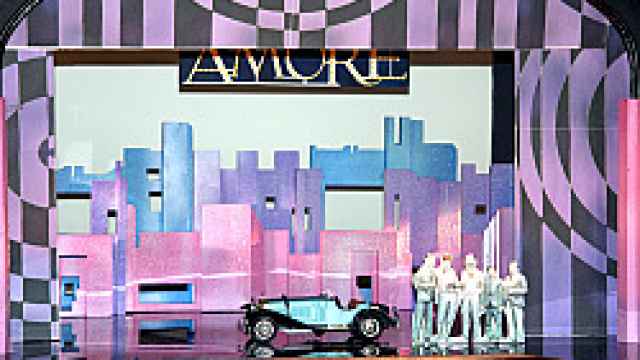 Novaya Opera The model for the stage of Giaochino Rossini's "The Barber of seville," due at Novaya Opera in Late October. |  |
| |
The Stanislavsky and Nemirovich-Danchenko, this season celebrating its 90th anniversary, has scheduled three new opera productions. First off, on the theater's Small Stage in November, will be the world premiere of a work by Vladimir Kobekin, a prolific composer of opera whose rather bizarre slant on the Faust legend, "Margarita," was seen here at last spring's Golden Mask festival. His new opera, puzzlingly titled "Hamlet (Danish) (Russian) Comedy," may well prove equally bizarre. Alexander Titel, director of the theater's operatic troupe, will provide the staging.
For its other two new productions, the Stanislavsky and Nemirovich-Danchenko has turned to more familiar fare. Gaetano Donizetti's "Lucia di Lammermoor" and Jules Massenet's "Werther" are both masterpieces long missing from Moscow opera houses. To stage them, the theater has engaged a pair of distinguished directors from the world of spoken drama, Adolf Shapiro, for "Lucia," and Mikhail Bychkov, for "Werther." "Lucia" makes its debut in February and will almost certainly feature the theater's outstanding coloratura soprano Khibla Gerzmava. "Werther" follows in July.
The Pokrovsky Chamber Musical Theater has long played an important role in the operatic life of Moscow, bringing to the stage a succession of works neglected by the city's other opera companies and promoting the music of contemporary Russian composers. This season sees it active again on both fronts.
Sometime before the end of the year and honoring the 200th anniversary of the birth of author Nikolai Gogol, the Pokrovsky plans to present one of the least-known of Pyotr Tchaikovsky's operas, "Cherevichki" (The Slippers), a comic fantasy based on Gogol's short story "Christmas Eve." Though the music may not be top-drawer Tchaikovsky, it nevertheless contains a large measure of the composer's familiar lyricism.
Before the season ends, the Pokrovsky is also due to present the world premiere of "Beg" (The Run), written in the mid-1980s by Nikolai Sidelnikov, a highly influential professor of composition at the Moscow Conservatory, who died in 1992. Based on a play of the same name by Mikhail Bulgakov that was banned from the stage on Stalin's orders, "Beg" tells a grim story of the misery and horrors of the Russian Civil War.
Not to be overlooked by opera lovers are this season's performances of opera in concert form at Tchaikovsky Hall and the Great Hall of the Moscow Conservatory. The Moscow Philharmonia's series "Opera Masterpieces" has already produced what may well prove to be the operatic sensation of the year, with a performance earlier this month of Vincenzo Bellini's "I Capuleti e i Montecchi" that featured bel canto singing probably as dazzling as any ever heard in Moscow. Still to come in the series are two rarely heard operas of the 18th century, Joseph Haydn's "Orfeo ed Euridice" and George Friderich Handel's "Orlando," both with casts of noted singers from abroad.
As in recent past seasons, conductor Valery Polansky and the State Symphonic Capella of Russia are again featuring opera on their concert schedule. Besides honoring Gogol with yet another version of "Cherevichki" and a second Gogol-inspired opera, Mussorgsky's "The Fair at Sorochinsk," they are due to perform "Eugene Onegin" and Jacques Offenbach's "The Tales of Hoffmann."
A Message from The Moscow Times:
Dear readers,
We are facing unprecedented challenges. Russia's Prosecutor General's Office has designated The Moscow Times as an "undesirable" organization, criminalizing our work and putting our staff at risk of prosecution. This follows our earlier unjust labeling as a "foreign agent."
These actions are direct attempts to silence independent journalism in Russia. The authorities claim our work "discredits the decisions of the Russian leadership." We see things differently: we strive to provide accurate, unbiased reporting on Russia.
We, the journalists of The Moscow Times, refuse to be silenced. But to continue our work, we need your help.
Your support, no matter how small, makes a world of difference. If you can, please support us monthly starting from just $2. It's quick to set up, and every contribution makes a significant impact.
By supporting The Moscow Times, you're defending open, independent journalism in the face of repression. Thank you for standing with us.

Remind me later.