

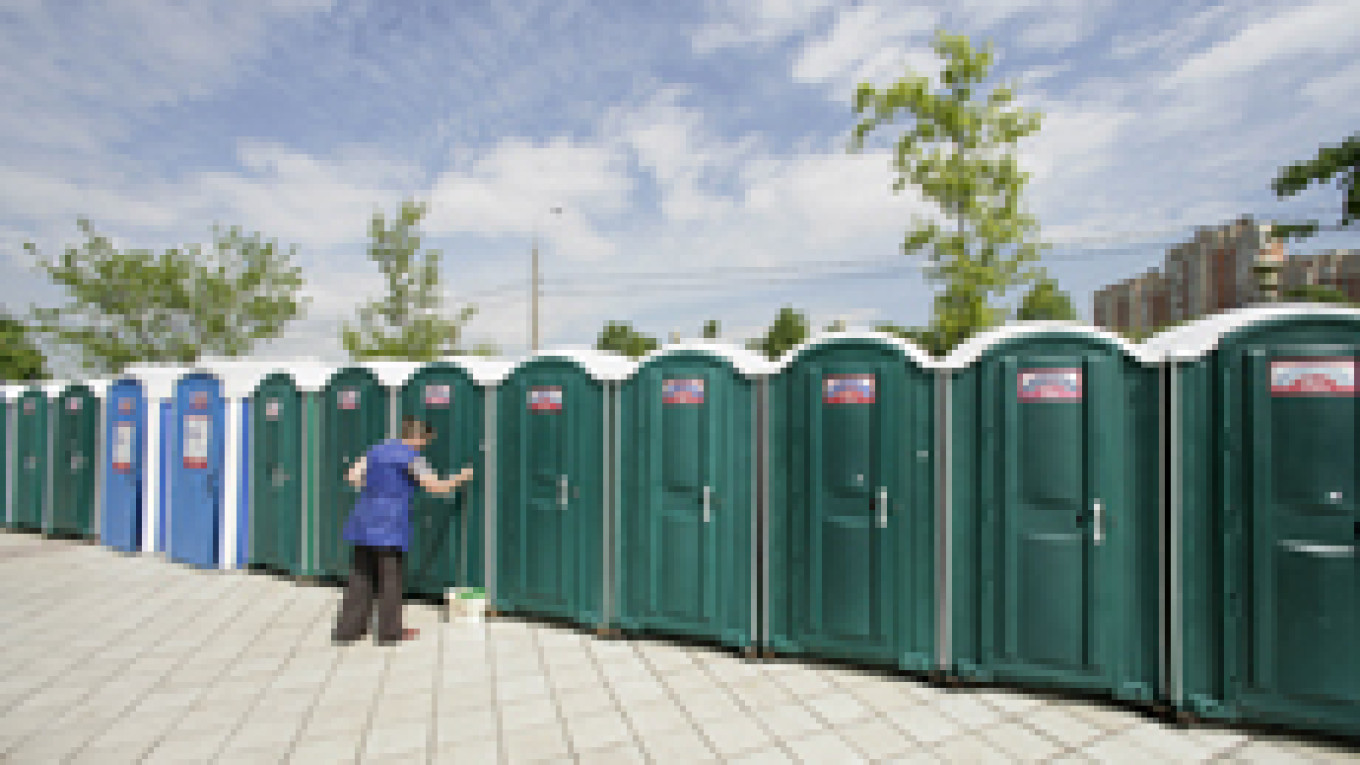
But the cabins are being touted as an example of good practice.
"This is an example worth imitating," Vladislav Chernyavsky, deputy head of the state organization that runs the city's free public restrooms, said as he stood beaming in front of the cabins during a recent press tour of the city's toilets.
Tsaritsyno has 100 cabins in all. But the problem, Chernyavsky said, is that Moscow has less than a quarter of the number of free public restrooms that it needs: just 565 for a population of more than 10 million.
"For Moscow, it's too few," Chernyavsky said. "The population is growing extremely quickly, and this is a hot topic."
His organization, Santekhrabot, calculates that there should be one free restroom per 1,000 people and one plastic cabin per 500 people. This year, however, it plans to build just nine permanent structures to house public restrooms, in part because of the economic crisis.
Currently, Moscow has 225 free restrooms in public buildings, including in parks and markets. It also has 300 clusters of basic plastic cabins like those at Tsaritsyno, and 40 clusters of modern portable toilets — called modules ?€” with amenities like wash basins.
The count does not include the restrooms that are arguably the most popular ?€” and cleanest ?€” in the city, located in dozens of McDonald's restaurants.

Igor Tabakov / MT
Skotnikov showing off a module complete with a sink, mirror and heater.
|  |
| |
"It's an absolutely modern toilet that all of Europe will envy," Chernyavsky said.
A complete list of addresses of public restrooms is published on the web site Santehrabot.ru/address.html.
People are far more likely to come across toilets in the paid-for sector, where the use of a basic plastic cabin similar to the free ones costs 10 to 20 rubles. The sector is barely regulated, and there is no centralized information on how many toilets there are ?€” let alone how often they are cleaned and emptied.
"They spring up spontaneously. They work a little bit here, a little bit there, and they don't pay taxes," said Vladimir Moksunov, head of the Russian Toilet Union and director of a toilet manufacturer.
The modules with wash basins are the right idea, but the ones available in Moscow are "only used at construction sites and at international festivals," he said. "The quality of the cabins needs to be completely different."
Moksunov knows his toilets. A true enthusiast, Moksunov is a member of the World Toilet Association and has traveled to more than 20 countries to write a book on the history of toilets. He has even opened a Museum of Toilet Culture in the Moscow region that includes rarities such as a 1890 stand-up toilet for women that he says shows how the water-closet industry was well-developed before the 1917 Revolution.
The Moscow city government is wrong to concentrate its attention on building new toilets, Moksunov said.
"Fixed toilets are awfully expensive and don't get many visitors," he said. "It takes three or four years to design and build them. They always come along too late."
Moksunov, of course, has a financial reason behind his argument as well. The city has installed 40 of his toilets for the disabled and mothers and babies but cut the program this year because of the crisis. The toilets cost 20 rubles but are free for the disabled and children under 7.

Igor Tabakov / MT
Reporters examining a module used by workers at a city construction site.
| |
| |
His company has also produced three mobile toilets inside minivans. He said he has driven the vans around the world to show off the technology, which includes diaper-changing facilities and separate ladies and gents.
A Komsomolskaya Pravda article laughed at the idea, suggesting that people would slip in during traffic jams, Moksunov said. In fact, the idea is that people would use the parked van like a normal public toilet.
His portable toilets are designed to separate waste, so it can be processed and used for watering crops and fertilizer.
Even more innovative, his company is currently working on a light toilet that can be towed to sites on a tricycle, like a rickshaw. It's aimed at the developing world, Moksunov said.
The toilets at Tsaritsyno Park are run by Moscow's biggest portable toilet manufacturer and operator, Ekoservis.
Its development director, Anatoly Voronkov, conceded that the toilets offer "the minimum level of comfort." He directed blame on the park administration, saying it did not pay enough to include even one wash basin.
Ekoservis has 1,533 cabins and modules around Moscow, 50 of them at construction sites. Some of them cost 15 or 20 rubles to use.
The company's general director, Vitaly Skotnikov, said he wants the city to replace its free plastic cabins with the modules. But they cost three times more: 50,000 rubles as compared to 15,000 rubles for the basic cabin.
"The city's not ready to finance the modules," he complained. "We have to find investors to rent them.
"Naturally, a module is more expensive, but it's comfort," he added.
He stepped into a module at a building site on a recent afternoon, showing that there was a wash basin, soap, guard rails, a flush mechanism and even a heater, which is important in Russian winters.
"This is comfortable," Skotnikov said. "There's a mirror so a woman can do her lipstick and make herself look nice, and a man can even have a shave."
Many visitors to Russia have unexpected encounters with public restrooms, whether it's using squat toilets at rail stations or reading signs telling visitors not to flush toilet paper.
But Moscow should concentrate on other basic problems ?€” such as a lack of signs in English ?€” before it worries about its public restrooms, a tourism expert said.
"I think there are other issues for tourists to be dealt with first. How to get around is more frustrating for foreign tourists," said Helene Lloyd, Russia director of London-based consulting firm Travel Marketing Intelligence.
"I agree there probably aren't that many public toilets," Lloyd said. "The toilets will come naturally once they get more international tourists. Most people would go to a cafe and have a coffee and go the toilet there."
A Message from The Moscow Times:
Dear readers,
We are facing unprecedented challenges. Russia's Prosecutor General's Office has designated The Moscow Times as an "undesirable" organization, criminalizing our work and putting our staff at risk of prosecution. This follows our earlier unjust labeling as a "foreign agent."
These actions are direct attempts to silence independent journalism in Russia. The authorities claim our work "discredits the decisions of the Russian leadership." We see things differently: we strive to provide accurate, unbiased reporting on Russia.
We, the journalists of The Moscow Times, refuse to be silenced. But to continue our work, we need your help.
Your support, no matter how small, makes a world of difference. If you can, please support us monthly starting from just $2. It's quick to set up, and every contribution makes a significant impact.
By supporting The Moscow Times, you're defending open, independent journalism in the face of repression. Thank you for standing with us.

Remind me later.