

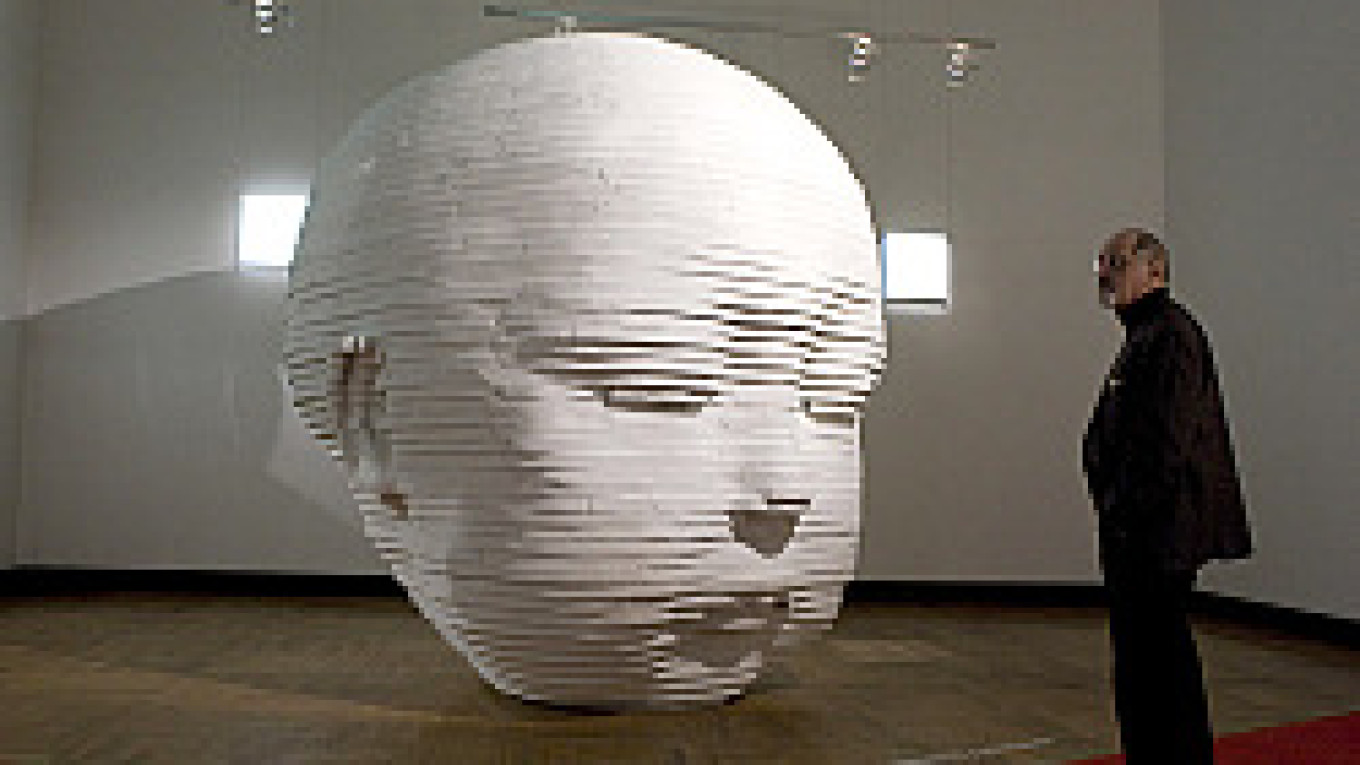
This year's Kandinsky Prize at the Central House of Artists aims to add the names of a few more Russians to those ranks. Launched in 2007 by ArtChronika magazine and Deutsche Bank, it will award 40,000 euros ($50,000) for the best Russian "project" of the year, 10,000 euros for the best media project and a three-month "creative business trip" to the best artist under 30. The winners will be announced in a ceremony at Winzavod Contemporary Art Center on Dec. 9.
The prize's organizers have an eye fixed squarely westward but are not just looking to emulate Britain's Turner Prize or France's Prix Marcel Duchamp. "Contemporary Russian art has been something of a poem without a hero in the West," explained jury member Andrei Erofeev. "Apart from the Ks, [Ilya] Kabakov and [Oleg] Kulik, it's quite anonymous."
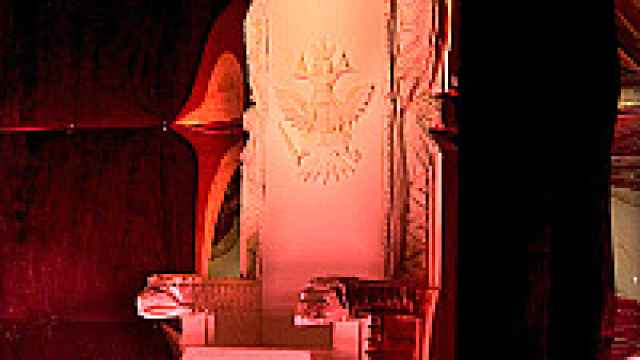 Vladimir Filonov / MT Sergei Shekhovisov's "Throne,"... |  |
| |
Some of those banned works are now in the running for this year's prize, including the Blue Noses' "Naked Truth" installation, a piece that depicts cavorting naked men and women with politicians' and celebrities' faces superimposed over their own, and PG Group's "Mobile Agitation Device," which imagines a Chinese invasion of Russia.
Organizers of the prize remain unconcerned, however, about political fallout. "Artistic independence was very important," said Alexandr Borovitsky, jury member and curator of the Department of New Movements at the Russian Museum in St. Petersburg. "We wanted to show the interesting and the unexpected not a curated exhibition."
Ironically, this absence of curatorial care is more striking than any of the political works on display. A Hollywood-style red carpet leads visitors from the entrance up two flights of stairs, then past the works of the 61 nominated artists that hang arranged in no apparent order, before coming to an abrupt end.
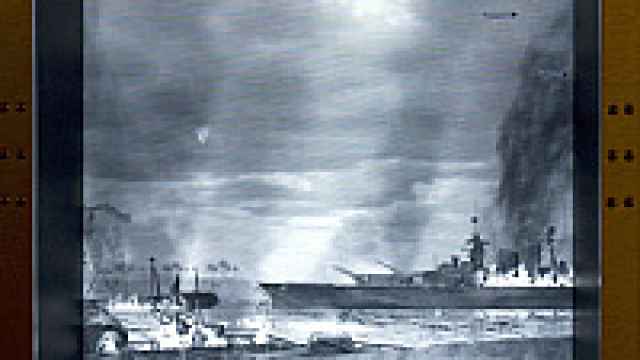 Vladimir Filonov / MT ...and PG Group's "Mobile Agitation Device" are two of the Kandinsky prize nominees. | |
| |
Guelman went on to call the carpet "idiotic," "as if it weren't an exhibition but the approach to some throne or to the Central Committee politburo." The harangue may have been tongue-in-cheek, though, given that it correctly identified two works on display: Sergei Shekhovtsov's giant styrofoam "Throne," styled after the 1982 sci-fi movie "Tron," and "Labor," Diana Machulina's photorealist painting of a Communist Party presidium.
With the overwhelming number of pieces on show, the exhibition ends up being not only exhaustive but exhausting. Moreover, the clumsy layout leaves some more modest pieces struggling for attention ?€” photographer Alexandr Gronsky's "Landscapes" are all but hidden by Georgy Puzenkov's massive and noisy multimedia piece "Who Is Afraid?" that looms nearby. More seriously, the dim lighting harms both some of the paintings, which require more illumination, and a number of the video pieces, which do better with less, creating a situation that Guelman described as "artists having to fight with each other."
This is unfortunate because the standard of art is high for such a large-scale exhibition.
And yet, even with the wealth of high-quality work on display, the future of Russian contemporary art seems no more certain. The most noteworthy pieces are those by artists already well-known in Russia, such as Anya Zhelud, Aidan Salakhova and the Blue Noses; few newer faces make as significant an impression.
As an overview for the uninitiated, the exhibition is excellent. For those already well-versed in the Russian contemporary art scene, however, the show holds disappointingly few surprises.
A Message from The Moscow Times:
Dear readers,
We are facing unprecedented challenges. Russia's Prosecutor General's Office has designated The Moscow Times as an "undesirable" organization, criminalizing our work and putting our staff at risk of prosecution. This follows our earlier unjust labeling as a "foreign agent."
These actions are direct attempts to silence independent journalism in Russia. The authorities claim our work "discredits the decisions of the Russian leadership." We see things differently: we strive to provide accurate, unbiased reporting on Russia.
We, the journalists of The Moscow Times, refuse to be silenced. But to continue our work, we need your help.
Your support, no matter how small, makes a world of difference. If you can, please support us monthly starting from just $2. It's quick to set up, and every contribution makes a significant impact.
By supporting The Moscow Times, you're defending open, independent journalism in the face of repression. Thank you for standing with us.

Remind me later.