

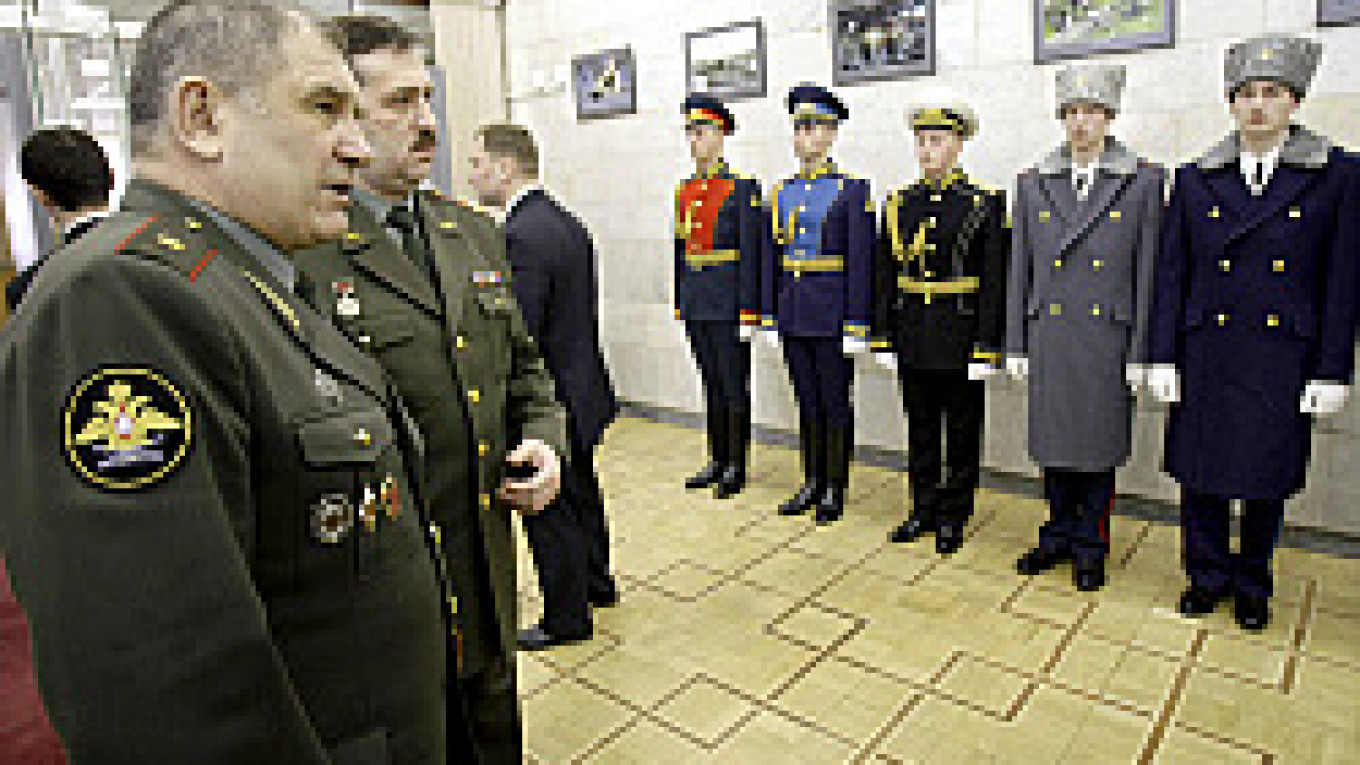
Serdyukov's statement — made alongside President Dmitry Medvedev at a meeting of the military's top brass ?€” reflected deeply entrenched Russian suspicions despite Obama's desire to improve relations with Moscow.
Medvedev, meanwhile, said that NATO expansion, along with international terrorism and local conflicts, meant that upgrading the country's nuclear forces was the top priority in an ambitious military modernization plan that he pledged to pursue despite the worst economic crisis in a decade.
Medvedev's first meeting with Obama next month will set the tone for talks over a new arms control treaty and other major disputes between the Cold War rivals. But Russia is signaling that it will be a tough negotiating partner.
"U.S. aspirations have been aimed at getting access to raw materials, energy and other resources" of former Soviet nations, Serdyukov told military officers. "Active support was given to the processes aimed at pushing Russia out of the sphere of its traditional interests."
Moscow has fiercely opposed plans to put Ukraine and Georgia on track to NATO membership. Russian officials have also hoped that the Obama administration would also cancel plans to deploy missile defense sites in Poland and the Czech Republic. Moscow has raised the stakes by threatening to deploy missiles next to Poland if the U.S. moves ahead with the missile shield.
Windfall oil wealth over the last decade allowed the Kremlin to nearly quadruple defense spending, but military modernization has gone slowly, and glaring weaknesses, such as shortages of precision "smart" weapons and modern communications gear, were highlighted during Russia's war with Georgia in August.
The financial crisis has raised more doubts about meeting modernization goals, something Medvedev sought to dispel Tuesday.
"Let me mention the top priorities. The main one is a qualitative increase in the troops' readiness, primarily of strategic nuclear forces. They must guarantee the fulfillment of all tasks of ensuring Russia's security," Medvedev said.
Military officials have said about 25 percent of the government's 1.5 trillion rubles ($43 billion) budgeted for weapons purchases this year will be spent on upgrading the aging, Soviet-era nuclear force.
The military has said more than 10 new intercontinental ballistic missiles will go into service by year's end ?€” a much faster pace of deployment than in previous years.
Colonel General Nikolai Solovtsov, the chief of the Strategic Missile Forces, said the first three RS-24, multiwarhead ballistic missiles would be deployed after Dec. 5, when the 1991 Strategic Arms Reduction Treaty, or START, expires, Itar-Tass reported Tuesday.
The new missile, which Solovtsov said would carry "at least four" nuclear warheads, would violate the landmark treaty.
A Message from The Moscow Times:
Dear readers,
We are facing unprecedented challenges. Russia's Prosecutor General's Office has designated The Moscow Times as an "undesirable" organization, criminalizing our work and putting our staff at risk of prosecution. This follows our earlier unjust labeling as a "foreign agent."
These actions are direct attempts to silence independent journalism in Russia. The authorities claim our work "discredits the decisions of the Russian leadership." We see things differently: we strive to provide accurate, unbiased reporting on Russia.
We, the journalists of The Moscow Times, refuse to be silenced. But to continue our work, we need your help.
Your support, no matter how small, makes a world of difference. If you can, please support us monthly starting from just $2. It's quick to set up, and every contribution makes a significant impact.
By supporting The Moscow Times, you're defending open, independent journalism in the face of repression. Thank you for standing with us.

Remind me later.