

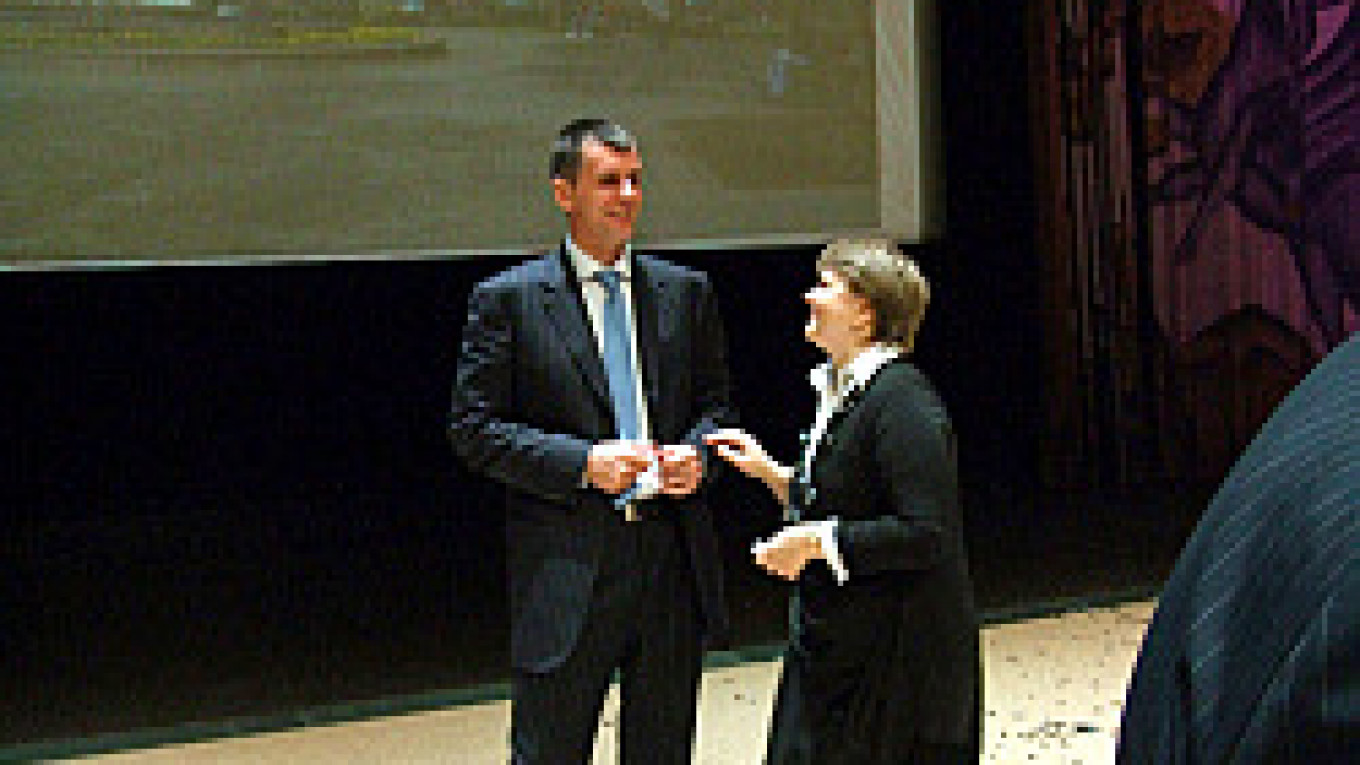
"There are young people who go to work in state service right after graduation," Prokhorov said. "I recommend you to go only into business. Only there will you find drive and real life."
"See you in big business in five years. And five years after that, see you in the Forbes list," said Prokhorov, the country's fifth-richest man according to Forbes Russia, with an estimated fortune of $22.6 billion. "We will work either as colleagues or as competitors. Let those who fail to do all that go into state service."
Prokhorov's advice appeared to go slightly against his own history, however.
Graduating from the academy in 1989, his first job was working for the Bank of International Economic Cooperation, a state-owned bank representing the governments of nine Communist countries, including the Soviet Union, Cuba and Vietnam.
Prokhorov, speaking at the Pushkinsky Theater, assured the students that they would benefit from the connections they made at the academy.
"Beginning today you become the full-fledged members of this mafia of the Financial Academy -- the mafia in the good sense of the word," Prokhorov said. "For now, just believe what I say, but you will understand how lucky you are in 10 to 15 years."
"You of course have to study well, but the most important thing is to have fun -- real fun," he said. "Success only comes to the people who live in harmony."
The Financial Academy, founded in 1918 as a socialist economics institute, in the late 1980s and 1990s became an incubator for a number of high-ranking officials and businessmen, who have since lavished generous sponsorship on their alma mater.
Last year, for instance, Prokhorov donated $5 million to the academy's endowment fund.
Among Prokhorov's class of '89 were current Krasnoyarsk Governor Alexander Khloponin and Andrei Kozlov, the late first deputy chairman of the Central Bank who was assassinated in 2006.
Prokhorov's rock star-style speech was set off by a more conventional address by Finance Minister Alexei Kudrin, a member of the academy endowment fund's board of trustees, who used the occasion to tout the strength of the Russian economy and its ability to withstand investor concerns about the conflict with Georgia.
"It is 10 years since the 1998 financial crisis, and our economy is stronger today," Kudrin said. "The world financial crisis hasn't shaken our strength. But the risks of those years are far lower than those we are facing today. The decision that was made on the republics of Abkhazia and South Ossetia was the only one possible. But our financial system is durable enough to stand it."
In contrast to Prokhorov, Kudrin also encouraged the students to go into both business and government service.
"I see future bankers and ministers here," Kudrin said. "There are about 1,500 people working at my ministry today, and we always need new specialists."
Prokhorov's advice not to go into government service seemed to be ignored among some students.
"You can't begin business from nothing, just after graduation, as Prokhorov advised," said student Anna Shchudenkova, 16. "To get all that, you first have to get into state service to earn some money, connections and reputation."
"We'll become Kudrins," Shchudenkova said, winking to her girlfriends standing around her at the cinema entrance.
Stas Burlenov, 16, who said he had enrolled for a part-time course, said it was not as easy now to make a fortune in business as it was in the 1990s.
"Russia is now going the European way, where people reach the top jobs by the age of 70," Burlenov said. "But what Prokhorov said excited and somewhat challenged me and my friends."
A Message from The Moscow Times:
Dear readers,
We are facing unprecedented challenges. Russia's Prosecutor General's Office has designated The Moscow Times as an "undesirable" organization, criminalizing our work and putting our staff at risk of prosecution. This follows our earlier unjust labeling as a "foreign agent."
These actions are direct attempts to silence independent journalism in Russia. The authorities claim our work "discredits the decisions of the Russian leadership." We see things differently: we strive to provide accurate, unbiased reporting on Russia.
We, the journalists of The Moscow Times, refuse to be silenced. But to continue our work, we need your help.
Your support, no matter how small, makes a world of difference. If you can, please support us monthly starting from just $2. It's quick to set up, and every contribution makes a significant impact.
By supporting The Moscow Times, you're defending open, independent journalism in the face of repression. Thank you for standing with us.

Remind me later.