

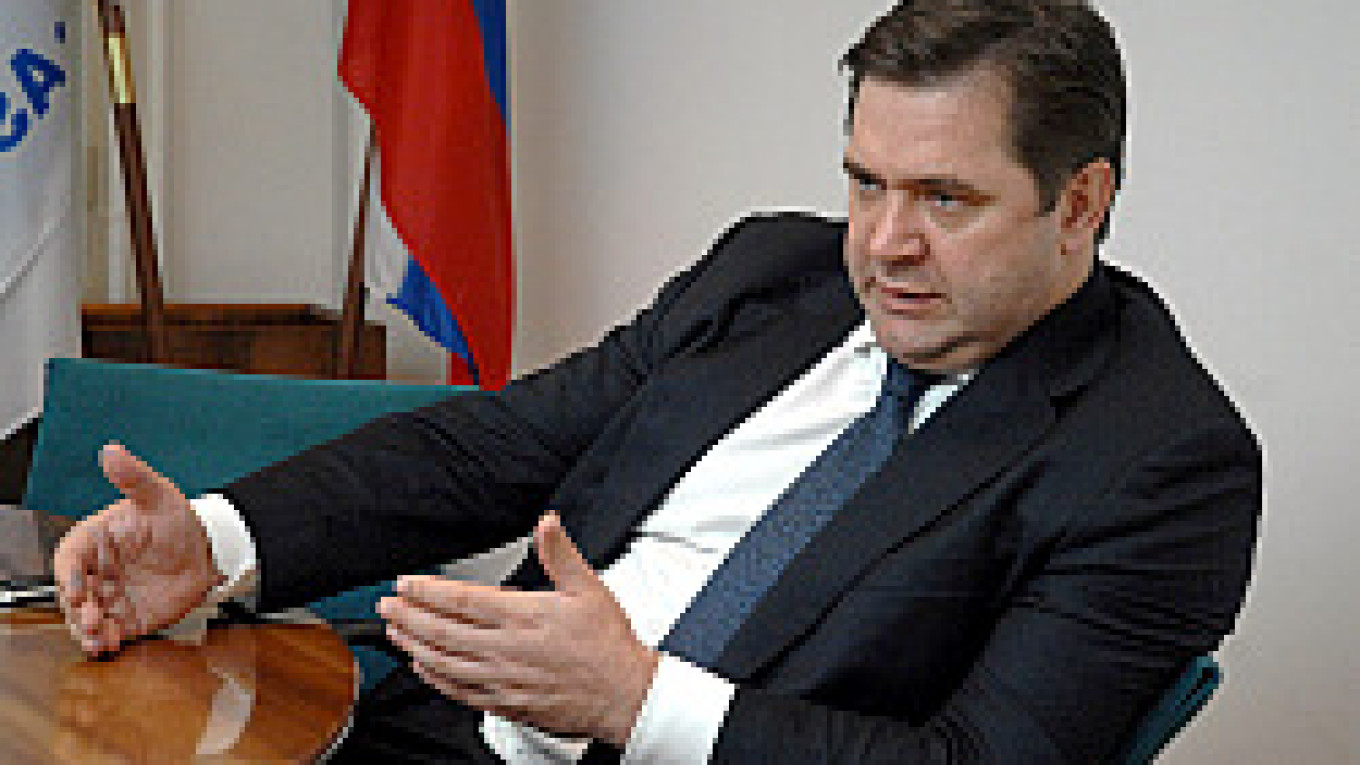
Shmatko will answer to newly appointed Deputy Prime Minister Igor Sechin, who was put in charge of industry, energy and natural resources, according to a list of duties published on the Cabinet's web site.
Shmatko had been president of state-controlled Atomstroiexport, overseeing construction of Iran's first nuclear reactor in Bushehr and a successful bid to build a reactor in Bulgaria, since June 2005.
Russia wants to build 26 new reactors by 2030 under a plan developed by Sergei Kiriyenko, now chief of the state nuclear corporation Rosatom.
The Energy Ministry was spun off from the Industry and Energy Ministry as part of Putin's proposals for his Cabinet. Former Industry and Energy Minister Viktor Khristenko will head the new Industry and Trade Ministry, whose priorities will include developing such high-tech sectors as electronics, shipbuilding and aviation, a statement from the ministry said Monday.
Under Shmatko as energy minister, "nuclear energy will have more attention than before," said Anton Khlopkov, executive director of think tank PIR Center.
As minister, Shmatko will also take charge of regulating the powerful oil and gas sector that has brought the country a tidal wave of export revenues in past years.
Russia is the world's largest gas producer and second-largest oil exporter.
In addition, Shmatko will oversee the current sweeping reforms in the entire electricity market, which will see the winding-up of national electricity giant Unified Energy System on July 1.
Despite his strictly nuclear background, Shmatko will likely oversee the other energy sectors just as efficiently, Khlopkov said.
"A class of professional managers has emerged in Russia," Khlopkov said. He recalled that Kiriyenko made the opposite transition from overseeing oil and gas in the 1990s as fuel and energy minister to his current position at Rosatom.
But Konstantin Simonov, director of the National Energy Security Fund, speculated that Sechin, who is also chairman of state-run Rosneft, would assume wide-ranging powers over the oil and gas sector.
Rosneft, the country's top oil producer, rose to such prominence after gobbling up most of the assets of bankrupted Yukos.
"It's clear that, despite expectations, the Energy Ministry will not closely watch oil and gas," Simonov said. "Sechin will do it all."
The oil and gas sector now contributes more than half of federal budget revenues and plays an important role in foreign policy, Simonov said, apparently referring to gas price disputes with Ukraine that prompted several Western government to accuse Russia of using energy trade as a political weapon.
Oil and gas companies gave no reaction to Shmatko's appointment Monday afternoon. "We don't comment on such things," said Dmitry Dolgov, a spokesman for LUKoil, the country's largest privately controlled oil firm.
Shmatko first came into contact with nuclear technology when he was conscripted to serve on nuclear-powered submarines in the Northern Fleet from 1985 to 1988.
After the Navy stint, Shmatko majored in economics at universities in Yekaterinburg and Marburg, Germany. He was a student in Germany at the time when the Soviet Union collapsed.
He stayed in Germany after his studies to work as an auditor at a firm called BDO Binder. At the age of 28, he took the job of director of a company, RFI GmbH, that represented the Federal Property Fund in the European Union.
Shmatko moved to Russia as head of external relations at the All-Russia Bank for Regional Development in 1995. Two years later, he became an analyst at the Federal Nuclear Power Agency and has remained linked with the industry since then.
A Message from The Moscow Times:
Dear readers,
We are facing unprecedented challenges. Russia's Prosecutor General's Office has designated The Moscow Times as an "undesirable" organization, criminalizing our work and putting our staff at risk of prosecution. This follows our earlier unjust labeling as a "foreign agent."
These actions are direct attempts to silence independent journalism in Russia. The authorities claim our work "discredits the decisions of the Russian leadership." We see things differently: we strive to provide accurate, unbiased reporting on Russia.
We, the journalists of The Moscow Times, refuse to be silenced. But to continue our work, we need your help.
Your support, no matter how small, makes a world of difference. If you can, please support us monthly starting from just $2. It's quick to set up, and every contribution makes a significant impact.
By supporting The Moscow Times, you're defending open, independent journalism in the face of repression. Thank you for standing with us.

Remind me later.