

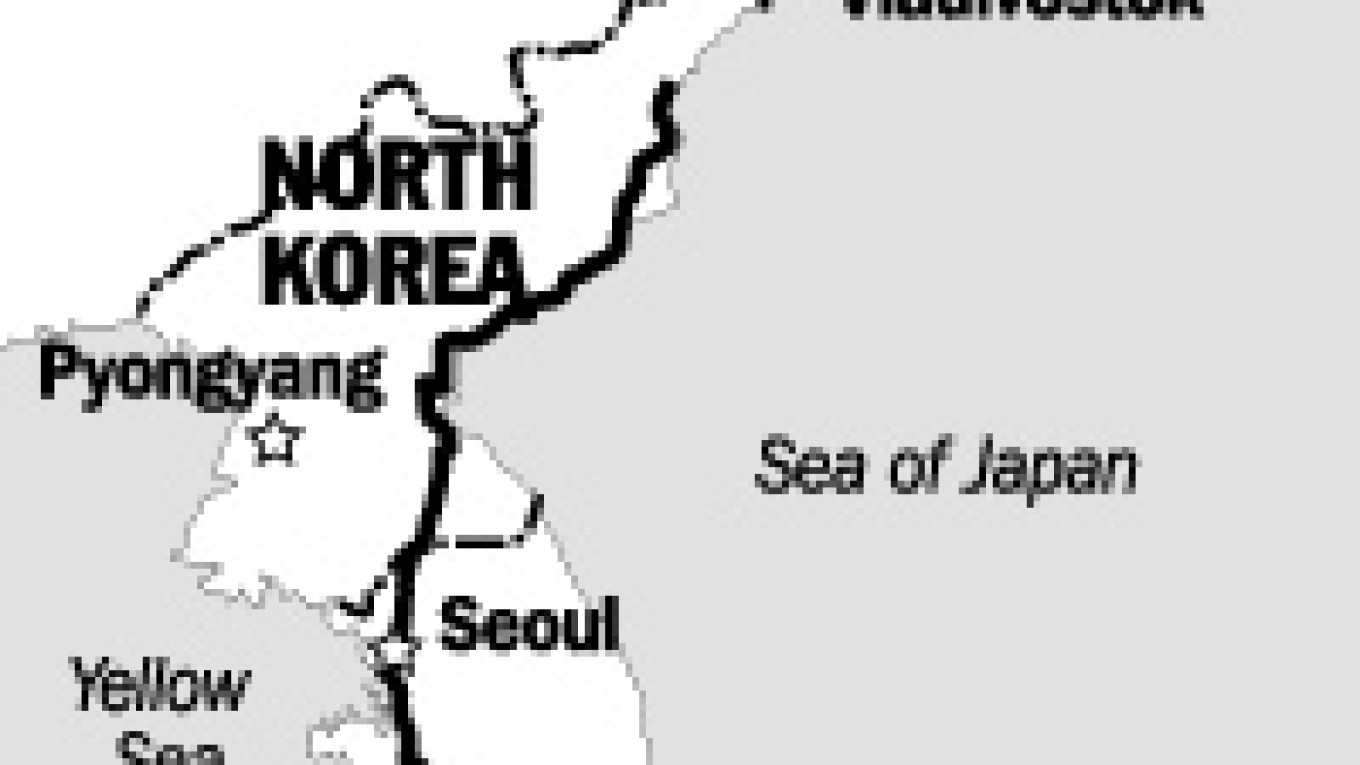
The 240-kilometer section is a key link in an ambitious cargo project to link Western Europe to the South Korean deep-water port of Pusan via Russia and North Korea.
Railways Minister Gennady Fadeyev arrived in Pyongyang on Tuesday for five days of discussions on the $3.3 billion project at the invitation of North Korean leader Kim Jong Il.
Khasan, called Hunchun by North Koreans, was built during World War II to transport Soviet troops and arms to Korea to fight against the Japanese. In Soviet times as much as 5 million tons of freight passed through Khasan annually, but last year only 92,000 tons crossed the border, according to customs officials.
Russia has strongly supported the Eurasian cargo corridor, which was one of the main topics during the August summit between Kim and President Vladimir Putin in Vladivostok.
At the time Putin urged the Railways Ministry to speed up work on the link, saying that if it did not, China would push a trans-Asia link that would bypass Russia, costing the government billions in transit fees.
In September, North and South Korea began removing mines from a 500-meter stretch of track near their border.
The ministry is also preparing a feasibility study on reconstructing the 781-kilometer stretch of track that runs the length of North Korea's east coast.
Modernizing that section will cost some $2 billion, South Korea's ambassador to Russia, Chung Tae-ik, said last week.
|
 The Trans-Siberian was started in 1891 by order of Count Sergei Witte and completed in 1905.
On Tuesday, Deputy Railways Minister Vladimir Sazonov said Russia is ready to invest heavily in linking the Trans-Korean to the Trans-Siberian, but an international consortium needs to be formed first to guarantee the project's commercial viability.
"Setting up an international consortium will make it possible to attract international and domestic investors, which will significantly facilitate the financing of this large-scale project," Sazonov was quoted by Itar-Tass as saying.
Earlier, the ministry said it was seeking private financing in all three countries and that other countries, most notably Japan, had expressed interest in participating in the project.
Fadeyev said last month that once a corridor connecting South Korea, North Korea, China, Russia, Kazakhstan and Europe is operational, the Trans-Siberian would handle up to 10 percent of all Eurasian cargo traffic. In 2001, it carried less than 1 percent.
The ministry puts the annual capacity of the extended line at 500,000 containers and projects yearly revenues of more than $1 billion in transit fees for Russia alone.
A Message from The Moscow Times:
Dear readers,
We are facing unprecedented challenges. Russia's Prosecutor General's Office has designated The Moscow Times as an "undesirable" organization, criminalizing our work and putting our staff at risk of prosecution. This follows our earlier unjust labeling as a "foreign agent."
These actions are direct attempts to silence independent journalism in Russia. The authorities claim our work "discredits the decisions of the Russian leadership." We see things differently: we strive to provide accurate, unbiased reporting on Russia.
We, the journalists of The Moscow Times, refuse to be silenced. But to continue our work, we need your help.
Your support, no matter how small, makes a world of difference. If you can, please support us monthly starting from just $2. It's quick to set up, and every contribution makes a significant impact.
By supporting The Moscow Times, you're defending open, independent journalism in the face of repression. Thank you for standing with us.

Remind me later.