

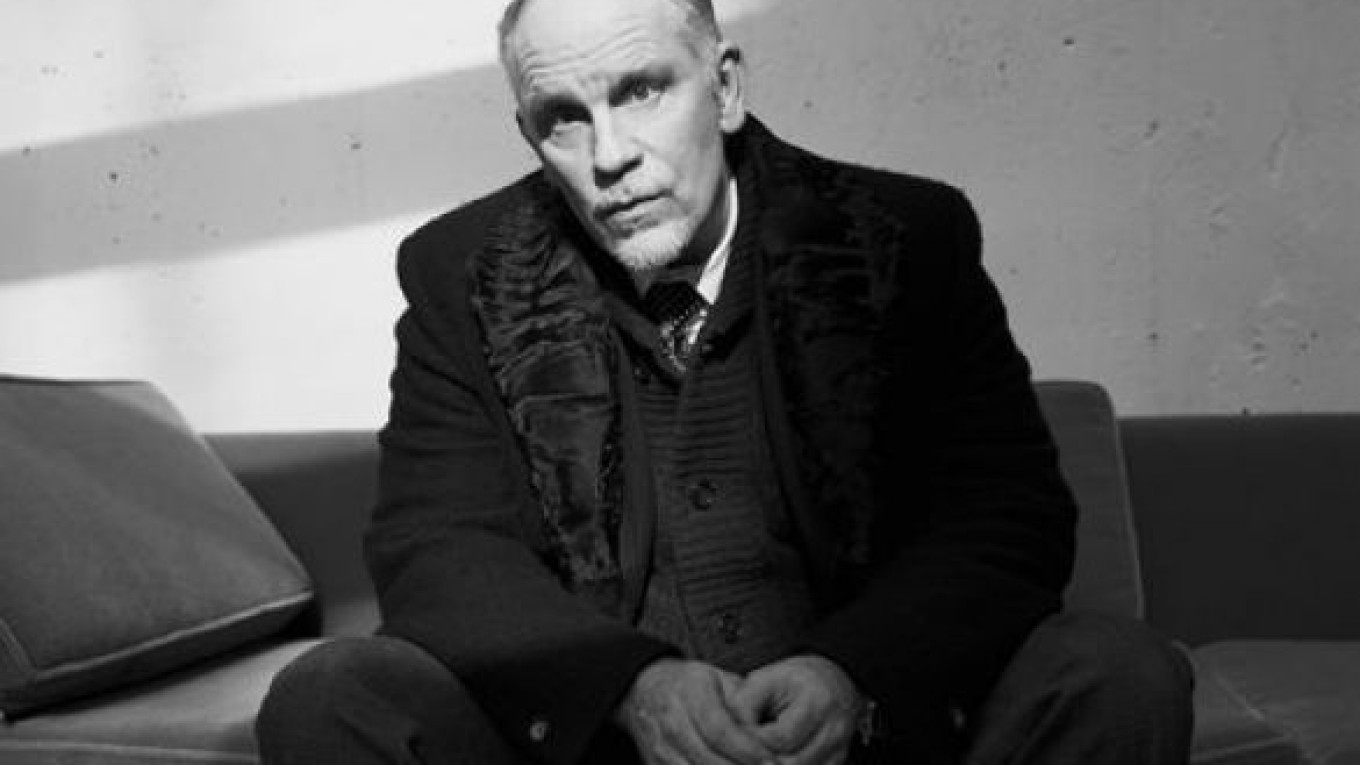
Actor John Malkovich came to St. Petersburg this week as part of an international tour of the opera “The Infernal Comedy: Confessions of a Serial Killer,” where he plays a charming serial killer.
Written and directed by Michael Sturminger, “The Infernal Comedy” brings together Malkovich, several sopranos and a baroque orchestra to tell the story of Jack Unterweger, who killed 11 prostitutes in Europe and the U.S. by strangling them with their own bras.
In an interview before the show, the U.S. actor explored the human face of monsters, his role in the cult film “Being John Malkovich” and discussed the healing properties of art.
A baroque orchestra, two singers and an actor is a rather unorthodox stage format. How do you find it?
The St. Petersburg production is quite different in that we will have five singers. Normally we have two, and they share the arias. I have loved this experience. I know nothing about baroque music and really nothing about classical music. It has been a fantastic experience and a fantastic education for me. I have loved working with something that is so powerful and so irrepressible as this music. It is kind of like having an incredible, perfect acting partner.
Following a campaign by Austrian intellectuals, Unterweger was pardoned and granted an early release by then-Austrian President Kurt Waldheim — only to commit another string of murders within the first year of his release. How do you think he managed to fool everyone? When you watched the recordings of Unterweger being interviewed in a TV talk show and insisting he was a reformed character, did you find his acting convincing?
Not so much, actually. When I go somewhere and, say, watch a performance, I am perfectly capable of believing it, and I often do, but that presupposes the performance is believable — and I simply did not find him believable. I am not an expert on crime, and I do not speak German, but of course I knew of him and had read his writing; but having said that, no one could have known what he would do once he was out of prison. My feeling was essentially an instinct.
I think a lot of people were actually able to see through him. There was a group of people who said he had redeemed himself and was rehabilitated because this fit in with their worldview and their political persuasion. Another group of people said he had not redeemed himself, and that fit in with their worldview. Very often, you just cannot know what people can do and what they are capable of doing. That is part of the human condition. Whether we like it or not, whether we accept it or not, and, of course, whether we do it or not, does not mean we are not potentially capable of a lot of not very nice things.
Do you see anything in common between actors and criminals, perhaps in the sense that both have to be good at making people believe their stories?
I do not think this is a unique quality for actors. This is exactly how most people conduct their lives. You want someone to believe you are like this or like that. Maybe actors feel more comfortable in game-playing or role-playing than, say, the general populous. And serial killers are of course quite accomplished at gaining people’s trust; that is how they do what they do. Whether actors are as good at gaining people’s trust, I do not know.
Do you always seek to make each of your characters believable, or do you see some roles as a way to make a particular point?
No, I never do that. I do not make points. I am not a football player or tennis player. I try to play a role, and just let the chips fall wherever they may. When I am offstage, of course, I am happy to judge all of the things we all judge every day. But when I am on stage, it is not for me to judge, it is not in my code.
And what is in your code?
To give my characters the fullest, most complex life you can in the time you have. And present them to the public, and let the public then make a judgment about what they saw. I am not a judge.
People’s reactions will always be different. “The Infernal Comedy,” for example, has had very different reactions in just about every city we have been in, and I think it will here in St. Petersburg. You never know. Some people have seen the production as an attempt to glorify Jack Unterweger. But it is really not that.
“The Infernal Comedy” is an attempt, in a way, to create the situation that arose when Unterweger was released from prison. Here comes this guy, he is in a white suit, he is charming, he is funny, he tells silly jokes, he is childish. People generally are charmed by him, but then they begin to find out who he is. And that recreates the experience I think that a lot of the Austrian populous had. I do not see it as in any way glorifying him at all. I cannot say all monsters, because I do not know, but a lot of monsters have a human face. They have some human feelings, maybe even a lot of them. Maybe they have some good qualities — maybe a lot of them. This piece shows it, but I do not think the production glorifies the monster in any way.
Do you agree that art can heal?
Maybe I’m a sucker, but I think there is truth in that, from what I have witnessed in my life. I don’t know if it is healing, but at times it certainly makes you not ashamed to be part of the human race when you see what real artists are capable of creating. There are a lot of times when one could feel not so overjoyed about being a human being, when you look around the world and see what we do and what we have done, and all that sorrow and chaos. But when you listen to a beautiful piece of music or read a fantastic book or go to the Rijksmuseum to see Rembrandt’s “The Night Watch,” I think it is at least comforting to know what people are capable of doing artistically.
In what way, if any, was acting in “Being John Malkovich” a different experience from your other roles?It was not special. It was just a different story. I did not feel that an extra effort or any kind of a different skill was required of me. It was just like any other role.
When I first read “Being John Malkovich” many years before it was made, my producing partner and I discussed it. And he met with Charles Kaufman, and we offered to produce it, and for me to direct it, if he made it about someone else. In other words, not about me, but, for example “Being Sean Penn,” or whoever. Charles did not want to do that, and so we did it the way we did. So for me it was not the role, in particular, I just thought it was a fantastic script, a hilarious, very creative and very odd script. I also loved Kaufman’s voice, and I loved [the director] Spike Jonze, when I met him, and I loved his take on what he wanted to do with the material. But to me the role itself is in no way related to me.
Are there any myths or misconceptions about you that you would really like to dispel?
Whenever you are a known figure, there will be people who love you without even any knowledge of you. There will be the vast majority of people, for whom you will remain unheard of, and they will remain uninterested in you. Then there will be another body of people who will hate you. And I think this is one thing you have to get used to. The only thing that I ever try to dispel is when — and I have to do this all the time — people print really damaging stories about you that are fictitious. I do not mind when people hate me. This is OK. If I knew them, I may hate them also. If I knew them, I may like them. I would go as far as to say, I would like to think I’d understand the reason and even empathize with the reason some people hate me. That sort of thing would not make me jump off a building. I will live my life, and when it is over, that will be that, and the poor people who dislike what I do may be occasionally haunted by an image or two of me when they run across a film or two that I did. I understand that. Hatred is part of human nature. I think it is unfortunate that it is human nature. People I dislike, or, say, known people or celebrities that I dislike, although there are very few, I just do not think about. But I do not hate them. I may not be fond of someone’s acting, or I may find one’s personality irritating, but I do not have time in my life for that sort of contempt. And dispelling misconceptions about me — what is the point? Once you become a public figure, people are going to take their shots. Occasionally, when something is really egregious and goes on and on and on — things like that have a life, you know — if some journalist in Catalonia announces that I am paid 200,000 euros per show, I have to do something about it. It is utterly untrue, and very, very damaging to me. So, I respond. I’d rather not be interested.
You have appeared, both in film and on stage, in thrillers, horror, comedies and costume dramas. How do you decide to take up a particular role?
That really depends. When I do a role in a theater, I want to be assured that it has sufficient depth and coloring that will allow me to investigate it, to do my work at length. With a movie, that does not matter. You do it one day per scene, normally. There is no time for an in-depth examination of that material. You have to make a quick decision — OK, I see this person like this — and go about it. Movies are about a few good seconds or good minutes a day, or merely that appear to be good — cut in a certain way. I am trained in both now, but when I started I was only trained to do theater. Film is not actually my natural milieu, it is not my instrument, although I’ve had a fantastic opportunity to learn it. If I was a football player, I would say, it is not my natural position.
So when I choose a role, I have to bear that in mind in the theater in a way that does not matter in movies. I have to be assured that I am not going to run out of space or possibilities with the role I choose in the theater. When I have made that mistake, nothing is more miserable than doing a play that you cannot make live. And nothing is more fun than being in a play that you can make live. Movies are not about that. It is about a totally different set of factors, many of which have their charm: You have to make a quick sketch of your character. I love to do “Saturday Night Live,” which is all little quick comic sketches, it is fantastic — but I would not necessarily want to do those sketches for a year. They are funny to rehearse three times, and they may be really funny to watch, even 20 years later, but I would not want to do it every night for a year.
What do you find rewarding in film, compared to theater acting?
You know, it is funny, the things I like about movies are really weird things. They are all quite technical. Obviously, I like to work with my fellow performers, and I love the quick sketch aspect, but I am also attracted to the technical aspects of film-making: You act with the other people, but you act with the camera, too. The camera can do close-ups and a lot of things you cannot do in theater.
What do you regard as your big breakthrough?
It was when I agreed to go with some of my classmates to start Steppenwolf Theater, which I thought would maybe last a day, or a month. What made the company last was a lot of respect among the members of Steppenwolf for the work of the others in Steppenwolf. That was the main thing. There were so many close friendships, and lots of love between us and lots of humor and farce and tragedy shared. But what it boiled down to is we liked to watch each other work — and that is probably the reason it lasted.
What makes a theater production last?
That it is living. It should be lifelike — not realistic, but lifelike, meaning it reminds you of life. It is ephemeral.
I always compare acting to surfing, which I do not do; I just watch. Theater is like riding a wave. The performer is not the wave. The wave is created by the collision of the material and the public. And then you just ride it, and, yes, sometimes you fall off, and sometimes you wipe out, and sometimes you ride better than others. And that is what theater acting is to me.
What makes a production alive is the sense that the public does not know what is going to happen.
Which works of art would you like your children to see?
That would probably be a lot of things. Just a few weeks ago I said to my son as I was watching the Italian composer Ennio Morricone’s work “The Mission” played by a symphony orchestra in Verona, “Just see what a man — say, a composer — can do all by himself with a pencil and a piece of paper and a piano.”
I want to give my children exposure to many different things. Nothing of mine, but of other people. I want to show them human talent and the various possibilities.
A Message from The Moscow Times:
Dear readers,
We are facing unprecedented challenges. Russia's Prosecutor General's Office has designated The Moscow Times as an "undesirable" organization, criminalizing our work and putting our staff at risk of prosecution. This follows our earlier unjust labeling as a "foreign agent."
These actions are direct attempts to silence independent journalism in Russia. The authorities claim our work "discredits the decisions of the Russian leadership." We see things differently: we strive to provide accurate, unbiased reporting on Russia.
We, the journalists of The Moscow Times, refuse to be silenced. But to continue our work, we need your help.
Your support, no matter how small, makes a world of difference. If you can, please support us monthly starting from just $2. It's quick to set up, and every contribution makes a significant impact.
By supporting The Moscow Times, you're defending open, independent journalism in the face of repression. Thank you for standing with us.

Remind me later.