

From this week, the Pushkin Museum of Private Collections is displaying more than 50 of his works, including his lesser-known paintings and drawings in an exhibition titled "Alberto Giacometti."
Giacometti was born in Switzerland in 1901. His father was a painter, and Giacometti begun to follow in his footsteps in high school. It was not until the early '20s that he started to study sculpture seriously.
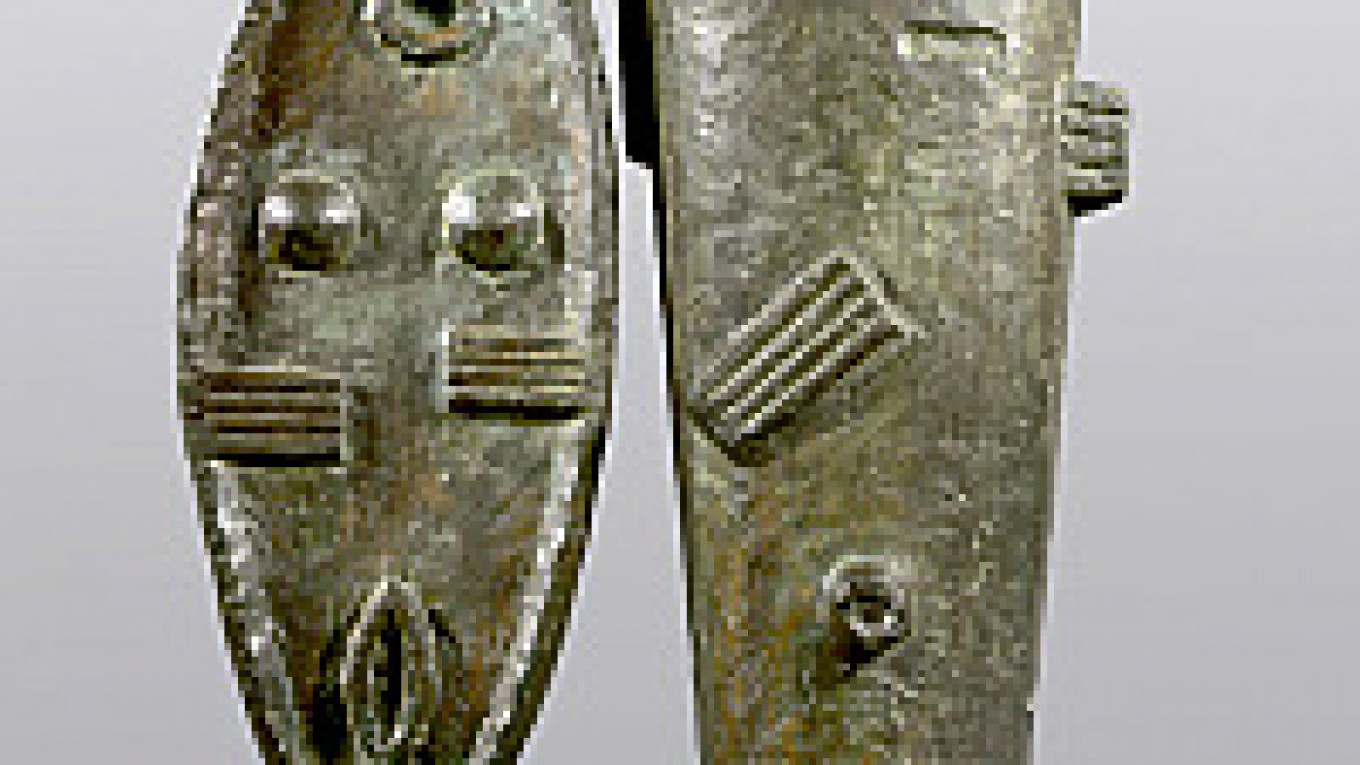
One of his first key pieces, which is displayed at the exhibition, is "Spoon Woman," a figure that borders on the abstract, with the large bowl of a spoon in place of a woman's torso. Giacometti was influenced by African art at the time he produced this work.
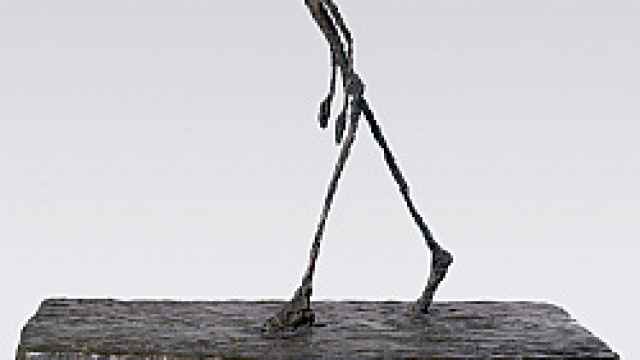 Pushkin Museum Of Fine Arts / For MT Alberto Giacometti was influenced by African art (below) before he established his signature style (above and left). |  |
| |
One of the exhibits, "Man Crossing a Square," looks as if it would crumble in your hand if you were to touch it. While the man appears to be walking, his large heavy feet weigh him down and the top half of his body looks resigned to the fact that there is no possibility for movement.
Many of the post-war sculptures have vaguely molded heads and crudely shaped bodies, but despite their lack of detail, they express a sense of tragedy. "Dog" shows a dog walking, its feet glued to the base and its head lowered toward the ground. It is painfully thin and the skin seems to hang off its frail body.
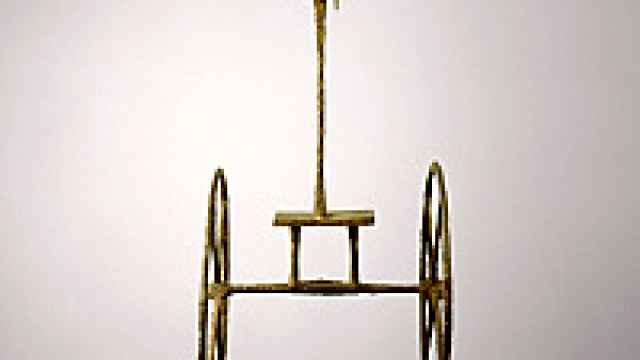 Pushkin Museum Of Fine Arts / For MT | |
| |
By the early '60s, Giacometti had reached a certain level of fame. In 1961, Samuel Beckett asked him to design the set for "Waiting for Godot," and the sculptor made a barren plaster tree. A year later, Giacometti had his own pavilion at the Venice Biennale. He also met Francis Bacon during a trip to London. Unfortunately, he was diagnosed with stomach cancer soon afterward, and he died in 1966.
"Alberto Giacometti. Painting, Drawing, Sculpture" runs to Nov. 20 at the Museum of Private Collections, located at 10 Ul. Volkhonka. M. Kropotkinskaya. Tel. 203-7998. Closed Monday and Tuesday.
A Message from The Moscow Times:
Dear readers,
We are facing unprecedented challenges. Russia's Prosecutor General's Office has designated The Moscow Times as an "undesirable" organization, criminalizing our work and putting our staff at risk of prosecution. This follows our earlier unjust labeling as a "foreign agent."
These actions are direct attempts to silence independent journalism in Russia. The authorities claim our work "discredits the decisions of the Russian leadership." We see things differently: we strive to provide accurate, unbiased reporting on Russia.
We, the journalists of The Moscow Times, refuse to be silenced. But to continue our work, we need your help.
Your support, no matter how small, makes a world of difference. If you can, please support us monthly starting from just $2. It's quick to set up, and every contribution makes a significant impact.
By supporting The Moscow Times, you're defending open, independent journalism in the face of repression. Thank you for standing with us.

Remind me later.