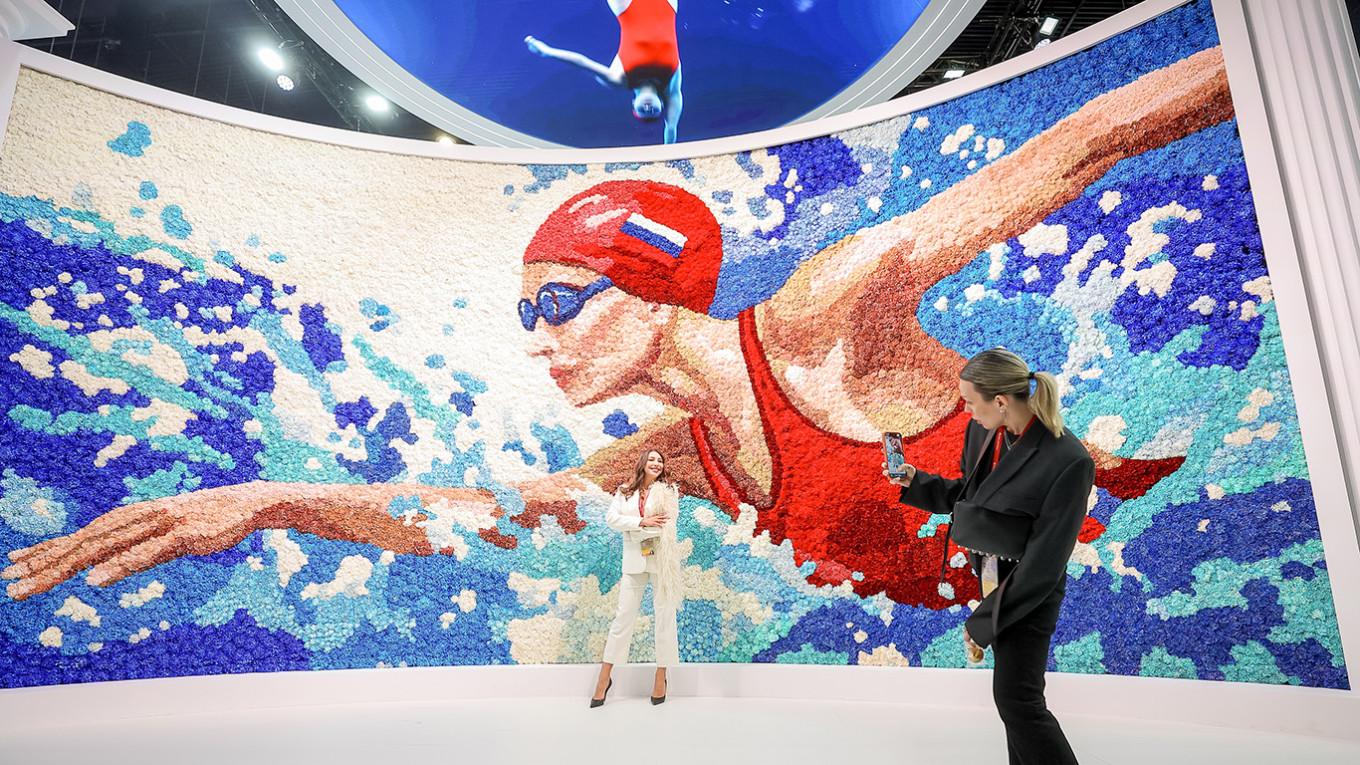
A key feature of the St. Petersburg International Economic Forum (SPIEF) is that it once genuinely worked. It wasn’t set up to be yet another one of the sham events organized by the Russian authorities — such as Direct Line with President Vladimir Putin — but rather an event that enjoyed genuine international recognition and prestige, putting Russia in the best possible light.
SPIEF was used to showcase the country’s potential to foreign investors, as a springboard for Russia’s accession to the WTO, the launch of ambitious projects such as Nord Stream, as well as being a symbol of a new Russia open to the world, complete with free concerts by Sting and Roger Waters.
For Putin, SPIEF has always been an important PR tool to mollify his critics’ concerns: perhaps there is nothing to fear about a third presidential term, given that agreements worth almost 10 trillion rubles ($310 billion at the time) were signed at the 2013 forum? Perhaps Western sanctions aren’t all that effective if European leaders and entrepreneurs continue to attend SPIEF, as if nothing had happened?
Following the full-scale invasion of Ukraine, the “Russian Davos” quickly degenerated into a marginal event, where the most talked-about guests are now representatives of the Taliban — until recently banned in Russia as a terrorist organization — and panel discussions are led by radical ideologues such as Alexander Dugin.
It would appear that in 2026, the organizers set themselves the task of convincing foreign guests that rumors of Russia’s collapse had been greatly exaggerated, and that it still represents an open and investment-friendly country. This task can be considered partly accomplished if one reads the high-profile interview given by Holger Friedrich, publisher of the German newspaper Berliner Zeitung, to Die Zeit upon his return from SPIEF.
While acknowledging that Russian society is becoming increasingly isolated and atomized, and that visiting Russia as a German is becoming ever less comfortable, Friedrich also shared several rather unexpected observations. In particular, he argued that there is still freedom to criticise the authorities in Russia, noting that no one arrested him for referring to a “bloody war” and the “failure of the political elite” during his speech. Furthermore, Friedrich maintained that “independent media” continue to operate in Russia, citing the newspaper Kommersant as an example.
“The doors are wide open for discussion and, consequently, for de-escalating the conflict,” said Friedrich, who believes that this year’s SPIEF should have been attended not only by members of the controversial right-wing party Alternative for Germany (AfD), but also by representatives of the governing CDU. In his view, Germans should make more active use of the freedom that exists in Russia to “convey information.”
The impression that a reader not particularly well versed in Russian politics is likely to take away from this interview is that there remains a possibility of dialogue with Russia that Europe — and Germany in particular — is failing to make proper use of. The same idea, expressed more directly, was advanced at SPIEF by former Austrian Foreign Minister Karin Kneissl, who, in an interview with TASS, complained that European diplomats were not approaching negotiations with Russia professionally enough and were obstructing the dialogue process. “And if I were in the Russian side’s shoes, I wouldn’t be too friendly right now,” she concluded.
The Russian side, for its part, is also doing a great deal to reinforce this worldview. To begin with, according to a source involved in organizing this year’s forum who spoke to the publication Bereg, SIM cards and VPN subscriptions were purchased in advance for all foreign guests so that they could access Instagram and WhatsApp to ensure their stay in Russia did not bring inconvenient shocks.
Russian media outlets and news agencies, meanwhile, circulated highly exaggerated headlines and press releases emphasizing the forum’s supposedly international character. In particular, they reported that Germany was sending a large official delegation of companies to the forum, a claim also highlighted by Kirill Dmitriev, the foreign investment and economic cooperation envoy who led Russia’s side in negotiations with the United States over Ukraine.
In reality, however, no such delegation existed. In fact, there were just several German businesspeople, most of whom hold Russian citizenship and whose activities are entirely tied to Russia. The Russian director of a long-suspended initiative between Vienna and Moscow moderated a panel on Austro-Russian cultural dialogue despite the suspension of the Sochi Dialogue format, featuring an Austrian conductor who lamented the supposed loss of Western Europe’s cultural identity.
This narrative can be summed up by a statement made by an AfD MP that Germany was in fact more globally isolated than Russia. Peculiarly, an outsider watching SPIEF might believe it. Friedrich may well have believed Kommersant was independent after he read Andrey Kolesnikov’s recent reports from the forum. In his signature wry style, Kolesnikov allows himself a degree of soft irony when describing events — sometimes even when recounting Putin’s own remarks — hinting that all that glitters is not gold.
When I began my career at Kommersant as a 19-year-old news reporter during the first year of the full-scale invasion of Ukraine, I too tried to convince myself that the newspaper was at least relatively independent. I focused on Kolesnikov’s irony-laden writing and dismissed obvious instances of censorship as the inevitable price of operating within a complicated and turbulent political context.
This is precisely the model of selective perception that the Russian authorities are trying to encourage among the international public: a focus on rhetoric about peacefulness, dialogue, and cooperation — allegedly interrupted at the initiative of the West — while overlooking repression, war, and the complete absence of any genuine steps or intentions to bring either to an end.
Austrian journalist Simone Brunner noted how Russia shamelessly attempts to present the impression of business as usual when reality is anything but. In fact, both in the 2000s and the 2010s, SPIEF largely served a similar purpose: to normalize the situation in Russia by legitimizing the regime by shifting attention away from political issues and towards economics and business.
Today, more than ever, it is vital not to succumb to this form of manipulation, since it has the potential to shape public opinion in the West and, consequently, influence Russia’s position in future peace negotiations.
A Message from The Moscow Times:
Dear readers,
We are facing unprecedented challenges. Russia's Prosecutor General's Office has designated The Moscow Times as an "undesirable" organization, criminalizing our work and putting our staff at risk of prosecution. This follows our earlier unjust labeling as a "foreign agent."
These actions are direct attempts to silence independent journalism in Russia. The authorities claim our work "discredits the decisions of the Russian leadership." We see things differently: we strive to provide accurate, unbiased reporting on Russia.
We, the journalists of The Moscow Times, refuse to be silenced. But to continue our work, we need your help.
Your support, no matter how small, makes a world of difference. If you can, please support us monthly starting from just $2. It's quick to set up, and every contribution makes a significant impact.
By supporting The Moscow Times, you're defending open, independent journalism in the face of repression. Thank you for standing with us.

Remind me later.