

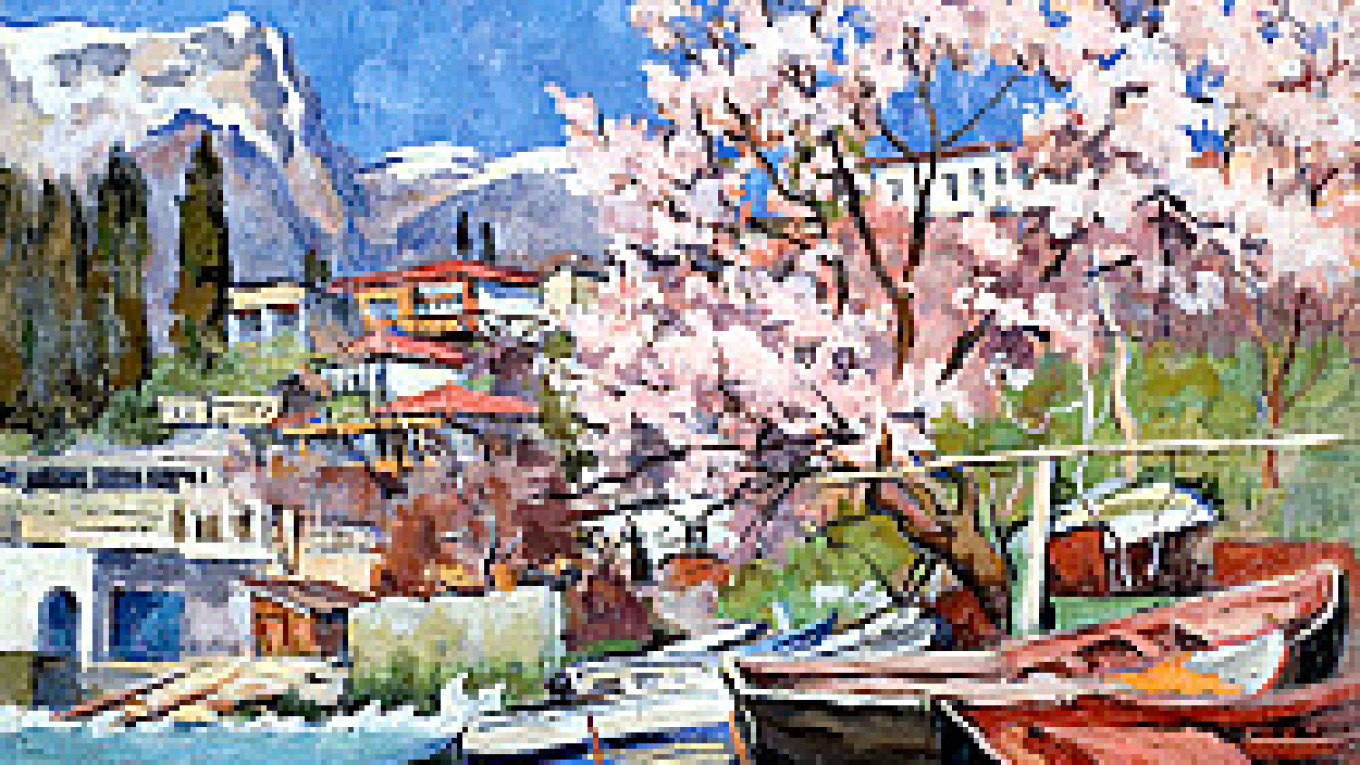
Their brief life span produced only two notable Russian followers, Grigory Sretensky and Nina Stenshinskaya, whose work is now on show at the Moscow Museum of Modern Art.
The Jack of Diamonds included artists such as Robert Falk, Aristarkh Lentulov, Ilya Mashkov and Pyotr Konchalovsky, and following their first scandalous exhibition in 1909 the group, which mixed folk art into its artwork, became the most significant movement of avant-garde artists in Russia.
The name was chosen because it emphasized the impish attitude to life that the artists had and their love of the playing card, which appears in a number of their works.
Avant-garde art fell out of Soviet favor at the end of the 1920s, replaced by socialist realism, with its images of striving workers and heroic soldiers.

Moscow Museum of Modern Art
The exhibition features the later work of Sretensky and Stenshinskaya.
|  |
| |
Two artists who did not turn to socialist realism were Sretensky and Stenshinskaya, pupils of Konchalovsky and Mashkov, respectively. The two finally enter the limelight in the "Heirs to the Jack of Diamonds" exhibition.
The pair are "masters whose talent is incontestable," according to Valery Turchin, the curator of the exhibition and a professor of art history at Moscow State University.
It is the first large-scale show for Sretensky and Stenshinskaya, and it follows recent successful sales of Sretensky's paintings in London auctions, where many pieces were bought for private collections in Europe and the United States.
Sretensky and Stenshinskaya started their creative careers in the 1920s, before seeing all their work destroyed when the Nazis bombed Moscow in World War II. The show displays the works of the postwar period, which survived thanks to the efforts of the artists' relatives and private collectors.
An oil painting of Tuapse, a city on the Black Sea, shows off Sretensky's emotional expression of color.
Moscow Museum of Modern Art
| |
| |
"I'm more attached to the paintings of Sretensky, since to me they have a greater inner strength, which by no means diminishes the importance of Stenshinskaya's paintings, which are more colorful and tranquil," said Dr. Dragoljub Milicevic, who is founding a nonprofit organization dedicated to the couple.
The pair's paintings are shown with a few of their teachers' works -- pieces by Konchalovsky, Mashkov and Kuprin are all on display -- and the museum has also placed a little jewel among the art: an easel made by Mashkov as a present for his favorite disciple, Stenshinskaya.
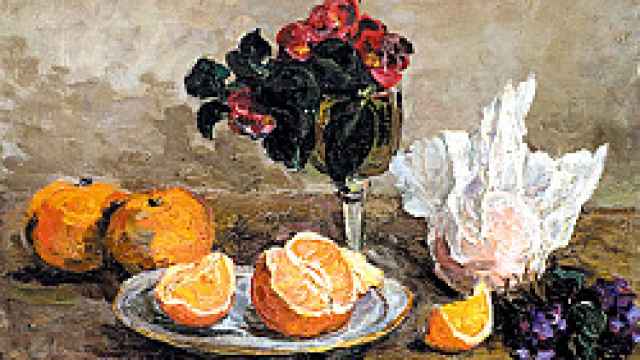
All the works are Cezanne-influenced, a natural continuation of the work of the Jack of Diamonds group, featuring dachas, still lifes with sushki (traditional Russian biscuits), a painted teapot and a series of intimate landscapes from Gorky to Kyrgyzstan, the Sea of Azov and Moscow.
The works are mainly landscapes and still lifes devoid of any political connotations, just like most of their work in the 1920s.
"During the dark period of the Bolshevik era, they remained faithful to the quiet and dignified post-Cezannism, known nowadays as the Moscow School of Painting," said Milicevic. "In other words, they carried the torch of freedom of artistic expression through the darkness."
"Heirs to Masters of the Jack of Diamonds: Paintings by Grigory Sretensky and Nina Stenshinskaya" runs through Nov. 30 at the Moscow Museum of Modern Art: 25 Ulitsa Petrovka. M. Chekhovskaya. 694-2890. www.mmoma.ru.
A Message from The Moscow Times:
Dear readers,
We are facing unprecedented challenges. Russia's Prosecutor General's Office has designated The Moscow Times as an "undesirable" organization, criminalizing our work and putting our staff at risk of prosecution. This follows our earlier unjust labeling as a "foreign agent."
These actions are direct attempts to silence independent journalism in Russia. The authorities claim our work "discredits the decisions of the Russian leadership." We see things differently: we strive to provide accurate, unbiased reporting on Russia.
We, the journalists of The Moscow Times, refuse to be silenced. But to continue our work, we need your help.
Your support, no matter how small, makes a world of difference. If you can, please support us monthly starting from just $2. It's quick to set up, and every contribution makes a significant impact.
By supporting The Moscow Times, you're defending open, independent journalism in the face of repression. Thank you for standing with us.

Remind me later.