

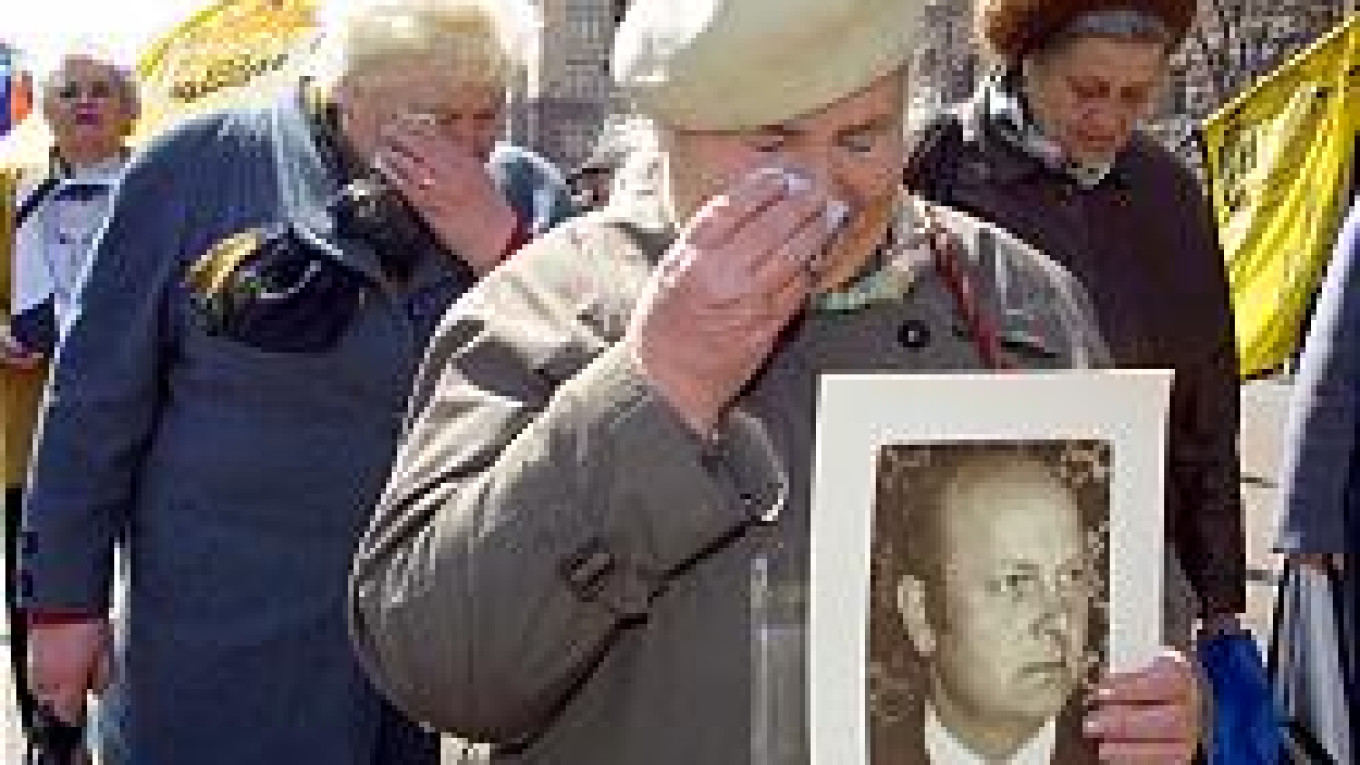
Led by an orchestra playing a funeral march, protesters from across the country, including elderly people and children suffering health problems from the world's worst nuclear accident, marched down the Ukrainian capital's main boulevard.
Many carried photographs of loved ones killed in the accident and banners with slogans such as "Chernobyl Is Closed. Are the Problems of Chernobyl Forgotten?"
Police estimated the crowd at 5,000.
The Ukrainian Chernobyl Union, an advocacy group representing victims of the disaster, organized the protest to protest planned budget cuts and to demand the government pay long-overdue social and medical benefits to thousands of people still suffering from the disaster.
The demonstration came a week before the 17th anniversary of the accident.
"They give us only kopeks," said a protester who identified herself only by her first name and patronymic, Halyna Danylovna. "If we don't protest they'll take away everything,"
Ukraine's cash-strapped government has been unable to meet its generous Soviet-era obligations to provide social benefits for the estimated 3.3 million people, including 1.5 million children, affected by the accident.
Tens of thousands of Ukrainians disabled by Chernobyl-related illnesses suffer from inadequate health care.
Some 25,000 families evacuated from contaminated areas still await housing, according to official reports.
The disaster on April 26, 1986, in which a reactor exploded and caught fire, sent a radioactive cloud over vast areas of Ukraine, Russia and Belarus and much of northern Europe.
Ukraine shut Chernobyl's last reactor in December 2000. Western governments have pledged to help fund completion of two new reactors to compensate for the lost electricity capacity.
A Message from The Moscow Times:
Dear readers,
We are facing unprecedented challenges. Russia's Prosecutor General's Office has designated The Moscow Times as an "undesirable" organization, criminalizing our work and putting our staff at risk of prosecution. This follows our earlier unjust labeling as a "foreign agent."
These actions are direct attempts to silence independent journalism in Russia. The authorities claim our work "discredits the decisions of the Russian leadership." We see things differently: we strive to provide accurate, unbiased reporting on Russia.
We, the journalists of The Moscow Times, refuse to be silenced. But to continue our work, we need your help.
Your support, no matter how small, makes a world of difference. If you can, please support us monthly starting from just $2. It's quick to set up, and every contribution makes a significant impact.
By supporting The Moscow Times, you're defending open, independent journalism in the face of repression. Thank you for standing with us.

Remind me later.