
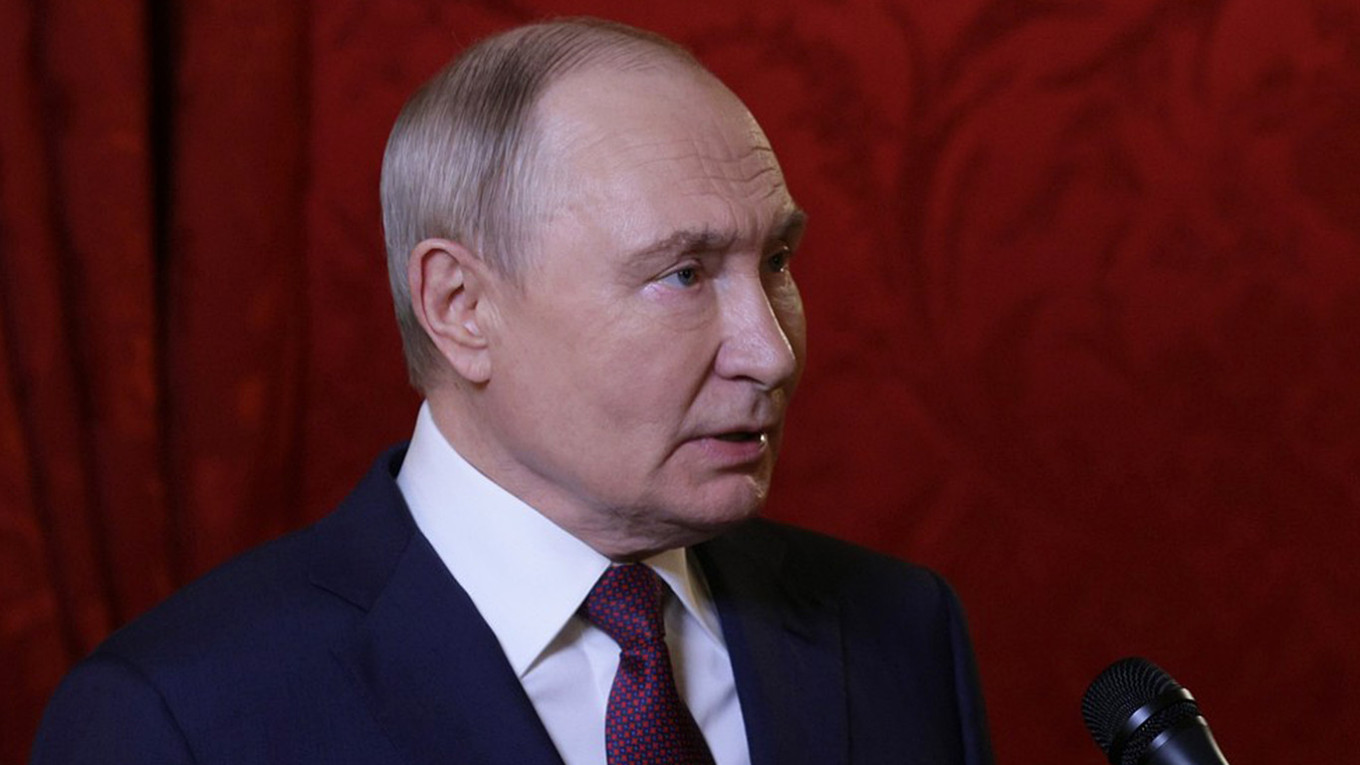
Russian President Vladimir Putin said Thursday that future talks on ending the war against Ukraine should focus on security guarantees for both countries and an overall framework for security throughout Europe.
Putin, interviewed on Russian state television a day after meeting U.S. special envoy Steve Witkoff, confirmed that Russia was ready to resume U.S.-mediated talks with Ukraine next month.
He restated longstanding Kremlin policy that Russia never wanted to launch its full-scale invasion, but had run into hostile reactions from Ukraine on key issues of concern to Moscow.
Talks on a variety of matters could lead to a positive outcome, Putin said, but Russia remained intent on resolving the conflict once and for all rather than agreeing to a short-lived ceasefire.
"The goal of these talks will be to ensure the security of Ukraine and Russia after reaching peace agreements, in their final form, not as a result of a temporary ceasefire for some short period of time. We are ready to resume these contacts to achieve this goal," Putin said.
The Russian president said Witkoff also stressed that discussions had to extend to "the architecture of European security as a whole. And I agree with that too. Well, let's see how things develop in the coming days."
Ukrainian President Volodymyr Zelensky, who met Witkoff in Norway on Tuesday, said Ukraine was ready for talks likely to take place by early next month. Ukraine, he said, supported "any proposals for a ceasefire, an end to the war, an energy ceasefire as well as humanitarian initiatives."
The United States has led efforts to negotiate an end to the war in Ukraine, but talks have stalled since Trump ordered attacks against Iran in February.
Many of the disagreements about how to end the Ukraine war focus on territory, with Russia demanding Ukraine cede all of eastern Ukraine's Donbas region. Kyiv rejects any deal that would include giving up land it currently holds.
In his comments on Thursday, Putin said any discussion on territory in eastern Ukraine had to consider what he said was the fact that the area was "historically Russian land."
And residents there, he claimed, had voted to be a part of Russia in referendums staged seven months after Moscow launched its full-scale invasion.
"Firstly, my attitude on this matter is that this is not their territory. It’s the territory of historical Russia," Putin said.
A Message from The Moscow Times:
Dear readers,
We are facing unprecedented challenges. Russia's Prosecutor General's Office has designated The Moscow Times as an "undesirable" organization, criminalizing our work and putting our staff at risk of prosecution. This follows our earlier unjust labeling as a "foreign agent."
These actions are direct attempts to silence independent journalism in Russia. The authorities claim our work "discredits the decisions of the Russian leadership." We see things differently: we strive to provide accurate, unbiased reporting on Russia.
We, the journalists of The Moscow Times, refuse to be silenced. But to continue our work, we need your help.
Your support, no matter how small, makes a world of difference. If you can, please support us monthly starting from just $2. It's quick to set up, and every contribution makes a significant impact.
By supporting The Moscow Times, you're defending open, independent journalism in the face of repression. Thank you for standing with us.

Remind me later.