
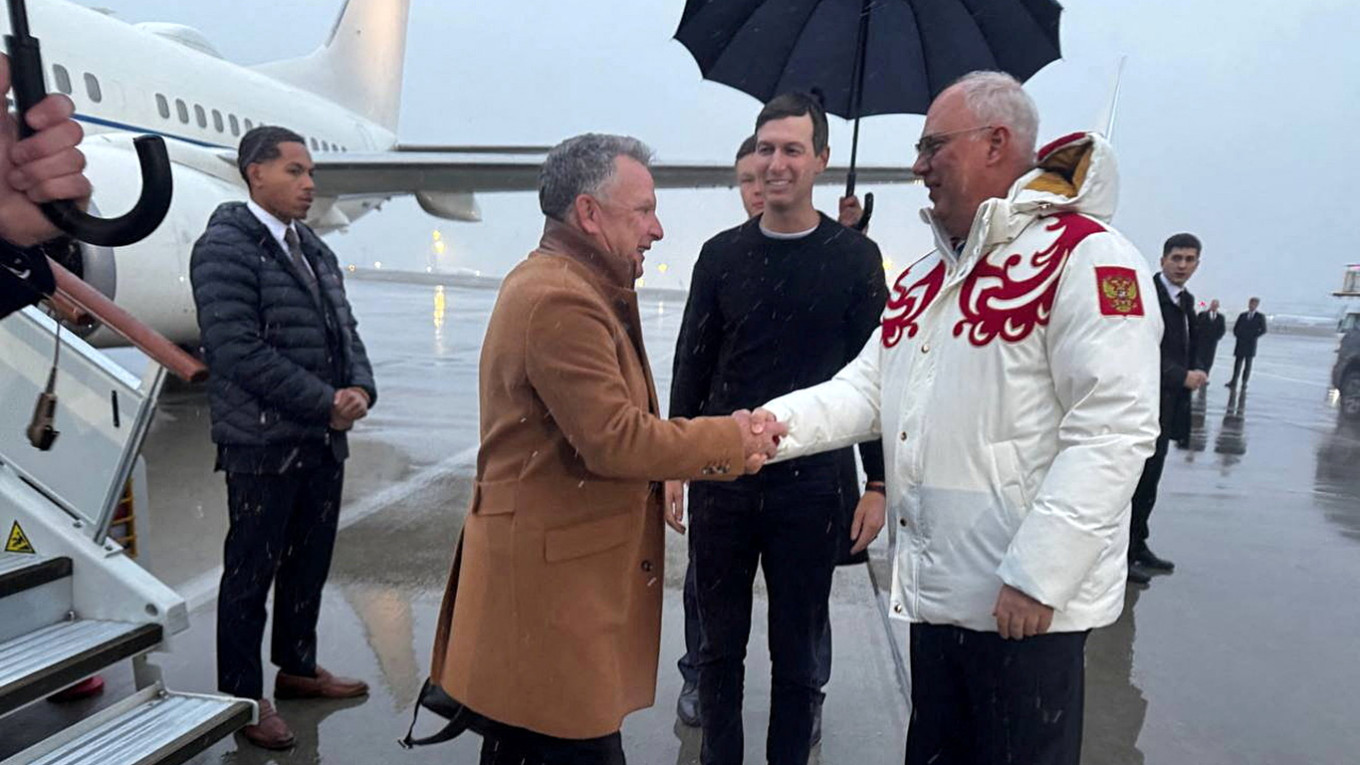
The Kremlin said Thursday that talks between Russian President Vladimir Putin and two U.S. envoys had been useful and that the American side had supported Putin's proposal for a joint humanitarian mission to a city in eastern Ukraine.
Kremlin aide Yury Ushakov said Putin would continue discussions on Ukraine with U.S. President Donald Trump at an APEC summit in China later this month and that direct peace talks with Kyiv, which resumed this week after a nine-month hiatus, would continue.
He said that Russia had made clear to the U.S. envoys, Steve Witkoff and Jared Kushner, that NATO could not expand further and expressed hope that Europe would support talks on a new European security architecture.
Thursday's negotiations marked the 10th time Witkoff has met Putin in person during a conflict that has lasted longer than the Soviet Union's fight against Nazi Germany in World War II, and follow two days of U.S.-led trilateral peace talks in Abu Dhabi.
After the Abu Dhabi talks, the sides said they had agreed on a major exchange of prisoners of war that is likely to happen in the coming weeks, but announced no breakthrough in wider negotiations.
As he entered a Moscow hotel before the Kremlin talks, Witkoff was asked by a reporter whether progress made in the talks so far meant peace was closer.
“I hope so,” he replied.
Russian and Ukrainian negotiators reported some progress in Abu Dhabi, but the U.S. side said differences remained on major issues, including territory.
Witkoff and Kushner are expected to fly to Dublin later on Thursday for talks with Ukrainian President Volodymyr Zelensky, who said on Wednesday he hoped a result in the talks could be achieved by the end of this year, but that much depended on how the United States approached Moscow.
President Donald Trump, who once said he could end the now 4.5-year conflict in 24 hours, has instructed Witkoff and Kushner, his son-in-law, to make a new push for peace, which he hopes will burnish his self-styled credentials as a peacemaker.
He said last week that the conflict was close to being settled in a “big beautiful agreement,” though he has frequently predicted breakthroughs that have not materialized.
At the meeting, Putin told U.S. envoys that Russia was proposing a joint Russian-Ukrainian humanitarian mission to the city of Kostiantynivka in eastern Ukraine, the Interfax news agency reported.
Putin was cited as saying that the mission could be modeled on a similar initiative that allowed residents to leave the Russian-controlled town of Oleshky in southeastern Ukraine at the end of last month and for aid to be brought in for those who chose to remain.
Russia needs five days to clear the area near Kostiantynivka of mines, Putin was cited as saying.
After the meeting, Witkoff said a new round of trilateral talks was agreed, according to the state-run RIA Novosti news agency.
Witkoff also said that Europeans would join the next meeting.
U.S. envoy Jared Kushner told RIA Novosti that the talks were substantive and detailed.
Disagreement on territory
Kyiv has rejected a demand by Putin to surrender the whole of the eastern Donbas region in return for peace — something Russian forces have long been trying to achieve on the battlefield in the face of fierce Ukrainian resistance.
Moscow has not made major territorial gains this year, but has heavily attacked Ukrainian infrastructure and Kyiv has frequently struck Russian oil refineries with drones, causing fuel shortages over the summer, a problem which has resurfaced in some regions this week, according to local officials.
Putin has shown no signs of being ready to moderate his territorial demands, which include a buffer zone in parts of Ukraine that Russia has not formally claimed as its own.
Vladimir Medinsky, Putin's lead negotiator in the Abu Dhabi talks, told state TV on Wednesday that “wherever the foot of our Russian soldier has stepped, that is ours.” He was also cited by the TASS state news agency as saying that “every inch” of what Moscow regards as Russian land would be returned.
There is tension too over a Ukrainian and European desire — backed by the United States — for the European Union, many of whose member states are staunch backers of Kyiv, to have a seat at the negotiating table.
The Kremlin has said that the EU should be included in the talks at some stage, but has poured cold water on the idea in recent days. Moscow points to a lack of constructive proposals from Brussels and an inability by the EU to select someone to represent it in any future talks, and says it lacks realism.
Kaja Kallas, the EU's foreign policy chief, accused Russia on Monday of pretending to negotiate and said Moscow had shown no goodwill in talks while continuing to bomb Kyiv.
With talks deadlocked on territory, U.S. mediators have tried to steer discussions towards post-war security guarantees and reconstruction, and Russia has spoken of the need to agree on a post-war security framework for Europe.
A senior Russian diplomat said on Wednesday that Moscow could conclude non-aggression pacts with NATO member states.
But the idea of discussing such matters has stirred fears in Kyiv and among its allies too.
European Commission President Ursula von der Leyen said on Monday that wider European security talks should come only once there is a ceasefire in Ukraine. Moscow has rejected the idea of a temporary ceasefire, saying it wants an overall deal to end the war rather than a pause in which Ukraine might rearm.
A Message from The Moscow Times:
Dear readers,
We are facing unprecedented challenges. Russia's Prosecutor General's Office has designated The Moscow Times as an "undesirable" organization, criminalizing our work and putting our staff at risk of prosecution. This follows our earlier unjust labeling as a "foreign agent."
These actions are direct attempts to silence independent journalism in Russia. The authorities claim our work "discredits the decisions of the Russian leadership." We see things differently: we strive to provide accurate, unbiased reporting on Russia.
We, the journalists of The Moscow Times, refuse to be silenced. But to continue our work, we need your help.
Your support, no matter how small, makes a world of difference. If you can, please support us monthly starting from just $2. It's quick to set up, and every contribution makes a significant impact.
By supporting The Moscow Times, you're defending open, independent journalism in the face of repression. Thank you for standing with us.

Remind me later.