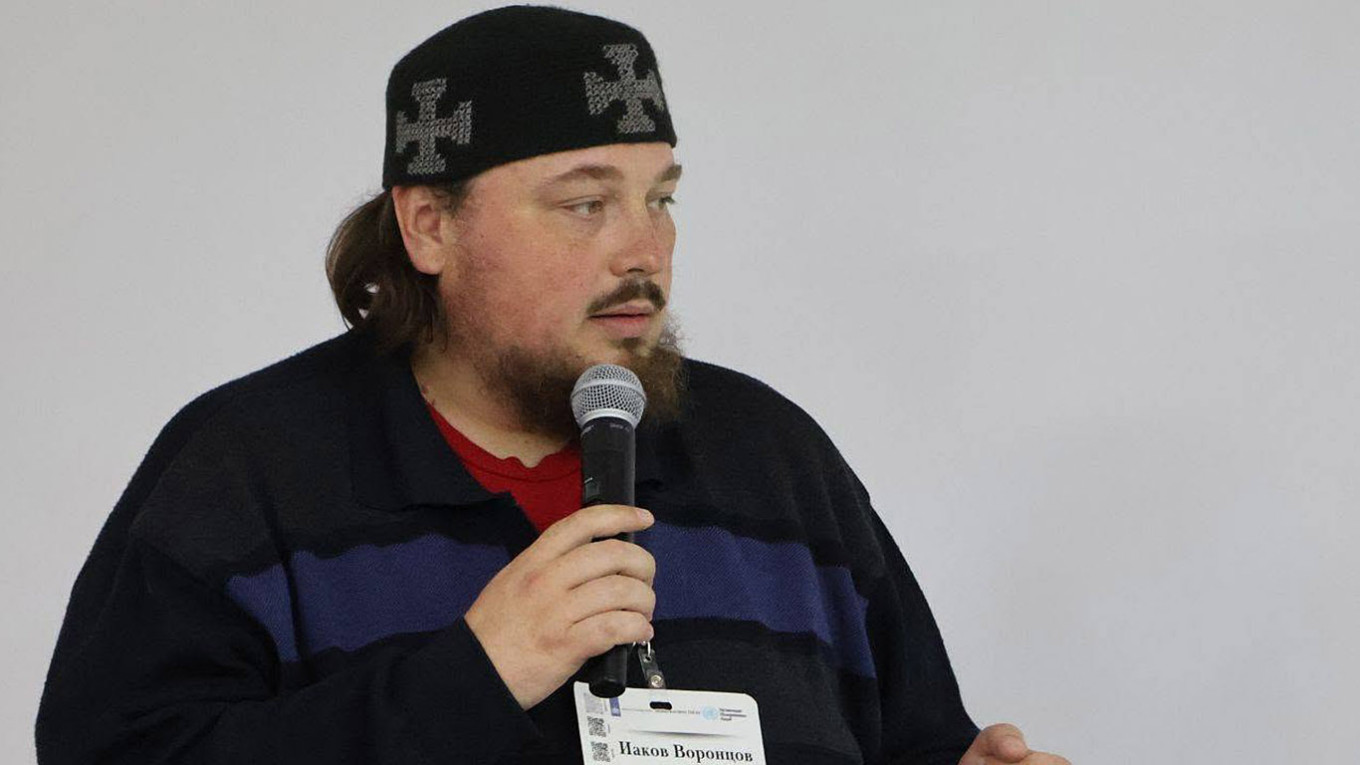
Earlier this month, a court in Almaty, Kazakhstan sentenced Yakov Vorontsov, a former priest who publicly opposed Russia’s full-scale invasion of Ukraine, to four years in prison. Officially, he was found guilty of illegally acquiring and possessing, without intent to sell, 2.44 grams of an analogue of a psychotropic substance.
Although this is far from the first case in which a Russian Orthodox priest has faced repression for criticizing the Church leadership or for expressing pacifist views on the Russo-Ukrainian war, it sets a new precedent in Kazakhstan.
Yet it would be wrong to ignore the roles that the structure of the Orthodox Church, Russian history and the former Fr. Yakov’s life story all play in his case. One also has to take into account the legacy of Stalin’s repressions and why Kazakhstan cannot, at present, have an Orthodox Church independent of Moscow.
Vladimir Yuryevich Vorontsov was born in the capital of Soviet Kazakhstan, then still called Alma-Ata, in 1986. He wouldn’t be known as Fr. Yakov until many years later, in 2018, when he was tonsured as a monk by His Eminence Alexander (Mogilev), Metropolitan of Astana and Kazakhstan — the very same cleric who signed the decree suspending him from priestly ministry in 2023.
The list of charges behind his suspension was extensive. Fr. Yakov was accused of “violating his priestly oath and perjury, abandoning his ministry without authorization, engaging in public political activity, disturbing the peace of the Church, slandering the Orthodox Church in the media, incitement to schism and fomenting interreligious and interethnic discord, as well as additional negative circumstances that have come to light.”
A year later, Patriarch Kirill, the head of the Russian Orthodox Church (ROC), would personally approve the Kazakhstani ecclesiastical court’s decision that Yakov should be defrocked.
In 2008, the then 22-year-old Vorontsov was known in Almaty literary circles as a poet and writer, as well as a qualified Russian language and literature teacher.
Just two years later, on Dec. 2, 2010, Vorontsov would be ordained and appointed second priest at the Church of the Nativity of the Most Holy Theotokos in the village of Sarymoldayevo, Zhambyl region.
To those unfamiliar with the institution, it may seem strange that the only Orthodox churches in Kazakhstan fall under the Moscow Patriarchate. The Christian presence on the territory of modern Kazakhstan goes back centuries, but only gained a secure foothold from the mid-18th century under Russian rule. St. Petersburg sent thousands of peasants and garrisons of soldiers to the Kazakh Khanate, for whom they built churches. Initially, these were built exclusively for Russians, without any aim of proselytizing and converting the locals.
To understand why the lone voice of Fr. Yakov was silenced by a system he had served for so long and so diligently, one has to understand the structure of the Orthodox Church itself.
Unlike the Catholic Church, there is no absolute authority like the Pope. Unlike Protestantism, with its decentralized congregations, Orthodoxy is organized as a family of independent churches, the most honored of which is considered to be the Patriarchal Church of Constantinople.
Over the past four years of Russia’s war, Constantinople has become a refuge for Russian priests who have been defrocked or suspended for criticizing church leadership or for expressing pacifist views, including Andrei Kuraev and the former Moscow priest Ioann Koval.
In 2022, five priests in Lithuania who expressed their disagreement with Patriarch Kirill’s position on the invasion of Ukraine were defrocked by the head of the Moscow Patriarchate’s Diocese of Vilnius and Lithuania. In 2023, the Archbishop of New Rome and Ecumenical Patriarch Bartholomew of Constantinople restored them to clerical rank. In January of this year, they established an Orthodox exarchate in Lithuania under the Ecumenical Patriarchate of Constantinople.
Moldova also saw an exodus of priests from the Russian Orthodox Church’s Metropolis of Moldova, with clergy joining the Metropolis of Bessarabia within the Romanian Orthodox Church.
A few years ago, Yakov and his supporters wrote to Patriarch Kirill, asking for the establishment of an Orthodox church in Kazakhstan independent of the ROC.
Why can an anti-war Orthodox Christian not simply remain a parishioner of the ROC in Kazakhstan? The Church has made no public statement condemning the invasion of Ukraine, but nor has it directly supported it. Broadly speaking, any Kazakhstani priest is ultimately subordinate to Patriarch Kirill. But individual parish priests usually have no direct connection to the Russian authorities.
Fr. Yakov made his views clear. “Orthodox Christians in Kazakhstan have the right to profess faith in Christ without the admixture of idolatry. Because the narratives of the ‘Russian World’ ideology are precisely that: idolatry. Moreover, we do not want the Church to be an instrument of Russian political influence over Kazakhstan’s internal affairs,” he said in an interview. “As I have already said, the hierarchs of the Russian Orthodox Church have betrayed Christ.”
So for some of his supporters, it is a matter of principle. Fr. Yakov’s sister Svetlana said her brother wanted to resist the system that was trying to force him to repent. Kazakhstani poet and journalist Vadim Dergachev, who attended every hearing in Yakov’s case, says the priest was determined to follow Christ’s example, not merely thinking about his authority in the church. Another supporter, an ethnic Kazakh, told me that the ROC’s backing for the war in Ukraine was the main reason he did not get baptized into the church.
The ROC leadership takes a different position. After Constantinople’s 2018 decision to grant autocephaly — independence — to the Orthodox Church of Ukraine, the ROC severed relations with the Church of Constantinople.
But unlike Ukraine, which has sought to cut off all ties with Russia amid its invasion, Kazakhstan does not have an Orthodox Church independent of Moscow.
The main reason is political. Astana’s relationship with Russia is far less hostile than Kyivs, so it has no need to establish its own Orthodox Church. Nor has such a desire been publicly expressed by other, less prominent Kazakhstani priests.
Alexander Suvorov, archpriest of Almaty’s main Orthodox church, told me in an interview a couple of years ago that an attempt to open a Constantinople representation in Kazakhstan would amount to “raiding in the most literal sense,” because Constantinople has no historic connection to Kazakhstan.
In Suvorov’s view, potential “interference” by the Patriarchate of Constantinople in Kazakhstan would also be “politically motivated,” since Constantinople has close ties to the U.S. and its patriarch is perceived by the Orthodox world as a vector of American influence. This assertion is somewhat difficult to verify, although it would be hard to call the opinion unusual.
Yet Kazakhstan already has at least two Orthodox communities that are predominantly Russian. The Russian Orthodox Church Outside Russia (ROCOR), specifically the part that refused to recognize reunification with the ROC in 2007, has one parish in the southern Zhambyl region. It had another in Kostanay until 2023, when the Moscow Patriarchate seized the church’s land from the parish.
Kazakhstan’s government was supposed to settle the question of an independent Orthodox church in the country by either permitting or banning the initiative. No direct answer was given, but the idea wasn’t officially outlawed.
Was Fr. Yakov persecuted because of his interest in the idea? Notably, instead of being tried for political statements or actions, he was officially tried for drug offenses. Of course, not everyone agrees with the court’s framing. In March, Yakov was included by the U.S. Commission on International Religious Freedom in its database of people persecuted for their faith, which appears to have had almost no effect on the judge’s decision.
Will Yakov’s followers be able to continue this work without him? Only time will tell. In any case, they appear determined to do so for now. They attended the court hearings wearing T-shirts in support of him, write actively about the case on social media and remain convinced that he is innocent.
If the archived page of the Metropolitan District in the Republic of Kazakhstan is to be believed, Vladimir Vorontsov, as he was then known, had been a source of pride for the church in the 2010s, before his fall. At first, he served as a sacristan, reader and general handyman. He then worked his way up to become the rector of a rural church. For years, he organized a children’s camp for pupils of Sunday schools and remotely taught the history of the Russian Church and the history of the local Churches.
In March 2018, the once-ordinary village priest was appointed a staff priest at the Ascension Cathedral in Almaty at just 32 years old. Moreover, he was appointed head of the Department for the Canonization of Saints of the Astana Diocese, made responsible for museum affairs and appointed custodian of antiquities for the Astana Diocese.
Eight days later, he was tonsured as a monk in Almaty. How would the newly appointed Yakov differ from Vladimir? Instead of simply celebrating liturgies in a provincial church, he would study the New Martyrs, Orthodox Christians who suffered at the hands of the Bolsheviks.
What happened to Yakov after the full-scale invasion? Did he remain faithful to God to the end? Or was he tormented by a demon to cause a schism in Kazakhstan’s already small Orthodox community? Is he sowing unnecessary discord, or is he attempting to bleed the community in order to heal it?
By December 2018, Fr. Yakov had joined the Publishing Council of the ROC and later took part in creating Turkestan Golgotha, the largest electronic database of clergy and lay members of the ROC who were subjected to repression and whose lives were connected with Central Asia. At that time, he wanted to become a hieromonk, renounce everything worldly and devote himself forever to God and His Church.
Vorontsov was tonsured in March 2018 in honor of Archbishop Yakov. Known as the Hieromartyr Yakov of Barnaul, he was an innocent man who was shot by atheist Bolsheviks, yet displayed steadfastness and dignity in the face of those who no longer felt any reverence toward him. It is precisely the example of Yakov of Barnaul and many other New Martyrs that, as Yakov Vorontsov says, prevents him from acting against his conscience.
The supporters of the disgraced Fr. Yakov and his opponents already have their clearly articulated positions, which are unlikely to change any time soon. Is Fr. Yakov’s case unique and isolated, or is it a symptom of something more far-reaching?
The answer to that question lies beyond the walls of his Almaty prison. But at least one thing can be said with certainty: the era in which Christianity in Central Asia could rhetorically exist in an absolute ideological vacuum, far removed from the storms of the outside world, has gone forever.
A Message from The Moscow Times:
Dear readers,
We are facing unprecedented challenges. Russia's Prosecutor General's Office has designated The Moscow Times as an "undesirable" organization, criminalizing our work and putting our staff at risk of prosecution. This follows our earlier unjust labeling as a "foreign agent."
These actions are direct attempts to silence independent journalism in Russia. The authorities claim our work "discredits the decisions of the Russian leadership." We see things differently: we strive to provide accurate, unbiased reporting on Russia.
We, the journalists of The Moscow Times, refuse to be silenced. But to continue our work, we need your help.
Your support, no matter how small, makes a world of difference. If you can, please support us monthly starting from just $2. It's quick to set up, and every contribution makes a significant impact.
By supporting The Moscow Times, you're defending open, independent journalism in the face of repression. Thank you for standing with us.

Remind me later.