Forests have served as both refuge and resource throughout Russian history. They have shaped how Russians understand their landscape and national identity while also enabling conquest and economic expansion.
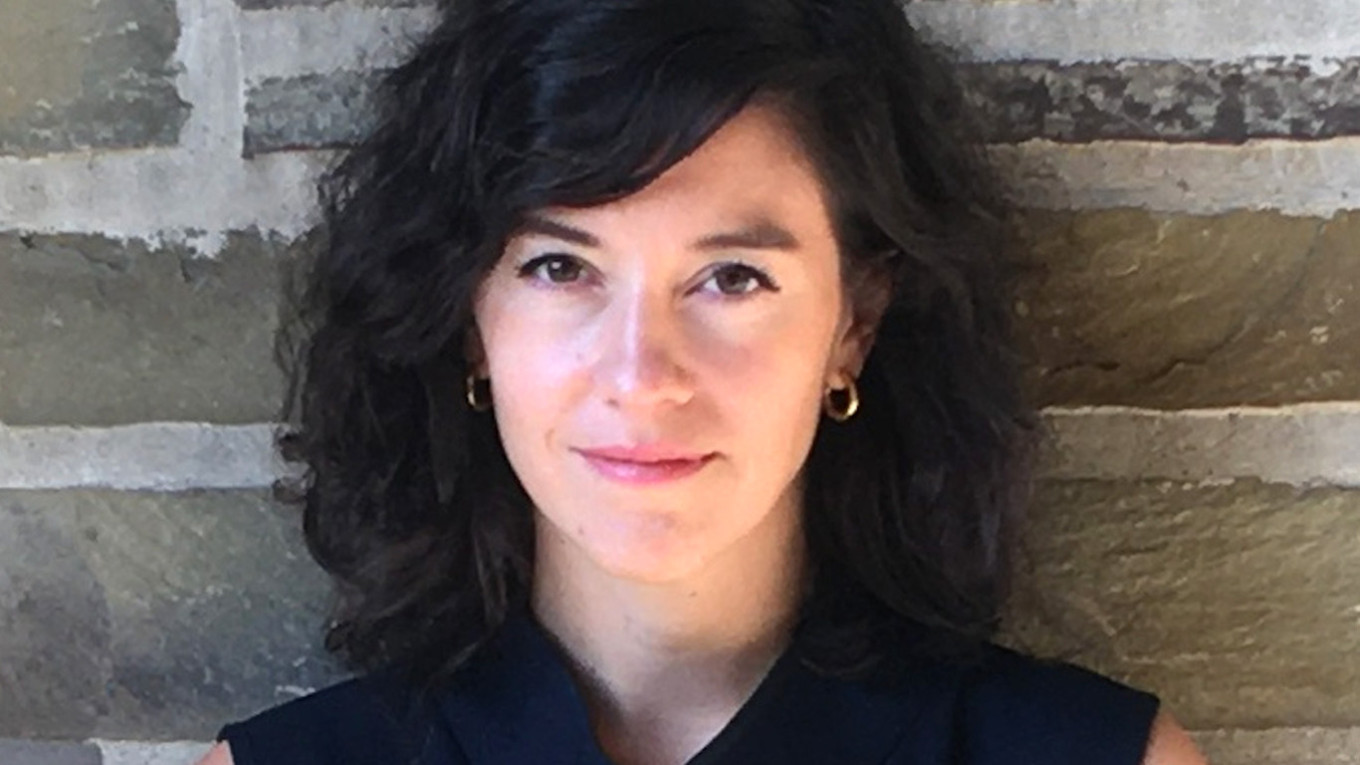
In “The Oak and the Larch: A Forest History of Russia and its Empires,” writer and historian Sophie Pinkham examines the forest’s place in Russian culture and its role in the country’s imperial development. The book has been shortlisted for the Pushkin House Book Prize, whose winner will be announced in London on Sept. 26.
Pinkham spoke to Pushkin House Book Prize founder Andrew Jack about the forest’s hold on the Russian imagination and its links to colonialism — and why environmental activism retains some room to operate under President Vladimir Putin.
PH: How did you become interested in Russia?
SP: I have no Russian background at all. My family is English and French, but I grew up in Manhattan among a lot of people who had immigrated as small children with their parents from the former Soviet Union. I became enchanted by Russian poetry and particularly Mayakovsky, so I started learning Russian on a whim when I was in college. I also had an interest in public health and after I graduated, I ended up on a volunteer exchange program in Irkutsk, where I spent a couple of months working at the Red Cross. The main medical issues were frostbite, HIV and other issues related to injecting drug use. That set off a very intense interest in Soviet and post-Soviet history, culture and public health. I ended up working in that field for several years, mainly focusing on Russia, Ukraine and Georgia. Then I wanted to really learn Russian fluently. I managed to get a Fulbright grant and lived in Ukraine for several years — so I learned a very Ukrainian-inflected Russian. I eventually did a Ph.D. in Slavic studies; my thesis was on the cult of Pushkin in the transition from communism, as a bridge that helped Russians maintain a sense of integral cultural identity amid the instability of the 1990s.
PH: What was the inspiration behind writing ‘The Oak and the Larch?’
SP: I'm always thinking about Russia, but also about climate change, which is an even bigger question that affects all of us. It struck me how little writing there is about Russia in relation to climate. A lot of especially foreign language writing about Russia is very intensely focused on Moscow and on great men — which is understandable, of course. But my interest has never stemmed from the metropolitan center. I've always been lurking, whether literally or metaphorically, on the peripheries of Russia. There are capacious and fascinating realms — geographically, historically and thematically — that are almost never covered in English-language writing. I kept coming back to Andrei Sinyavsky’s ‘Tenants,’ a short story which I first read in grad school. It’s about characters from Russian folklore who have been forced to flee from the forest and countryside and are now stuck in a communal apartment, with a supernatural twist on all the problems that arose in real kommunalki. One of the tenants is a leshii, a forest spirit. That story inspired me to explore the centrality of the forest in Russian culture. It’s so integral that it can be hard to notice, the way we don’t notice that the sky is blue unless it’s been grey for a long time. I realized how entwined that quiet forest backdrop was with many of the central threads of Russian history and culture, and the central questions about Russia’s evolving, conflicted conception of itself over the centuries.
PH: How would you summarize the key message of the book?
SP: The forest had an intensely ambivalent role in Russian history. On one hand, it was an essential source of fuel and building materials, of meat, of lucrative furs, of honey and berries, of refuge from invaders or persecution. Symbolically, it was the threshold to another world, one that promised both danger and fantastical rewards. It was the provider of so many things that were good and necessary for Russian life. The Soviet novelist Leonid Leonov wrote that the forest accompanied Russians along every step of their life, from providing the wood for their cradle to the cross above their grave. The forest shaped Russian life and Russian character; Leonov warned against deforestation, saying that Russia would not be itself without the woods. But the forest was also an enemy. To clear the forest to make a field for agriculture took backbreaking labor, and the forest was liable to creep back and overtake these once so-called civilized areas. In that sense, the forest could be a reminder of how quickly human advancement could be erased. More recently, there’s been discussion of ‘aggressive forests’ that are swallowing up Russia’s abandoned rural settlements. That ambivalence is essential to the Russian understanding of the forest.
PH: Do you see parallels with the U.S. view of forests?
SP: Certainly. Russia and North America have a lot of geographical and ecological similarities. The experiences of settler colonialism, of westward or eastern expansion and conflicts with indigenous peoples are in many ways comparable. In Russia today, as in the United States, some people cherish a fantasy of returning to the forest. Sometimes it’s about escaping from the state, no longer being a subject. But sometimes it is also about returning to an essential Russianness that is uncorrupted by urban life or globalization. In that iteration, it resembles eco-fascism or eco-nationalism. It’s especially curious when it happens in Siberia, which of course is a colonized place — but this is another parallel with the United States.
PH: Do you see other resonances with Putin’s Russia?
SP: As I understand, Putin doesn’t even go outside anymore — so although he used to be photographed riding horseback with no shirt or flying with the cranes, that that sort of outdoorsy, frontiersman iconography has receded. But I think it is quite central to a lot of conservative thinkers who are to the right of Putin himself. Someone like Zakhar Prilepin, the novelist turned warlord, makes much of the fact that he lives in the countryside, close to the forest; he styles himself as a warrior and also a frontiersman, renewing the colonial project in Ukraine. The Izborsky Club published a manifesto about the Russian ark and Russia as a place that guards conservative values. This concept can manifest as an urge to leave Moscow or St. Petersburg for the countryside, for traditional wooden architecture, for life among the fields and trees, in an effort to connect with previous generations. This is a long tradition in Russia — centuries ago, the Old Believers began to flee to the woods to protect their way of life. For Russian hermits, the forest was a crucial place of holy solitude — the Russian version of the Biblical desert.
PH: How did you carry out your research?
SP: I had spent quite a lot of time in Russia before the war. The full-scale invasion of Ukraine pushed me to do more of my research on the periphery, which was extremely productive. I spent time in Finnish Karelia with these wonderful wolf researchers who I encountered by chance. In Karelia, certain species only exist on the Russian side because there has been so much less exploitation of the forest, because of the far more chaotic nature of Russian forest management and of the size and scale of the forest. Russia’s chaos has a great cost, but it can sometimes have positive effects in relation to biodiversity. I also went on an amazing horseback riding expedition in northern Mongolia, trying to get as close as I could to the densely forested mountain where Genghis Khan was born; that forest, according to ‘The Secret History of the Mongols,’ was what saved him from being killed as a youth. The forest as a refuge from enemy invaders would end up becoming quite important to the Slavs when the Mongols were invading.
PH: What about the role of the environmental movement?
SP: Even now, when you can be arrested for holding a blank sign in Moscow, there still seems to be some space for environmental protests. Last winter there was a protest in Irkutsk against clear-cutting the protected forest on the edges of Lake Baikal, which is bad for the forest and also for the lake. That rally was part of a quite large-scale protest of scientists, environmental activists and ordinary people who were not afraid to complain in the press. Some politicians even voted against the law that would allow clear-cutting. I think that comes down to the fact that the forest, like Lake Baikal, is still seen as patrimony. So it’s not necessarily acting against the government to protest in favor of protecting these areas; it can be spun as a form of patriotism, in fact. Some of the last really successful protest movements in Russia were about ecological protection. Any type of protest in Russia now is dangerous, but there is a bit more space perhaps for ecological and forest-related protests.
PH: What is your next writing project?
SP: I have some smaller essays that I’m working on as I mull over my next book project. I’m getting more and more interested in Central Asia, partly as a result of this project — especially in the use of art and architecture as a kind of global currency. I’m curious about the yoking together of art and economic development and tourism. How do art and economics, how do beauty and freedom, relate to each other, and how do these projects relate to the past?
A Message from The Moscow Times:
Dear readers,
We are facing unprecedented challenges. Russia's Prosecutor General's Office has designated The Moscow Times as an "undesirable" organization, criminalizing our work and putting our staff at risk of prosecution. This follows our earlier unjust labeling as a "foreign agent."
These actions are direct attempts to silence independent journalism in Russia. The authorities claim our work "discredits the decisions of the Russian leadership." We see things differently: we strive to provide accurate, unbiased reporting on Russia.
We, the journalists of The Moscow Times, refuse to be silenced. But to continue our work, we need your help.
Your support, no matter how small, makes a world of difference. If you can, please support us monthly starting from just $2. It's quick to set up, and every contribution makes a significant impact.
By supporting The Moscow Times, you're defending open, independent journalism in the face of repression. Thank you for standing with us.

Remind me later.