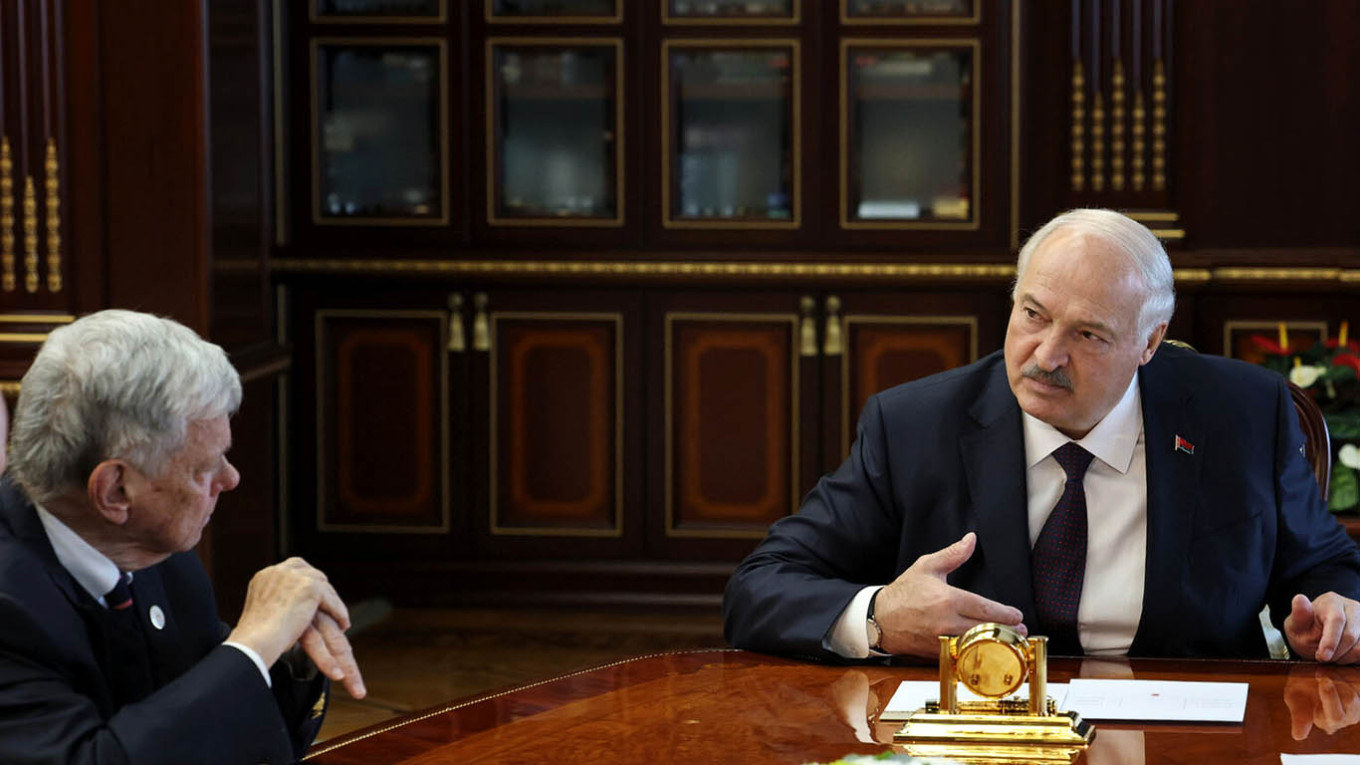
The White House is seeking the release of Belarusian funds that are frozen in U.S. banks, Trump’s special envoy to Belarus John Coale told President Alexander Lukashenko during a meeting in Minsk on Tuesday.
Lukashenko said last week that up to $44 million belonging to Belarus was “stuck at Citibank” and called for its return. He claimed the funds were payment for shipments of Belarusian potash, an ingredient used in fertilizers.
“Return the money! This is a disgrace for the United States. Then we will agree on more serious things,” state media quoted Lukashenko as saying in an interview.
On Tuesday, Coale said that Citibank must release the funds and promised the Belarusian president to resolve the issue.
Lukashenko told Coale, who has visited Minsk multiple times since being appointed special envoy, that his government remains open to discussing “any issues” with the United States on the condition that “we both strictly abide by our agreements.”
Belarus has sought to have U.S. sanctions lifted since Donald Trump returned to the White House last year. The Biden administration had introduced many of the sanctions in response to the 2020 election crackdown in Belarus and Russia’s full-scale invasion of Ukraine.
The U.S. has negotiated the release of hundreds of Belarusian political prisoners in exchange for sanctions relief since Coale initiated talks with Minsk last year. Tuesday marked Coale’s first visit to Belarus in six months.
At the latest meeting, which Belarusian state media said lasted around three hours, Coale told Lukashenko that Trump “fully supports everything we’re doing.”
Before traveling to Belarus, the American envoy met with Lithuanian Foreign Minister Kęstutis Budrys in Vilnius and freed Nobel laureate Ales Bialiatski in Washington to discuss regional security and ongoing prisoner releases.
Rights groups estimate that more than 900 political prisoners remain behind bars in Belarus, while UN experts reported Tuesday that “systematic” human rights violations exist across the country’s entire judicial process.
“Oh, for heaven’s sake, take them,” Lukashenko told reporters last week, expressing frustration that U.S.-Belarusian talks are “stuck” on the issue of releasing political prisoners.
Reuters contributed reporting.
A Message from The Moscow Times:
Dear readers,
We are facing unprecedented challenges. Russia's Prosecutor General's Office has designated The Moscow Times as an "undesirable" organization, criminalizing our work and putting our staff at risk of prosecution. This follows our earlier unjust labeling as a "foreign agent."
These actions are direct attempts to silence independent journalism in Russia. The authorities claim our work "discredits the decisions of the Russian leadership." We see things differently: we strive to provide accurate, unbiased reporting on Russia.
We, the journalists of The Moscow Times, refuse to be silenced. But to continue our work, we need your help.
Your support, no matter how small, makes a world of difference. If you can, please support us monthly starting from just $2. It's quick to set up, and every contribution makes a significant impact.
By supporting The Moscow Times, you're defending open, independent journalism in the face of repression. Thank you for standing with us.

Remind me later.