
We had a tradition at the Foreign Ministry. Whenever someone returned from another business trip, they would announce to their colleagues that they had scored “another grand victory for Russian diplomacy.” It was our way of poking fun at the many bosses who wanted to pass off every little move as a major achievement.
But this time, we can say it about the Abu Dhabi meeting without joking or being unduly modest. It really is a success.
The success has nothing to do with the meeting bringing peace any closer. Nothing of the damn sort. The success is that it gave Moscow reason to expect that the negotiations could turn into a discussion with the United States about dividing the world into spheres of influence. For years, Moscow has been trying to focus negotiations on the “root causes of the war,” meaning Vladimir Putin’s desire to dictate policy to neighboring states. That now looks like a real possibility. As the saying goes, the ice has broken, ladies and gentlemen of the jury.
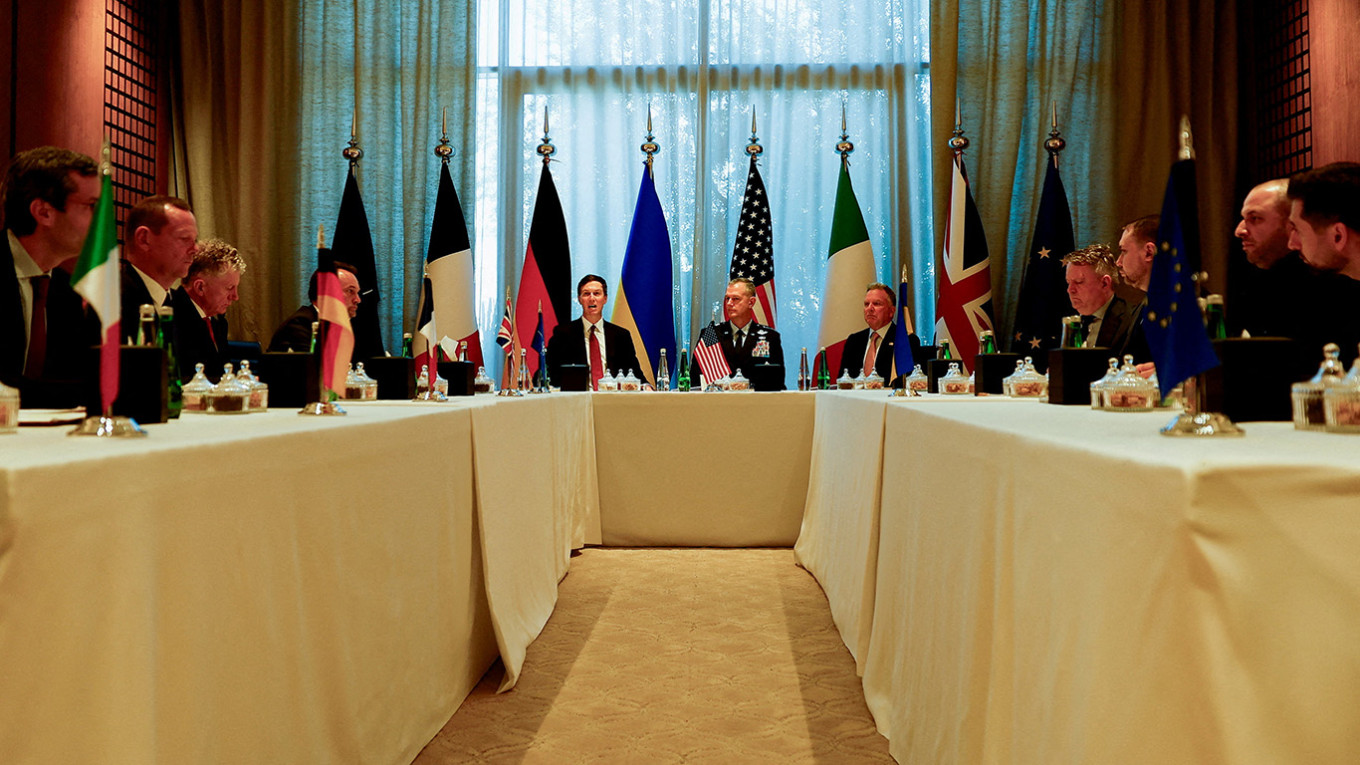
The setup of the meeting itself is curious. It was billed as trilateral, though in substance it was a bilateral meeting between Russia and Ukraine with the United States acting as mediator.
Yet the Russians, in effect, demanded that Ukraine be cut out of the discussion and that the Russian-Ukrainian dialogue with U.S. participation be replaced by a Russian-American dialogue on European security — without Europe and Ukraine.
Translated from Putin’s officialese, that means dividing the world into spheres of influence. Ukraine is in Europe, but no one intends to ask the Europeans what their future should be. Their fate is to be determined by Russia, which sees itself as Europe’s adversary, as well as the United States, which is geographically outside Europe as well. From Moscow’s point of view, that is an ideal arrangement.
The hapless American diplomats Steve Witkoff and Jared Kushner took this framing for granted without asking themselves what the U.S. position was. In doing so, they had effectively done away with Washington’s principles.
Trump initially portrayed this war as a strictly regional conflict. One country attacked another, so let them sort it out themselves.
Now the settlement is being recast as a reconsideration of the entire European security system and, with it, of the American commitments “from Vancouver to Vladivostok.” Continental Europe is only part of the question. The Americans have been led from their initial position of supporting Ukraine to its exact opposite. Ending the war is becoming a direct concern of their own security and foreign policy.
Russians have outplayed the Americans again. Though it hardly took much brains, as the Trump administration operates on the principle, “It’s easy to deceive me. I’m only too happy to be deceived.” It plays along with Russia in every way and may well sincerely believe this is the shortest route to the truce it seeks.
And this is hardly the first time Europe has backed down. In May 2025, for example, Ukraine and Europe threatened new sanctions unless Putin agreed to a 30-day general ceasefire. The Russian president did not respond to the demand at all and simply proposed holding talks in Istanbul. Ukraine was wary of the proposal, but its European partners refused to listen to Kyiv’s concerns and immediately supported the idea of talks. The threats, the ultimatums, and the very idea of a 30-day ceasefire were forgotten altogether. No ceasefire came of it, of course, but, as is customary these days, no one learned any lessons. Nor, by all appearances, did they intend to.
The problem, above all, is that Europeans and Americans are afraid to face the truth. The response to Russian aggression and threats should be a campaign to eliminate the threat itself. For the West, this means exertion, discomfort and the responsibility to inflict a strategic defeat on Russia that politicians so despise taking on.
Franklin Roosevelt’s words come to mind. “The only thing we have to fear is fear itself.” Today’s Western political class proceeds from the exact opposite premise. The only thing its members are unafraid of is showing their fear of aggression, of threats, of taking a firm and unyielding stance showing the will to pursue victory.
They are showing an almost pagan belief in the magic of words to talk this threat away. But there is far too little action.
Europe’s attempts to get a seat at the negotiating table in Abu Dhabi are a story of their own, bringing nothing but humiliation. European representatives were shut out, only able to sit in the anteroom and hold preliminary meetings with the Americans and Ukrainians.
What was the point of having them there? At a pinch, the Europeans could have announced that a joint Ukrainian-European delegation was going to the meeting. But then there would surely have been people in the European Union who would have been alarmed. “So we’re taking Ukraine’s side against Russia? We’re not at war. We want to be friends with Russia.”
Russia, naturally, would have showered everyone with accusations that the EU has openly sided with Ukraine. But such rhetoric would remain only words. After all, Russian representatives are constantly saying that they are fighting a war against NATO, against European hegemonists and imperialists. The Kremlin’s position has not changed.
Europe’s problem is that it attaches no importance at all to deeds. Europe talks a lot about rearmament, about the need to grow stronger and achieve strategic autonomy. But it does too little to make its words match reality. That does nothing for the credibility of European leaders’ statements, which Putin feels no inclination to take into account. We saw exactly that in Abu Dhabi.
If Europe really wants to be at the negotiating table, it needs a policy of its own that it will follow regardless of what others do. It needs to see its goal and pursue it despite the obstacles. Sooner or later, it will then become impossible to ignore. By its actions alone, it will force others to reckon with it. That is how grown-up politics works.
After the meeting, Russia stuck to its position and continues to wage war. It speaks quite openly about committing war crimes, about destroying civilian infrastructure, bridges and power generation capacity in Ukraine — and how it intends to keep doing so — prompting no serious action from the West
From the standpoint of serious diplomacy, the situation is surreal. The world’s strongest powers are doing everything they can to appease a decidedly middling power. They are incapable of decisive action or even clearly defining their own national interests and developing a consistent strategy to defend them.
There is no doubt that the great diplomats and political leaders of the past — Otto von Bismarck, Charles de Gaulle, Winston Churchill, Franklin Roosevelt, Ronald Reagan, and Margaret Thatcher — are spinning in their graves at a furious rate, ashamed of the current generation of Western politicos.
In their pursuit of immediate comfort, both the United States and Europe will lose both comfort and security. They could sacrifice some comfort for a time and make a major effort to defeat Putin, then restore and strengthen their positions and achieve a durable, lasting peace. But time and again, Western politicians choose present convenience at the cost of strategic defeat in the near future.
There exists a choice between standing up to threats and backing down. Nothing that comes next is predetermined. But the will to make that choice is evidently already gone in Europe and the United States
In August 1938, in the run-up to the Munich Conference, Churchill wrote to Lloyd George, “I think we shall have to choose in the next few weeks between war and shame, and I have very little doubt what the decision will be.”
To be honest, almost a century later, neither do I.

A Message from The Moscow Times:
Dear readers,
We are facing unprecedented challenges. Russia's Prosecutor General's Office has designated The Moscow Times as an "undesirable" organization, criminalizing our work and putting our staff at risk of prosecution. This follows our earlier unjust labeling as a "foreign agent."
These actions are direct attempts to silence independent journalism in Russia. The authorities claim our work "discredits the decisions of the Russian leadership." We see things differently: we strive to provide accurate, unbiased reporting on Russia.
We, the journalists of The Moscow Times, refuse to be silenced. But to continue our work, we need your help.
Your support, no matter how small, makes a world of difference. If you can, please support us monthly starting from just $2. It's quick to set up, and every contribution makes a significant impact.
By supporting The Moscow Times, you're defending open, independent journalism in the face of repression. Thank you for standing with us.

Remind me later.