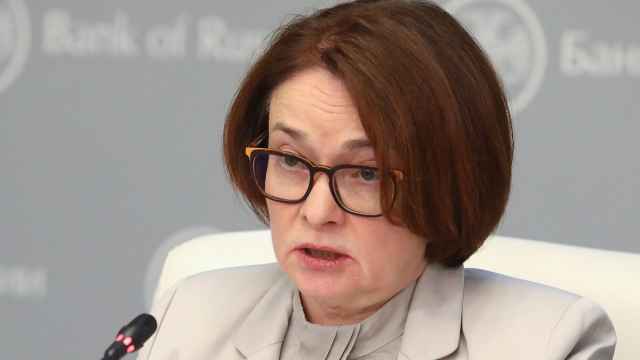
The Central Bank again cut its key interest rate by a symbolic quarter of a percentage point, to 14%, but warned that high rates will continue longer than planned. This creates problems not only for investors suffering from the stock market’s decline, but also for the Finance Ministry, which is frantically looking for money to cover the budget deficit and service expensive government debt.
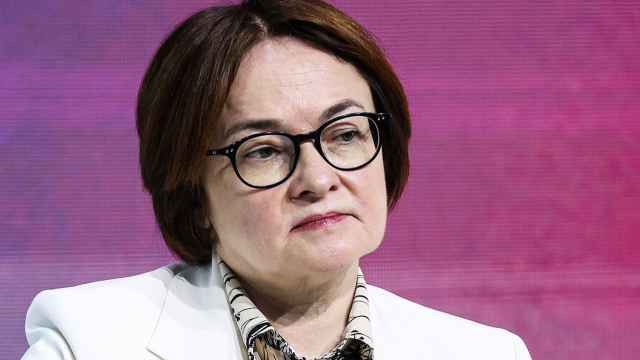
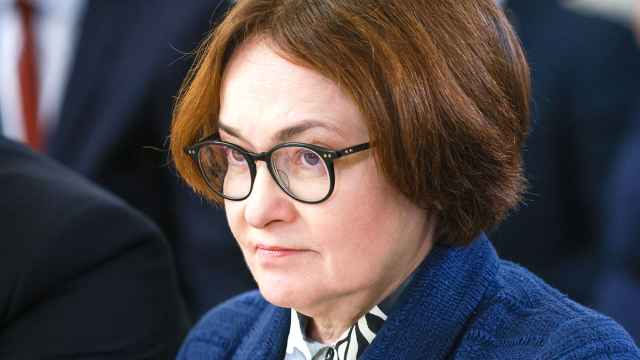
It was not hard to guess that this would happen. It is already obvious that Central Bank Governor Elvira Nabiullina’s superiors — probably President Vladimir Putin himself — ordered her to lower the rate. It was not difficult to work out that, with inflation rising again because of the fuel shortage, the Central Bank would, as it did last time, lower the rate symbolically and furrow its brows so that no one got too excited.
And that is exactly what happened.
In its press release, the Central Bank wrote that “pro-inflationary risks prevail” over the forecast horizon. It also expressed concern about uncertainty over the budget parameters. That’s a diplomatic way of referring to the uncontrolled growth in war spending. At the press conference after the meeting, Nabiullina was even more diplomatic: she called the rise in inflation temporary. But she warned that the budget deficit will be higher than planned: up to 8 trillion rubles ($99.9 billion) instead of 3.8 trillion ($47.7 billion). Though that equates to 3.6% of GDP, a budget deficit is considered manageable up to 4-5%.
But that is where the good news ends.
First, calculating the deficit — or anything else — from the size of projected GDP is a rather dubious exercise considering the conditions Russia is operating under. If budget parameters, as Nabiullina lamented, change more often and more sharply than before 2020, then the same can be said for GDP. Both depend on many factors Russia does not have complete control over.
First and foremost, there are oil prices. U.S. President Donald Trump helped Russia’s oil and gas revenues in the second quarter by staging his own “special military operation” against Iran, disrupting shipping through the Strait of Hormuz, while countries began buying large amounts of oil and LNG at exorbitant prices.
Second, the Ukrainian Armed Forces have launched a campaign against Russian refineries and logistics and are methodically turning Crimea into an island, making its supply ever more expensive and complicated.
The conflict with Iran will, one way or another, most likely end before the U.S. midterm elections, which could cause a sudden and lasting dip in oil prices. Yet revenue from oil companies remains a significant chunk of budget revenue. Meanwhile, the state will likely need to help repair damaged oil infrastructure before oil companies can even think about improving their air defenses. We all saw how well that was going when a missile fired by the valiant defenders of the Moscow refinery hit the refinery’s own tank and blew off its roof.
There are, of course, non-oil revenues, which make up an ever-larger share of the budget. But the problem is that they are no longer growing far enough, despite the government increasing the tax burden. For example, after Russia increased tax rates for higher earners, personal income tax revenues doubled. But that money came mostly from bank deposits that will be exhausted eventually, not a growing number of high-paid jobs. Alexander Shokhin, president of the Russian Union of Industrialists and Entrepreneurs as well as the business ombudsman, is warning that high interest rates could make businesses go bankrupt this fall. If companies start failing, who will be left to tax?
Small businesses will undoubtedly be the first to go under. Already struggling, they are now reeling from the attacks on Wildberries warehouses, destroying their wares and leaving customers empty-handed. But loans and tax debts aren’t going anywhere. When these businesses go bankrupt, the effects ripple down the supply chain. Once you remember that the Ukrainian Armed Forces have not promised to stop their attacks and that no one knows what they will knock out next, the planned tax-collection figures from the third quarter onward can already be kissed goodbye.
Even if the fall does not bring a perfect storm of falling oil prices and tax receipts — and it most likely will — the legal budget parameters are already unattainable. The Kremlin will have to shell out to deal with the consequences of Ukrainian strikes on Russian territory and Crimea. Something will have to be thrown to mollify affected businesses and the population. That’s before we even consider that some regions such as Kemerovo, are de facto bankrupt. Add the inevitable increase in war spending — and Putin confirmed this when saying goodbye to lawmakers — even if there is no mobilization after Russia’s State Duma elections, and things become rather worrying.
There’s a joke from the U.S.S.R. about a man who tells the inspector that he got his money from the nightstand. That’s where his wife put the money he gave her, only for him to take it out before she puts it back in again.
That’s what’s happening with the Russian economy today.
Finance Ministry is receiving less money than it is spending. Especially as military spending shows no sign of abating. Accordingly, the money it can seemingly conjure out of nowhere “nightstand” is shrinking. The Finance Ministry has three main sources of revenue: taxes, debt and currency devaluation. We’ve already covered the ticking time bomb of taxes. Additionally, devaluation is having little effect at the moment.
That leaves borrowing. The Finance Ministry has been doing exactly that: it gradually increased borrowing and last year reached a record of 7.2 trillion rubles ($90.5 billion), against a plan of 3.8 trillion ($47.7 billion). But high interest rates make servicing debt expensive. The cost reached 3.9 trillion rubles ($49 billion) this year, a figure that exceeds the entire planned budget deficit for 2026. In other words, the Finance Ministry now needs to borrow three times more than planned: both for the doubled budget deficit and for coupon payments — not counting repayment of the principal. And the cost of servicing debt will keep rising: the Central Bank began raising the key interest rate in summer 2023 to a peak of 21% in October 2024.
Though the key interest rate is falling, it is only doing so symbolically. But the market seems to have stopped believing the Central Bank and is demanding yields on new federal loan bonds above the key rate: 16.5-16.75% annually at the most recent auction.
I said “the most recent auction” for a reason: in July, the Finance Ministry canceled bond auctions indefinitely. The ministry says directly that it is not prepared to place government debt at such high rates. But where, then, will it get the money to service existing debt and cover the budget deficit? Let me remind you that, for the third quarter, the ministry planned to borrow 1.5 trillion rubles ($18.7 billion), but so far it has borrowed only 8.8 billion ($109.8 million).
Most importantly, where is the guarantee that banks will agree to buy the debt more cheaply?
A well-known economist, whom I have to keep anonymous because he’s still in Russia, told me that the Finance Ministry and banks can only continue their staring contest for about a month. In an extreme case, the government will strongarm the state-owned Sberbank and VTB to buy more bonds. But the banks themselves need money, which they can get from the Central Bank by pledging to it the federal loan bonds they have bought. The economist even says it’s canny for the Finance Ministry to pretend there is no money. This way, it can at least slightly slow the Kremlin’s and the military leadership’s ever-growing wish lists.
But that does not solve the issue. If suspicions that the Central Bank has lost its independence grow stronger, then banks will be increasingly reluctant to accept yields that are low relative to the risk of default. “I am afraid that a danger to the sustainability of government debt may arise,” another economist in Russia told me.
My first interlocutor believes that, for now, the Finance Ministry faces no risk of even a technical default. Needs can be covered by scraping together what remains in the National Wealth Fund and by dipping into Treasury balances, at times even delaying payments from them to public-sector workers and state companies. Judging by the fact that the Finance Ministry has recently been actively selling gold and diamonds, it is clearly determined to hold out to the end. Moreover, the banks have already begun to experience a liquidity shortage as customers withdraw their savings, so the calculation that the banks will blink first may well prove well-founded.
But the situation of falling revenues and rising expenses is unlikely to change if the war continues. My second interlocutor believes the Finance Ministry will hold out until the end of the year “through gritted teeth.” After that, however, government-debt sustainability will deteriorate and a full-blown crisis will be one or two years away.
In principle, this does not necessarily mean default. Given that government debt is mostly domestic, the authorities could opt for ruble devaluation, debt restructuring, or a total or partial freeze of bond payments. There are many options that don’t threaten the stability of the state financial system. But they would threaten the stability of the banks, which are already suffering from worsening economic conditions: corporate and consumer debts are rising, and arrears are growing. If — or rather, when — bankruptcies begin among small businesses, developers and then further down the chain, the banks will have a very hard time.
Citizens will have it even worse because they are the ones who will pay for everything in the end.
A Message from The Moscow Times:
Dear readers,
We are facing unprecedented challenges. Russia's Prosecutor General's Office has designated The Moscow Times as an "undesirable" organization, criminalizing our work and putting our staff at risk of prosecution. This follows our earlier unjust labeling as a "foreign agent."
These actions are direct attempts to silence independent journalism in Russia. The authorities claim our work "discredits the decisions of the Russian leadership." We see things differently: we strive to provide accurate, unbiased reporting on Russia.
We, the journalists of The Moscow Times, refuse to be silenced. But to continue our work, we need your help.
Your support, no matter how small, makes a world of difference. If you can, please support us monthly starting from just $2. It's quick to set up, and every contribution makes a significant impact.
By supporting The Moscow Times, you're defending open, independent journalism in the face of repression. Thank you for standing with us.

Remind me later.