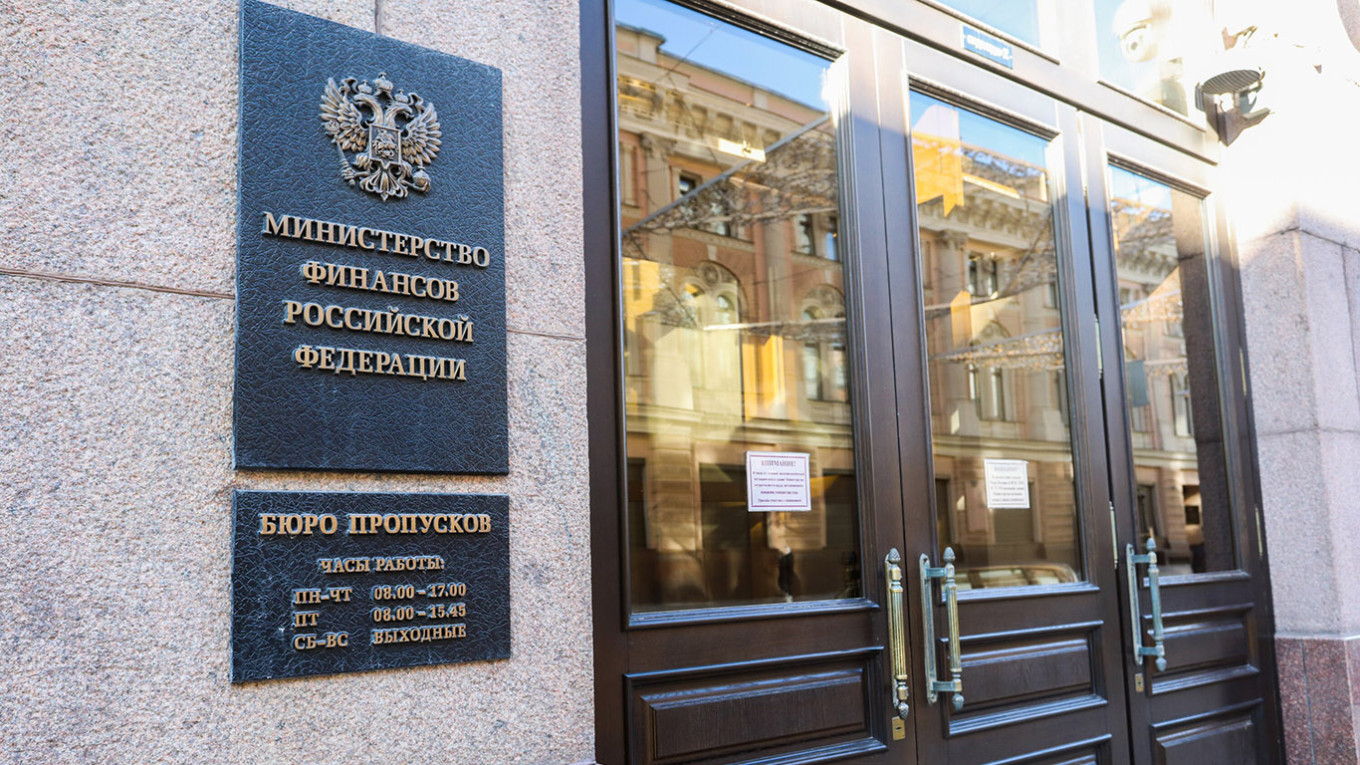
Russia's Finance Ministry has suspended federal government bond auctions indefinitely as borrowing costs climb and investor demand weakens, complicating efforts to finance a widening wartime budget deficit.
The ministry said on Monday it was halting its regular weekly auctions of government bonds, known as OFZs, "to facilitate the stabilization of market conditions." It did not say when sales would resume, saying only that it would announce their restart at a later date.
OFZs are ruble-denominated government bonds that underpin Russia's financial system. They are the government's primary source of domestic borrowing to cover budget deficits, while banks hold them to manage daily cash needs and foreign investors buy them for returns.
The Finance Ministry has relied heavily on domestic borrowing to help finance a budget deficit that reached 5.7 trillion rubles ($72.39 billion) at the end of June, while military spending continues to outpace initial government plans.
Prices of OFZs have fallen sharply since mid-June. The RGBI government bond index has dropped from around 119 points to about 110, its lowest level this year, while yields on bonds with maturities longer than 10 years have climbed above 16.5%.
The ministry's last four scheduled auctions were either canceled or attracted little demand. It canceled the June 24 auction, sold only 10.3 billion rubles ($130.81 million) of a planned 110 billion rubles ($1.40 billion) on July 1, canceled another auction on July 8 and, on July 15, scrapped the sale after receiving no bids at what it considered acceptable prices.
The Finance Ministry had planned to raise 1.5 trillion rubles ($19.05 billion) on the domestic debt market during the third quarter. So far, however, it has borrowed just 8.8 billion rubles ($111.76 million) in net proceeds during the quarter, according to Vector Capital analysts.
Analysts said the main factors weighing on Russian government bonds were rising inflation and expectations that the Central Bank may pause its cycle of interest rate cuts.
Nikolai Leonenkov, director of corporate finance at investment company Rikom-Trust, said inflation and expectations for monetary policy had been the main drivers behind the bond market's decline.
Investors are also concerned that a larger federal budget deficit could require increased government borrowing and additional bond issuance, said Pavel Payevsky, head of credit analysis and macroeconomics at asset manager RSHB Asset Management.
According to Bloomberg, the Finance Ministry plans to raise an additional 2-3 trillion rubles ($25.40 billion-$38.10 billion) in debt this year to help cover military spending that is expected to exceed budget plans by 4-5 trillion rubles ($50.80 billion-$63.50 billion). The rest would come from cuts to civilian spending, Bloomberg reported, citing people familiar with the matter.
Alexander Kolyandr, a senior fellow at the Center for European Policy Analysis (CEPA), said the ministry was unwilling to borrow at current market rates.
"Yields have jumped. In other words, the interest rate at which banks are willing to lend to the government has risen to around 16% for 10-year debt. That's a lot," Kolyandr said. "It's a very high yield, a very high interest rate. The Finance Ministry is clearly reluctant to borrow at that rate."
Read this article in Russian at The Moscow Times' Russian service.
A Message from The Moscow Times:
Dear readers,
We are facing unprecedented challenges. Russia's Prosecutor General's Office has designated The Moscow Times as an "undesirable" organization, criminalizing our work and putting our staff at risk of prosecution. This follows our earlier unjust labeling as a "foreign agent."
These actions are direct attempts to silence independent journalism in Russia. The authorities claim our work "discredits the decisions of the Russian leadership." We see things differently: we strive to provide accurate, unbiased reporting on Russia.
We, the journalists of The Moscow Times, refuse to be silenced. But to continue our work, we need your help.
Your support, no matter how small, makes a world of difference. If you can, please support us monthly starting from just $2. It's quick to set up, and every contribution makes a significant impact.
By supporting The Moscow Times, you're defending open, independent journalism in the face of repression. Thank you for standing with us.

Remind me later.