
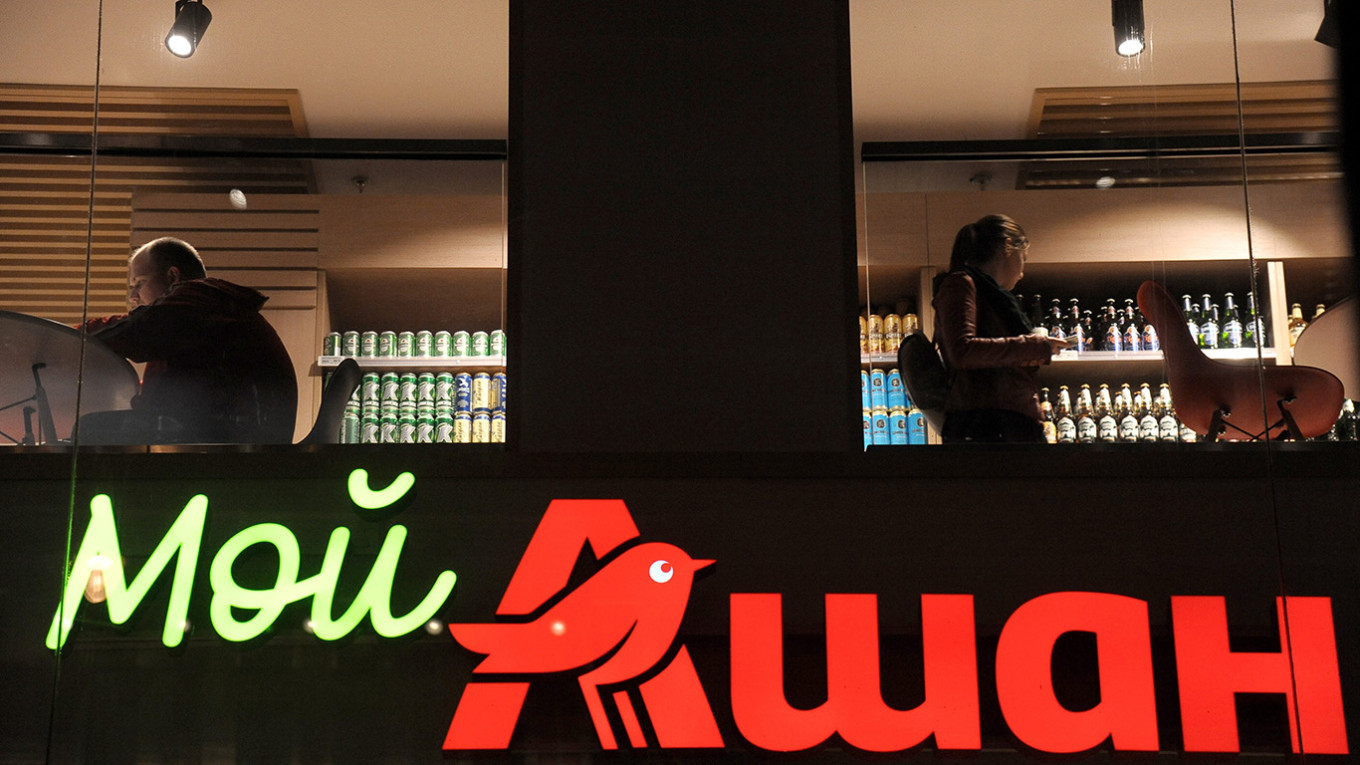
Two more Western giants have fallen to the Kremlin. The Russian government has placed Switzerland’s Nestlé and France’s Auchan under temporary administration, a move that strips the companies of their previous management and threatens to end in confiscation or nationalization.
These two firms were the most prominent amid a week-long, Kremlin-driven haul that included the former Leroy Merlin, a French home improvement chain already under new ownership; two French logistics companies and a United States healthcare packaging firm.
The sweeping reallocation of assets in Russia — a regular feature of the country’s ruthless domestic politics, but a less frequent piece of geopolitical vandalism — is proceeding at a brisk pace. For anyone who might have momentarily forgotten, business and geopolitics are inseparable in Russia, not to mention everywhere else in the world these days.
The Auchan and Nestlé cases stand out for at least two reasons. Russia hasn’t seized consumer-facing Western companies of this profile and magnitude since its 2023 attack on Denmark’s Carlsberg and France’s Danone. Britain’s Unilever plc once had four factories in Russia and a firm grip on the country’s supermarket shelves, but sold up in 2024. Alexei Sagal’s Arnest, already owner of several departed Western brands, bought the company as it emerged from the Russian government’s punitive exit process.
But these two cases stand out for more than their size and their prominence. Nestlé and Auchan were companies that chose to stay in Russia following the full-scale invasion of Ukraine. Usually, the Kremlin makes predatory moves on Western companies as they head for the exits. (More recently, the Russian government has also started talking about punishing so-called bad leavers, should they ever want to return to Russia.)
Auchan and Nestlé’s Russian operations resisted Western pressure campaigns to leave and bucked the exodus of hundreds of international companies. Nestlé reduced its product assortment and investment program in Russia in common with other companies that decided to stay, but were wary of being seen as engaging too energetically with the market of a military aggressor.
We will never know precisely why the Kremlin targeted Auchan and Nestlé — as ever in Russia, theories abound — but the move is a harsh reminder of how voracious and predatory the Russian state has become. Kremlin spokesman Dmitry Peskov said that both companies were from “unfriendly countries,” the label Russia gives to states that support Ukraine or sanction Russia. The German cash-and-carry chain Metro seemed to be operating relatively untouched — until it was nationalized shortly before this article's publication.
Did Auchan and Nestlé hope to avoid their fate because they chose to remain in the country? Did their ongoing presence in Russia buy them any favor with the Kremlin? Companies that stayed in Russia were seen as better corporate citizens than the companies that left. Staying in Russia was supposed to be more politically palatable for Moscow, even if it prompted widespread condemnation outside of Russia. Putin has on several occasions made public statements suggesting that for Western companies, staying was the right decision. “They have made an independent and responsible choice. And, of course, we respect that choice and will treat our partners with respect,” he said at the 2025 St. Petersburg International Economic Forum.
From the moment they first set foot in the country decades ago, Western companies made a series of assumptions about Russia that failed to hold up. Putting any weight on Putin’s statements and assuming there was a spoken or unspoken rule covering companies that stayed in Russia would be a mistake. There are no rules in autocracies; there is only the will of the autocrat. The sanctity of private property, perhaps even the very concept of private property, does not exist in today’s Russia.
This is not to blame the victim. No company took the decision to remain in Russia lightly. Leaving was expensive, even for the companies that left early and quickly, before Russia tightened the screws on the exit process. Some Western companies stayed in Russia because, on balance, it was the less painful option. Others were reluctant to leave because they knew it might mean surrendering their businesses to local owners at a massive discount.
The primary reputational concern for international companies still in Russia is paying taxes that will help fund the war. Some companies justified their decision to stay by explaining that their products (household and consumer goods, for example) were not of a strategic nature or had no military application. In a 2024 interview with the Financial Times, snack giant Mondelez’s CEO Dirk Van de Put said investors don’t “morally care” if companies stay in Russia and that Mondelez never faced shareholder pressure to leave.
Remaining in the world’s most sanctioned country has not been easy. Foreign and domestic companies were forced to perform gravity-defying financial and legal gymnastics to avoid sanctions and the damage they inflicted on supply chains, banking facilities and an entire array of operational arrangements.
But those were external pressures. How companies read domestic dynamics is perhaps the central question behind Auchan and Nestlé’s fates. In any case, if it matters, Nestlé’s activities in Russia were reportedly around one percent of its global turnover. Auchan’s presence in Russia is huge. It represents a large, but reportedly shrinking, chunk of the company’s global revenue.
Seizing Aptar, the American company, almost makes its own sort of perverse sense; the geopolitical trigger is easier to spot. President Trump has a freshly passed anti-Russian bill from Congress waiting for his signature. Among other things, that bill would allow the U.S., in theory at least, to punish some of Russia’s largest energy customers. Aptar, a specialist packaging company, is now under the administration of Health and Nature, the same company that took over Danone in 2023.
This is where things get interesting. Auchan and Nestlé are now under the administration of a company called L.E.V. Management. According to Russian media reports, L.E.V. Management is a shell company led by a former senior Interior Ministry official. That official’s wife, also according to Russian media reports, worked for companies associated with some of Russia’s wealthiest businessmen, allegedly as part of a network that leads to a childhood friend of Putin.
The Russian president has used the temporary administration mechanism several times; it packs a variety of benefits for how he governs.
If a foreign company is transferred to Russian private ownership, Putin has woven another stitch in a dense fabric of selective favors and favoritism. Perhaps he seized Nestlé and Auchan because someone in the Russian elite needed a new toy. On the other hand, if foreign companies — or Russian companies — are passed into state ownership, they become a badly needed source of revenue for the government.
The French and Swiss governments have protested the moves and are offering Auchan and Nestle assistance. Formal diplomatic contact between Russia and Europe is at a bare minimum; support short of calling in Russian ambassadors is being offered.
The companies, too, are seeking clarification from the Russian government. Various national and multilateral chambers of commerce remain active in Russia and they will be working overtime to mop up in the aftermath of these seizures and will redouble their lobbying efforts to reassure their member companies.
U.S. President Donald Trump sees Russia as a vast business opportunity for American companies. His two envoys to Russia, property developer Steve Witkoff and private equity executive (and son-in-law) Jared Kushner, spend more time talking about commercial prospects — some of which border on the absurd — than about the war against Ukraine. Russia’s lead contact with Washington, Kirill Dmitriev, is only too happy to indulge the Americans’ interest in such business deals.
The White House labors under the false impression that good business can deliver better politics. That equation has never delivered in Russia. If they haven’t already, Western companies still in Russia would be wise to abandon the same assumption.
A Message from The Moscow Times:
Dear readers,
We are facing unprecedented challenges. Russia's Prosecutor General's Office has designated The Moscow Times as an "undesirable" organization, criminalizing our work and putting our staff at risk of prosecution. This follows our earlier unjust labeling as a "foreign agent."
These actions are direct attempts to silence independent journalism in Russia. The authorities claim our work "discredits the decisions of the Russian leadership." We see things differently: we strive to provide accurate, unbiased reporting on Russia.
We, the journalists of The Moscow Times, refuse to be silenced. But to continue our work, we need your help.
Your support, no matter how small, makes a world of difference. If you can, please support us monthly starting from just $2. It's quick to set up, and every contribution makes a significant impact.
By supporting The Moscow Times, you're defending open, independent journalism in the face of repression. Thank you for standing with us.

Remind me later.