
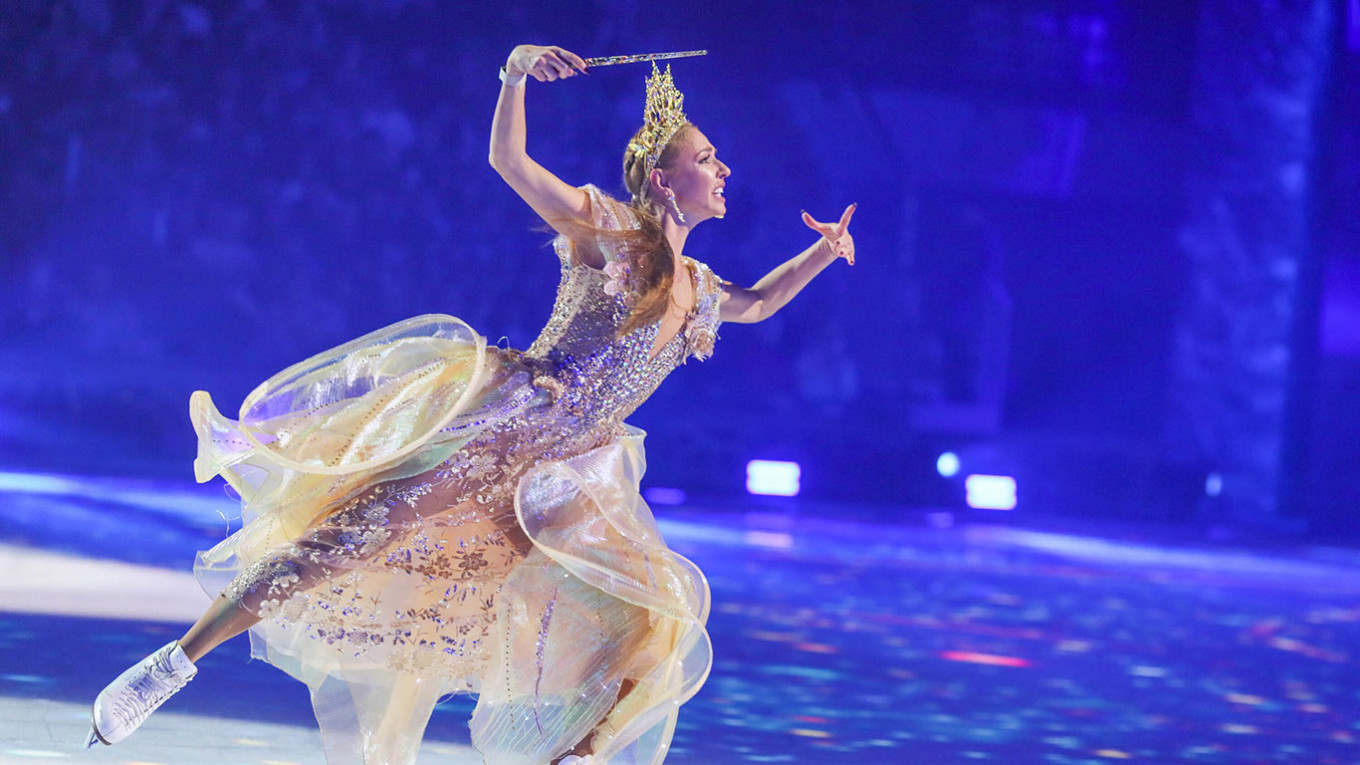
Tatiana Navka, the wife of Russian President Vladimir Putin's spokesman Dmitry Peskov, has launched a legal challenge aimed at overturning European Union sanctions imposed on her over the war in Ukraine, according to details published on an EU website.
Navka, a former Olympic ice-skating champion, was put on a sanctions list by the EU in June 2022 that targeted people over Moscow's invasion of Ukraine. Peskov's daughter Elizaveta and son Nikolai were included on the same list.
Brussels said at the time that the sanctions, which included a travel ban to the EU and financial restrictions, were imposed "in respect of actions undermining or threatening the territorial integrity, sovereignty and independence of Ukraine."
Details published on the EU's EUR-Lex website showed that Navka, who was born in Soviet Ukraine but is a Russian citizen, is now seeking to overturn the sanctions on her through the European Court of Justice.
The legal filing said she was arguing that the reason for the restrictions on her had not been properly set out, that errors of law and factual assessment had been made and that the EU had failed to prove a sufficient link between her and the stated aim of its sanctions.
Navka is seeking damages from the Council of the European Union for material damage and for damage to her reputation and other non-material damage totaling just over 2 million euros ($2.3 million), the same document showed.
Another official EU database shows that Yekaterina Ignatova, wife of Sergei Chemezov, head of the state-owned Rostec defense and industrial corporation, is seeking to overturn EU sanctions on her through the same legal route.
A Message from The Moscow Times:
Dear readers,
We are facing unprecedented challenges. Russia's Prosecutor General's Office has designated The Moscow Times as an "undesirable" organization, criminalizing our work and putting our staff at risk of prosecution. This follows our earlier unjust labeling as a "foreign agent."
These actions are direct attempts to silence independent journalism in Russia. The authorities claim our work "discredits the decisions of the Russian leadership." We see things differently: we strive to provide accurate, unbiased reporting on Russia.
We, the journalists of The Moscow Times, refuse to be silenced. But to continue our work, we need your help.
Your support, no matter how small, makes a world of difference. If you can, please support us monthly starting from just $2. It's quick to set up, and every contribution makes a significant impact.
By supporting The Moscow Times, you're defending open, independent journalism in the face of repression. Thank you for standing with us.

Remind me later.