
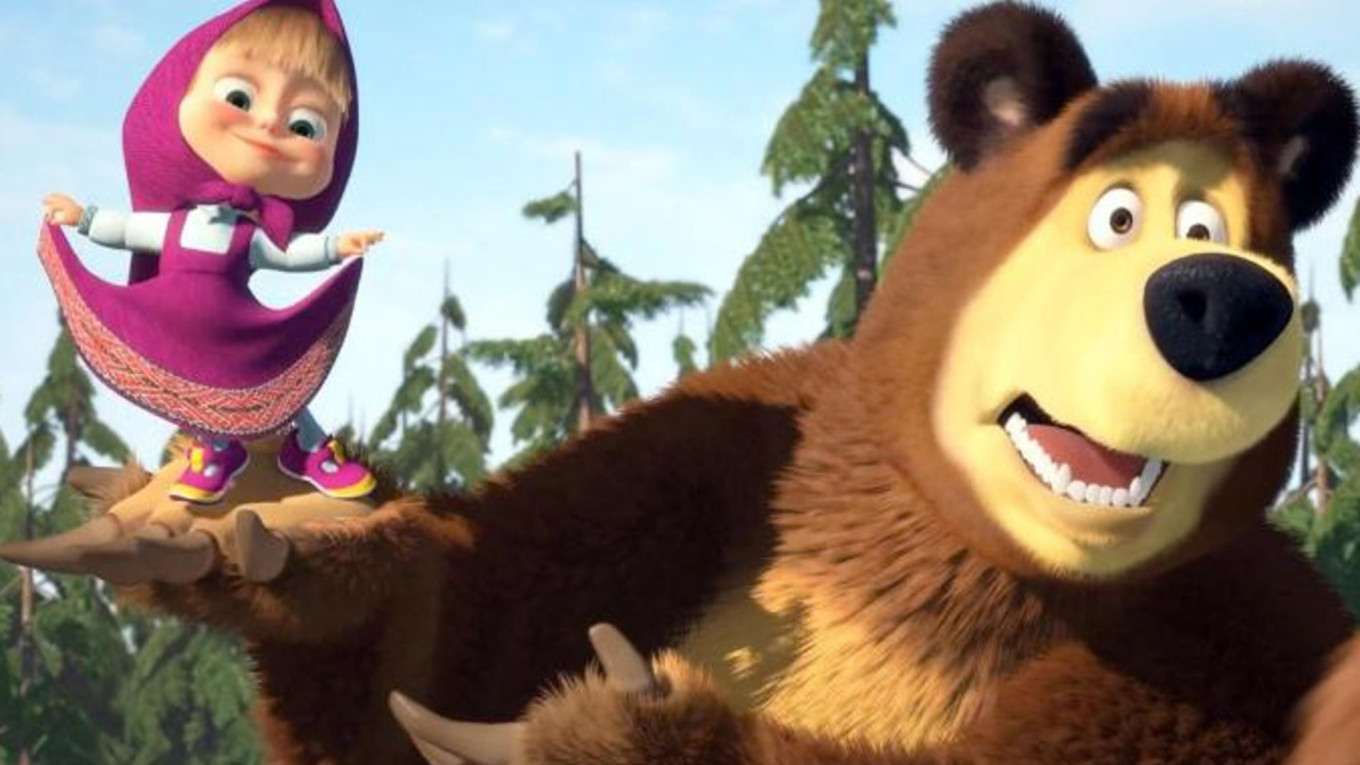
A specter is haunting the West: the specter of a cartoon bear and no-less-cartoon hyperactive little girl.
You might be tempted to click away from a piece that unironically analyzes the “Masha and the Bear” scandal while so many matters of life and death are happening in the world. But bear with me here.
The scandal encapsulates several important trends. On its surface, it is an all-around idiot plot about a silly cartoon and sillier British politicians. But on deeper examination, it showcases how different perceptions of soft power and culture shape European politics and what Europeans might be allowed to watch.
Let’s briefly look at the timeline. Early last month, Netflix acquired streaming rights for two new seasons of “Masha and the Bear,” the popular preschool animated show based on a Russian folk tale. The series has over 100 billion views on YouTube and has been a hit with children all around the world, including in the Middle East and Indonesia in part because the titular character covers her hair. In 2024, it was the second most popular show for preschoolers in the world, trailing only SpongeBob.
Taking this popularity into account it is unsurprising that Netflix streamed the show about an unruly girl pulling pranks on the bewildered bear for a decade before the latest controversy.
The news was picked up by Ukrainian state-funded platforms the Center for Countering Disinformation (CCD) and United24, which accused the U.S. streaming giant of platforming Russian propaganda. The show’s missteps include: Masha once and briefly wearing a Soviet Border Guard cap and a generic tanker’s hat; the duo being chummy with a panda (no doubt, a stand-in for Communist China); and, worst of all, Masha being annoying.
“The main character constantly misbehaves, damages property, ignores refusals, and causes suffering to others, yet receives encouragement instead of consequences or lessons,” as United24 put it.
Above all, the problem with the show seems to be that it is promoting Russia by virtue of being Russian.
As an aside, the original folktale is somewhat dark, although it is in no way as twisted as the original Grimm's fairytales. The lost little girl Masha survives her encounter with a talking bear by tricking the beast into carrying her in a basket all the way back to her village, while the bear thinks he is carrying goods for Masha’s grandparents. One could probably see insidious semiotics here as well: the hidden girl is like a hidden Kremlin narrative being packaged inside of the basket of a preschool cartoon.
Anyway, soon after the Ukrainian media reports, Estonia’s Foreign Minister Margus Tsahkna amplified the message, saying the show is “part of the Kremlin's soft power, embedding pro-Kremlin and militaristic messaging in children's entertainment while normalizing Russia's aggression and imperial ambitions.” The Toronto-based Ukrainian World Congress called for the show’s cancelation, providing a handy “cancelation guide” encouraging Ukrainians all over the world to lend ammo for the culture war.
This was then seized on by over 50 British MPs, led by Liberal Democrat Tom Gordon. In an open letter to Culture Secretary Lisa Nandy, the group demanded that the show be pulled from the air, specifically from ITVX, which receives some public funds.
When British expert Mark Galeotti ridiculed the idea of British politicians getting worked up about a preschool cartoon in a piece in The Spectator, he was met by an online mob.
The unanimity of the anti-Masha campaign is striking, whether they come from anonymous online accounts or serious experts. Their crux seems to be that Galeotti had committed the cardinal sin of marrying a “Russian wife,” with little regard for the fact that she is the author of several well-regarded books about Russia’s security state. How does this square with the Kremlin banning Galeotti from the country in 2022? I am not sure the righteous critics can recall this ancient history.
As Putin’s missiles devastate Ukraine, don’t we have better things to do than argue about a cartoon bear?
As you can see, some believe that the cartoon bear warrants our attention after all.
This illustrates a vastly different approach to soft power than even during the Cold War. Back then, the West liked to see itself as broadly liberal and open toward culture from all over the world. There are, of course, plenty of McCarthyist caveats here. But Soviet films were shown in the United States, and some even won Academy Awards. Notable among them was the 1969 adaptation of “War and Peace,” a mammoth glorification of Russian culture made by Sergei Bondarchuk, a pillar of the Soviet cinematic establishment and a sworn enemy of the more countercultural Andrei Tarkovsky.
The logic was that the free world possessed a cultural hegemony so powerful it wouldn’t be shaken by Soviet cultural exports. The West could accept communist culture because it could always offer better, shinier alternatives.
The Soviets took a strikingly different position, aiming to regulate culture in all its forms. A popular slogan from those days was: “Today he is playing jazz, tomorrow he will sell the motherland!" It rhymes in Russian. After the collapse of the U.S.S.R., the idea that culture should be regulated by the state didn’t go away.
To anyone who lived in the former U.S.S.R., the “Masha and the Bear” scandal might elicit strong deja vu. The notion that a kids’ cartoon harms “our values” and should therefore be banned is exactly what Russian officials have been saying forever — about shows like “My Little Pony” or “Peppa Pig” or even “Masha and the Bear” itself.
Yes, the show that critics say is spreading Russian soft power once received a sharp rebuke in Russia for not upholding Russian traditional values.
Note here that when activists or officials try to cancel media via the tools of the state, they never stop at just words. A 2025 “My Little Pony” convention was dispersed by police and some attendees were detained.
In trying to cancel “Masha and the Bear,” some influencers and politicians seem to be bringing the old Komsomol tactics to the West. They want to use the state apparatus to transform and control culture.
But what if they have a good reason for it?
The various Soviet hats Masha briefly wears and the Soviet songs she occasionally misremembers are callbacks reserved for the parents watching the show with their kids. Today’s youngsters are certain to miss them.
Still, some, like Estonia’s foreign minister, have asked — but what if Masha were wearing a Nazi hat? Wouldn’t it be bad then?
Yes, it would. So it’s a good thing she isn’t wearing one, then!
No matter how we feel about Soviet symbols — and some in Tallinn and Kyiv understandably would like to see them equated with those of the Nazi regime — for millions of people these songs and hats inspire nothing but vague warm nostalgia. Whether this is good or bad is rather irrelevant here: what is clear is that the creators of the cartoon did not mean to glorify Stalinist purges by having Masha wear the hat in one episode.
The headwear discourse feels especially nonsensical in the context of the other giant preschool show – “Paw Patrol” – being a bold-faced endorsement of American policemen. Are we going to see them taken off the air, too? The notion that Masha should be canceled for being a bad role model is similarly ridiculous: she hasn’t gotten up to half of the stuff Tom and Jerry commit in a single episode.
It is particularly worth noticing how United24 discusses Chinese connections in the show, pointing to Masha’s panda friend and a railcar with a Moscow-Beijing sign on the side as if it were self-evidently a reflection of the Kremlin’s foreign policy. The message seems to be that any mention of China is an attack on children’s fragile minds. Someone needs to let DreamWorks know that “Kung Fu Panda” is next on the chopping block.
What is somewhat fishy is the production company Animaccord’s murky relationship with the Russian state. The bear-hunters argue that Animaccord pays taxes in Russia, to which the studio responds that they are entirely Cyprus-based as of 2025.
In any case, there are things which contribute far more to Putin’s war machine — like the 7.2 billion euros ($8.2 billion) the EU spent on Russian liquefied natural gas in 2025.
The one solid argument the anti-bear movement makes is that the show does actually promote Russian culture. There are no two ways about it, regardless of how much Animaccord tries to rebrand as a Cyprus-based studio. The show is peppered with all things Russian: kokoshniks, bears, balalaikas, borscht … the list goes on.
Does the West have a moral right to consume a distinctly Russian show at a time when Putin’s forces slaughter Ukrainians under the auspices of expanding or defending the “Russian World”? Perhaps not.
But perhaps Western cultural dominance is not yet so weak that it requires rattled politicians to defend it. After all, 18 million Ukrainians have no problem watching the cartoon while repelling a Russian invasion — the show’s Ukrainian-language YouTube channel is still one of the most popular in the country by miles.
Maybe Western audiences should also be able to have the final vote on what content they want to consume — even if that content has Russians in it.
A Message from The Moscow Times:
Dear readers,
We are facing unprecedented challenges. Russia's Prosecutor General's Office has designated The Moscow Times as an "undesirable" organization, criminalizing our work and putting our staff at risk of prosecution. This follows our earlier unjust labeling as a "foreign agent."
These actions are direct attempts to silence independent journalism in Russia. The authorities claim our work "discredits the decisions of the Russian leadership." We see things differently: we strive to provide accurate, unbiased reporting on Russia.
We, the journalists of The Moscow Times, refuse to be silenced. But to continue our work, we need your help.
Your support, no matter how small, makes a world of difference. If you can, please support us monthly starting from just $2. It's quick to set up, and every contribution makes a significant impact.
By supporting The Moscow Times, you're defending open, independent journalism in the face of repression. Thank you for standing with us.

Remind me later.