
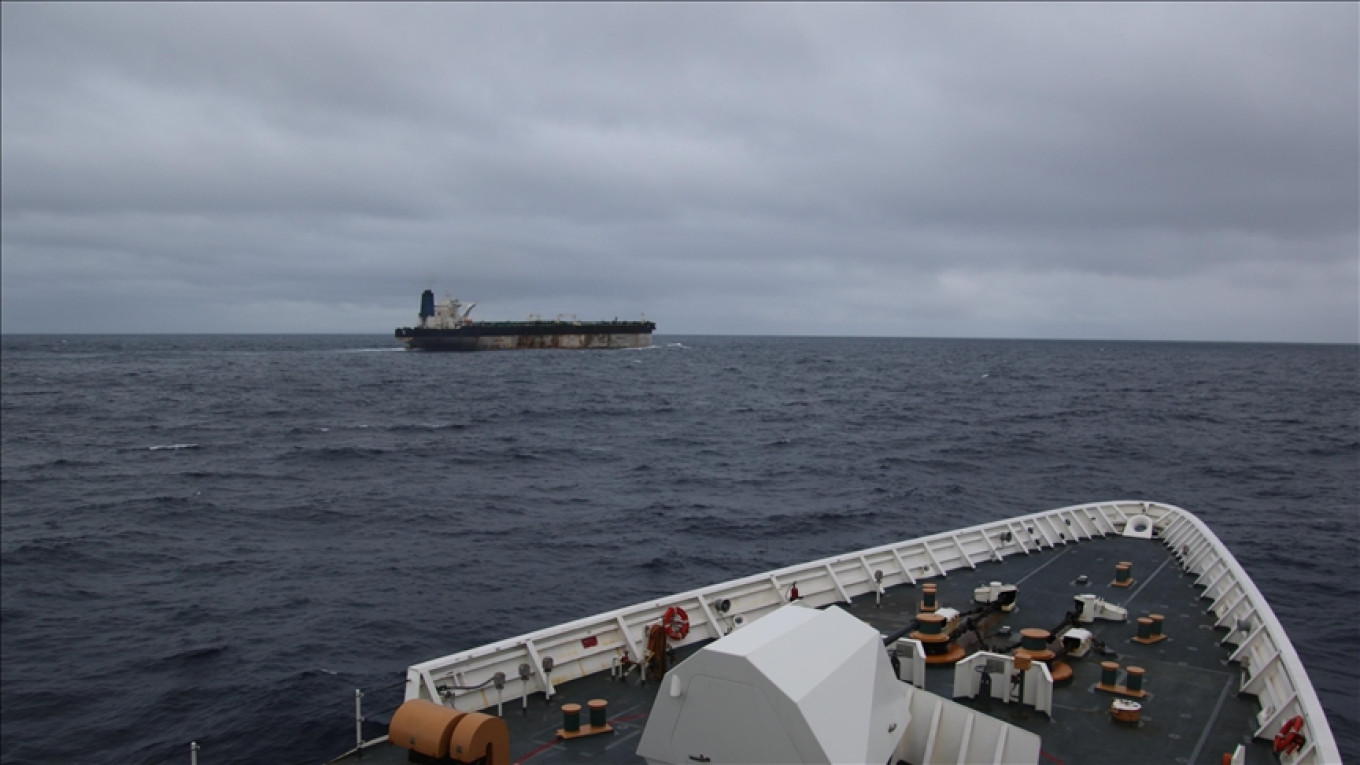
U.S. officials said that they had seized a massive Russian-flagged tanker linked to sanctioned Venezuelan oil in the North Atlantic on Wednesday, a move that risks inflaming tensions between the two countries.
The ship, formerly known as the Bella 1 and now operating under the name Marinera, had been fleeing from the U.S. Coast Guard for more than two weeks after evading capture near Venezuela.
Russian naval forces had been on their way to escort the tanker when it was captured by U.S. forces Wednesday.
The incident marks a rare open confrontation between Washington and Moscow in the second Trump presidency as the U.S. leader pushes for an end to Russia’s war on Ukraine.
Here’s what we know:
What happened?
The U.S. imposed a naval blockade on Venezuela in December as it sought to tighten the screws on President Nicolás Maduro’s regime before his surprise capture on Saturday. The order to prevent the travel of all sanctioned vessels going into or out of Venezuelan ports marked a steep escalation and threatened the country’s vital oil trade.
On Dec. 20, the U.S. Coast Guard attempted to stop the Bella 1 for not flying a valid national flag. The same ship had been sanctioned in July 2024 for allegedly transporting oil and generating funds for Hezbollah, and it had departed from Iran.
The ship did not allow authorities to board and fled into international waters in the direction of Europe.
For two weeks the Coast Guard pursued it, even as an elite team of U.S. military special operatives executed a mission to capture Maduro, a staunch ally of Russia, and bring him to New York to face drug trafficking charges. On New Year’s Eve, the Kremlin had formally asked the U.S. to stop the chase, The New York Times reported.
While cutting across the Atlantic, crew members changed the Bella 1’s name to Marinera, re-registered it in a Russian ship database and painted a Russian flag on the hull.
“This was Russia trying to gain leverage by intervening in the U.S. blockade,” Craig Kennedy, an associate at Harvard University’s Davis Center for Russian and Eurasian Studies, told The Guardian. “And then it backfired.”
Russia reportedly dispatched a submarine to escort the vessel on Tuesday — but it appeared to be too late.
Before help could arrive, the U.S. had caught up with the ship in waters between Iceland and Britain. Kremlin-backed outlet RT published what it said was footage from the Marinera’s deck showing American vessels making a final push to detain the vessel.
The U.S. European Command said the seizure supports Trump’s efforts “targeting sanctioned vessels that threaten the security and stability of the Western Hemisphere.”
Britain’s Defense Ministry said it provided logistical support for the operation.
“This was a Venezuelan shadow fleet vessel that has transported sanctioned oil,” White House Press Secretary Karoline Leavitt told reporters Wednesday, adding the the seizure was authorized by a court order and that the crew may face prosecution.
How did Russia respond?
The Foreign Ministry said Wednesday it was closely watching the situation and demanded the “humane and dignified treatment” of Russian crew members on board.
The next day, it said the move will "only result in further military and political tensions," adding that it was worried by "Washington's willingness to generate acute international crisis situations."
The ship was sailing "in accordance to the norms of international law and under Russian law's temporary allowance to sail under the state flag of the Russian Federation," the Foreign Ministry said.
It said the vessel was heading to a Russian port and that Moscow had several times informed U.S. authorities of its "civilian peaceful status."
Senator Andrei Klishas, one of the few Russian officials to speak out on the incident, called it “outright piracy on the high seas” in a post on his Telegram channel.
Putin appears to have tried to mitigate public spats with Trump since the latter returned to the presidency last January.
Despite historic tensions between Washington and Moscow, Putin has embraced what he sees as Trump’s willingness to negotiate an end to the war in Ukraine that favors Russia, and has sought to highlight cooperation rather than antagonism between the two countries.
“Trump is clearly disappointed that the conflict in Ukraine hasn't ended, and the detention of the tanker can be seen as a signal that patience isn't unlimited,” independent analyst Konstantin Kalachev told the Ostorozhno Media news outlet.
Yet White House press secretary Leavitt said Trump has a "very open, honest and good" relationship with Putin when asked if the tanker seizure would aggravate tensions with Russia.
A Message from The Moscow Times:
Dear readers,
We are facing unprecedented challenges. Russia's Prosecutor General's Office has designated The Moscow Times as an "undesirable" organization, criminalizing our work and putting our staff at risk of prosecution. This follows our earlier unjust labeling as a "foreign agent."
These actions are direct attempts to silence independent journalism in Russia. The authorities claim our work "discredits the decisions of the Russian leadership." We see things differently: we strive to provide accurate, unbiased reporting on Russia.
We, the journalists of The Moscow Times, refuse to be silenced. But to continue our work, we need your help.
Your support, no matter how small, makes a world of difference. If you can, please support us monthly starting from just $2. It's quick to set up, and every contribution makes a significant impact.
By supporting The Moscow Times, you're defending open, independent journalism in the face of repression. Thank you for standing with us.

Remind me later.