

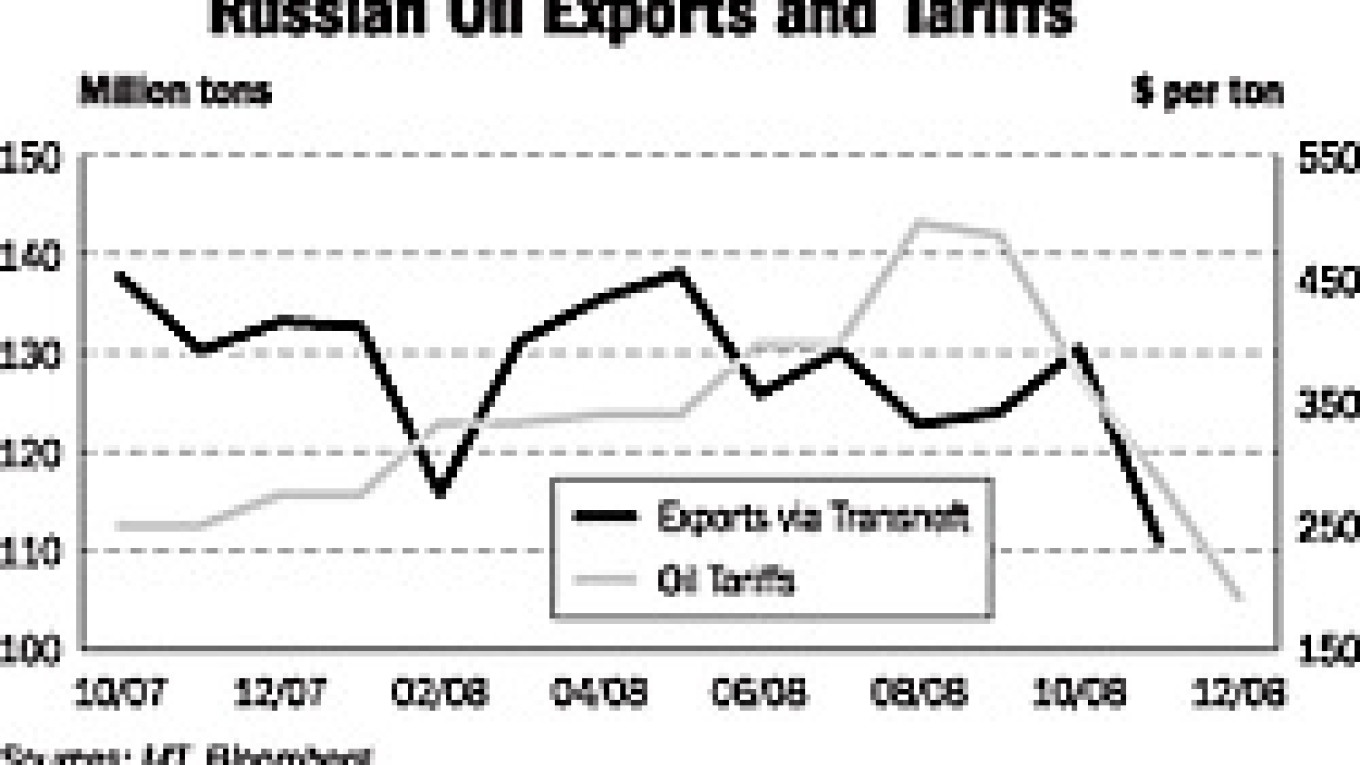
Falling shipments have become a major concern for the government since the budget depends heavily on oil-export revenues.
Energy Ministry data showed Tuesday that Russian oil exports via pipeline monopoly Transneft stood at 3.70 million barrels per day in November, down by 12 percent from 4.21 million bpd in October. Oil companies had threatened to cut November deliveries by as much as a quarter because they said exports were loss-making with an export duty at $287 per ton ($39 per barrel). The average price for Urals blend crude was about $55 per barrel.
The decrease in exports made the government change the scheme of calculating the oil export duty, which, starting from December, will be set monthly instead of once every two months.
The December oil-export duty calculated under the new scheme was set at $192.1 per ton, almost a $100-per-ton decrease from the November level, but oil firms have said it was still too high to make exports attractive.
Viktor Vekselberg, one of the major shareholders at BP's Russian venture, TNK-BP, said last week that the new export duty would help oil firms survive but was not enough to encourage investment.
The Energy Ministry data also showed that Russia's oil production fell by 0.4 percent to 9.82 million bpd in November from 9.86 million bpd in the previous month.
Oil output fell throughout the first half of the year, and analysts had expected that it would recover in the second half after a number of oil companies started new fields.
The government, which had expected 2008 oil output to grow by 1 percent from the 9.87 million bpd produced last year, now predicts a decline of 0.5 percent to 9.82 million bpd.
The revised forecast may be too optimistic. Oil output has already declined by 0.8 percent this year, to 9.79 million bpd in January to November, from 9.87 million bpd in the same period last year.
It will be the first annual decline since 1998 in the country's oil production, which rose by 2.3 percent last year after more impressive spikes in previous years, including a record 11 percent in 2003.
Falling oil production contributed to the general downturn in the country's manufacturing sector, which fell more sharply in November than during the 1998 financial crisis.
The VTB Bank Europe purchasing managers' index fell to 39.8, the lowest in its 11-year history and below the 50.0 mark that separates expansion from contraction.
A Message from The Moscow Times:
Dear readers,
We are facing unprecedented challenges. Russia's Prosecutor General's Office has designated The Moscow Times as an "undesirable" organization, criminalizing our work and putting our staff at risk of prosecution. This follows our earlier unjust labeling as a "foreign agent."
These actions are direct attempts to silence independent journalism in Russia. The authorities claim our work "discredits the decisions of the Russian leadership." We see things differently: we strive to provide accurate, unbiased reporting on Russia.
We, the journalists of The Moscow Times, refuse to be silenced. But to continue our work, we need your help.
Your support, no matter how small, makes a world of difference. If you can, please support us monthly starting from just $2. It's quick to set up, and every contribution makes a significant impact.
By supporting The Moscow Times, you're defending open, independent journalism in the face of repression. Thank you for standing with us.

Remind me later.