


Bascomb gives us a broad, and sometimes confusing, account of the historical background. The Russian Empire is reeling under the successive blows of military defeat at the hands of the Japanese and growing unrest at home as peasants and workers become increasingly dissatisfied with their lot. The sailors in the navy, like the soldiers on land, are themselves the children of rural poverty and urban squalor. They are ripe for revolt.
Aboard the battleship Potemkin, the most powerful vessel in the Black Sea Fleet, a small group of sailors dream of taking over their ship, and bringing the rest of the fleet over to their side by the force of example. Then, almost by accident, there is an armed scuffle over the rotten meat. Captain Yevgeny Golikov, his deputy, Commander Ippolit Gilyarovsky, and five other officers are killed. The sailors' leader, Grigory Vakulenchuk -- cool, measured, decisive -- is mortally wounded, and becomes the mutiny's first martyr. His place is taken by the fiery and impulsive Afanasy Matyushenko. The mutineers are left with the awkward task of deciding what to do next.
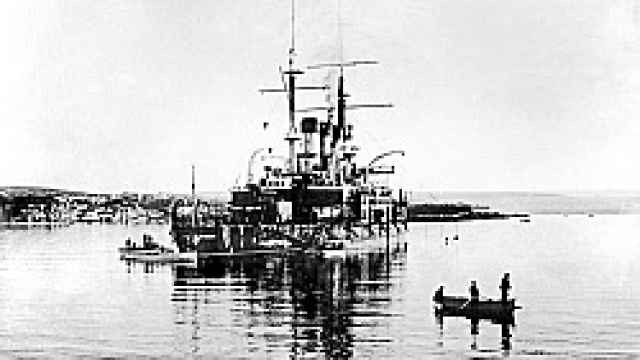 Itar-Tass The Potemkin was the most powerful vessel in the Black Sea Fleet in 1905. |  |
| |
Telegrams fly back and forth between St. Petersburg and the admirals, who struggle to keep the fleet together as it totters on the brink of disintegration. The admirals hope to recapture the Potemkin. The mutineers hope that the other ships will join them. Neither happens. The mutineers begin a fruitless odyssey across the Black Sea, until their coal and water runs out, their determination falters, and they are forced to seek refuge in Romania. Many eventually find political asylum in Britain and South America. After meeting the exiled Lenin, Matyushenko returns to Russia to continue the struggle. He is caught and executed.
The significance of the mutiny on the Potemkin was considerable, but it was above all symbolic. The mutinies that gripped the British Navy in 1797 had more immediate potential for disaster; they paralyzed the Channel Fleet and opened the country to invasion. The British Admiralty reacted with a mixture of concession and severity. Several ringleaders were hanged, but conditions of life for the sailors were improved. When the admirals appealed to their patriotism, the sailors willingly sallied forth against the French and the Dutch and defeated them. Had they not done so, Admiral Vincent would have boasted in vain when he told Parliament, "I do not say, my Lords, that the French will not come. I say only they will not come by sea."
The circumstances surrounding the Potemkin mutiny were different. Despite the defeats in the Far East, Russia did not risk an invasion of its heartland from the sea, so appeals to the patriotic feelings of the mutineers could make little practical impact. Nor could the mutiny have brought down the tsarist regime by itself. It was only one of many such incidents -- the massacre outside the Winter Palace on Bloody Sunday six months earlier, the strikes in Moscow and St. Petersburg, the "red cockerel" which flew across the land as peasants burned down one country house after another. Odessa had already seen much violence before the Potemkin arrived in the harbor. It was the combination of all of these events that forced the tsar to grant a tentative constitution in October 1905, and gave Russia the glimmer of hope for a more liberal, democratic and prosperous future. Without Eisenstein, the mutiny might now be almost forgotten.
Bascomb writes in the generous belief that it is worth recovering "the truth of [his protagonists'] lives, and the reasons they sacrificed them." But there is a strange hole at the core of his narrative. Was the mutiny part of a wider plan to subvert the Black Sea Fleet, or was it not? The British author Richard Hough speaks in "The Potemkin Mutiny" of a broad subversive organization across the whole of the Fleet. That brief, lucid and gripping account dates from 1960, when the historiography was still dominated by orthodox Soviet scholars trying to demonstrate that the mutiny was inspired, if not wholly guided, by the Social Democrats, or rather by Lenin's Bolshevik faction. Bascomb sometimes appears to argue that the mutineers rose up more or less spontaneously in the name of the common people, while the professional revolutionaries -- the Mensheviks, the Bolsheviks, the Social Revolutionaries -- sat in their coffee houses writing fiery pamphlets and exploiting the mutiny for their own propagandistic purposes. And yet he also speaks throughout of a mysterious "Tsentralka," a Center, a "revolutionary sailor organization" that mapped out the strategy of mutiny, held secret meetings of its potential leaders, and issued operational orders once the mutiny began. Matyushenko, says Bascomb, triggered the mutiny prematurely, before the Tsentralka was ready. But Bascomb does not say who was in the Tsentralka, where they came from, what their political affiliations were, how they were organized, or what happened to them when it was all over.
All of this we need to know if we are to understand the wider ramifications of the mutiny. What we do know is that the revolution of 1905 was brought about by an elemental surge among the whole people -- workers, peasants, soldiers, sailors, intellectuals, liberal politicians, professional revolutionaries. Their hopes of a better future for their country were extinguished by a combination of Tsar Nicholas II's boneheaded obstinacy, the appalling advice he got from his closest intimates, the devastating impact of World War I, and the ruthless willpower of Lenin and the Bolsheviks. Whether Russia could have taken a happier course if one or all of these factors had been absent is, of course, impossible to say.
Rodric Braithwaite is a former British ambassador to Moscow and the author, most recently, of "Moscow 1941: A City and Its People at War."
A Message from The Moscow Times:
Dear readers,
We are facing unprecedented challenges. Russia's Prosecutor General's Office has designated The Moscow Times as an "undesirable" organization, criminalizing our work and putting our staff at risk of prosecution. This follows our earlier unjust labeling as a "foreign agent."
These actions are direct attempts to silence independent journalism in Russia. The authorities claim our work "discredits the decisions of the Russian leadership." We see things differently: we strive to provide accurate, unbiased reporting on Russia.
We, the journalists of The Moscow Times, refuse to be silenced. But to continue our work, we need your help.
Your support, no matter how small, makes a world of difference. If you can, please support us monthly starting from just $2. It's quick to set up, and every contribution makes a significant impact.
By supporting The Moscow Times, you're defending open, independent journalism in the face of repression. Thank you for standing with us.

Remind me later.