Install

Get the latest updates as we post them — right on your browser

Today's paper. Last Updated: 05/28/2012

The Khodorkovsky Omen

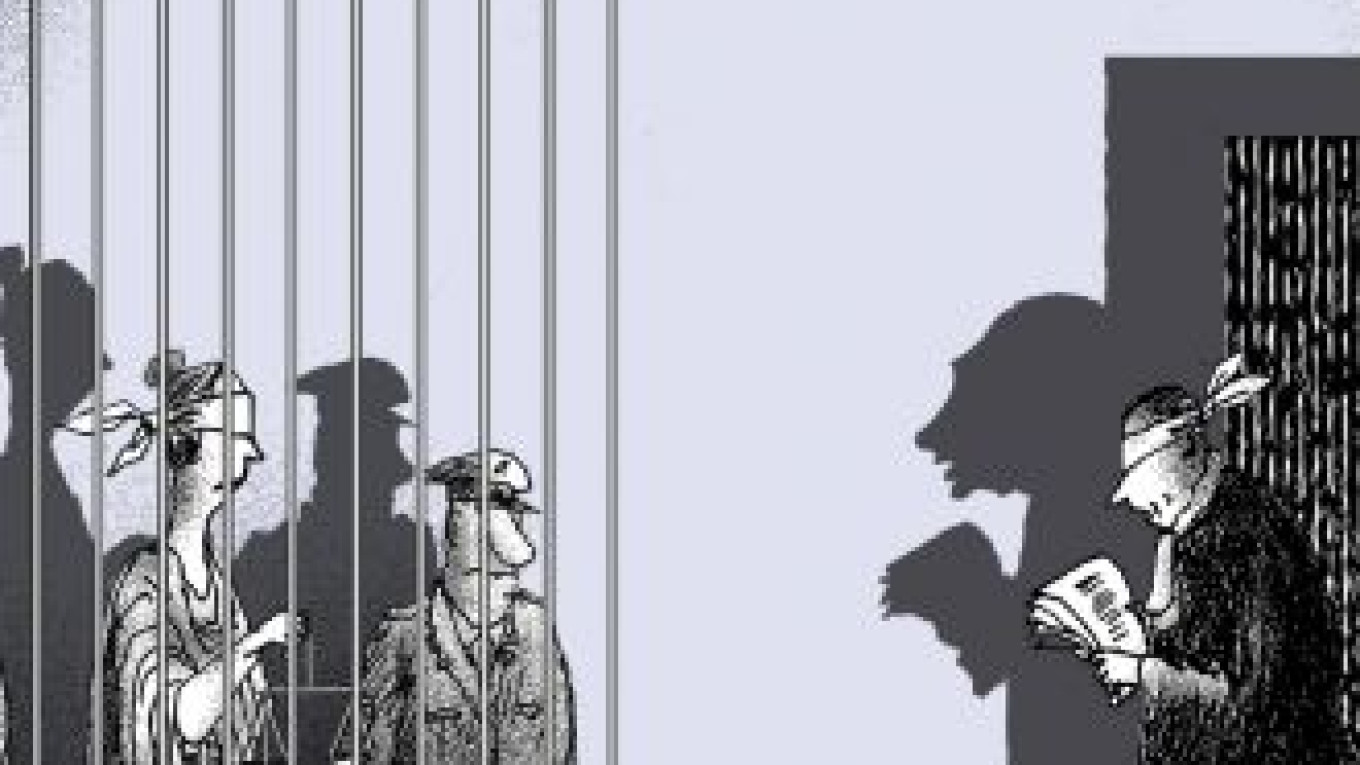
Prime Minister Vladimir Putin sent a clear and chilling signal on Dec. 16 that the “soft autocracy” of his first decade in power will become more oppressive in his second decade.

It was on that day that Putin effectively delivered the guilty verdict in the second trial of former Yukos CEO Mikhail Khodorkovsky during his annual call-in show — two weeks before Judge Viktor Danilkin actually found Khodorkovsky guilty of embezzlement and money laundering and added six years to his sentence, ensuring he will be locked up until 2017.

Putin’s declaration that Khodorkovsky belonged in jail was eerily similar to Stalin’s notorious practice of delivering a sentence and then having the court confirm it. Putin easily could have not selected the Khodorkovsky question during the call-in show and applied pressure on Danilkin in private. Instead, Putin flouted an apparent disregard for the law on national television. (Applying pressure or interfering in a trial is a violation of Article 294 of the Criminal Code.)

The Khodorkovsky verdict also dealt a serious blow to President Dmitry Medvedev — who said Dec. 24 that no top government official had a right to comment on the Khodorkovsky trial before a verdict is reached — and to his modernization and judicial reforms.

One of the main reasons Putin still enjoys high popularity ratings is that many Russians prefer Putinism to the chaos under former President Boris Yeltsin throughout the 1990s. Against this backdrop, Putin’s political model for stability comes out the clear winner.  

But as memories of the 1990s slowly fade, so will this comparative advantage. Support for Putinism could erode as people balk at being forced to pay for the elite’s prolonged feast in terms of low wages and pensions, substandard health care, unaffordable housing and a sharp rise in corruption and organized crime. Kushchyovskaya has become a striking symbol of how much the county has degraded under Putinism.

One reason Putin is tightening the screws is because he understands that he cannot indefinitely get away with masking growing stagnation as “stability.”

Like all autocracies, Putinism is dependent on a large class of lackeys who serve the ruling elite. They argue with straight faces that Putinism is good for Russia and cynically try to justify its autocratic rule in terms of the country’s “unique path and traditions.” If by “tradition” they mean the country’s 1,000-year tradition of autocracy, corruption and poverty — whether it be under serfdom, Soviet communism or Putinism — this is one tradition that many people would arguably like to end. Nikita Mikhalkov, Russia’s top apologist for autocracy, in his October manifesto “Right and Truth” tried to package Putinism as “enlightened conservatism” and urged Russians to be subservient and loyal to “authoritative power” and to respect the law. In light of the Khodorkovsky trial, Mikhalkov’s appeal to respect the law is a complete mockery.

Servility to Putinism is strikingly similar to its Soviet version. Mikhalkov has replaced his father, Sergei Mikhalkov; Kremlin ideologue Vladislav Surkov has replaced Soviet ideologue Mikhail Suslov; and Danilkin has replaced Yelena Savelyova, the illiterate judge who presided over the 1964 trial of poet Joseph Brodsky and eagerly fulfilled the state orders by sentencing him on “parasitism” charges to five years of hard labor in the Archangelsk region. In the spirit of this infamous tradition, it is no surprise that State Duma deputy and United Russia member Yevgeny Fyodorov claimed that the second Khodorkovsky sentence was a vivid example of the independence of Russia’s judicial system.

This was followed by a Foreign Ministry statement in response to Western criticism about the Khodorkovsky trial. “We hope that everyone will mind his own business — at home and internationally,” the ministry said.

This is a standard response from authorities who try to mask their abuses of power as “internal matters.” (Khrushchev, Brezhnev and Andropov also claimed that jailing dissidents were “internal matters.”) It is no surprise that a country that has so little tolerance for criticism from within the country reacts so sharply and defensively to criticism from outside the country.

In a similar fashion, during a December interview with Larry King, Putin said, “I would like to offer some advice to our [U.S.] colleagues: Don’t poke your noses in our internal affairs.” Putin said the same thing about U.S. officials during a June interview with French journalists: “Why do you think you have the right to criticize us? We can figure out for ourselves what is best for us.”

When Putin said “we,” “ourselves” and “us,” he clearly meant the ruling elite, not the people.

The Khodorkovsky trial also showed another standard characteristic of autocracies — cowardice. The verdict was postponed to Dec. 30, a day before the country shut down for the 10-day New Year’s and Christmas holidays. This allowed authorities to shirk responsibility and to limit public discussion and outrage over the verdict. Moreover, in a Soviet-style attempt to downplay the ruling, the top stories on state-run television evening news programs after the verdict was announced were the death of a Boney M musician and Medvedev handing out state awards at the Kremlin. Meanwhile, the Khodorkovsky verdict was a top story in many foreign newspapers.

Entering 2011, Russia lacks any viable political alternatives to Putinism, and this seems to be exactly the way Putin wants it. Several days after the Khodorkovsky verdict was delivered, a court sentenced opposition leader Boris Nemtsov to 15 days in jail on charges of “insubordination” to police during a sanctioned Dec. 31 demonstration. By all indications, this was a preplanned government operation to provoke, humiliate and intimidate one of the country’s most vocal opponents of Putin. Amnesty International has declared Nemtsov, who is being held in a cell with six other detainees, as a “prisoner of conscious.” The authorities’ message in this incident was clear: Think twice before you criticize Putinism.

Michael Bohm is the opinion page editor of The Moscow Times.


This article has 6 comments on TheMoscowTimes.com and 0 comments on Facebook.

Leave a comment


Discussion
The Moscow Times welcomes your comments and invites you to discuss topics with other readers. Your comment will be posted automatically to enable a live discussion. If you aren't familiar with our comments policy, you can read it here.

If you're a registered user, you can start typing your comment below. If not, take a moment to sign up. and then return to the article.

If your comment doesn't appear, contact us by using our web form.

Comments


The Khodorkovsky Omen

"The verdict has dealt a serious blow to Medvedev..." - as if Medvedev's comments were suppose to automatically decide the fate of the trial. "Support for Putinism could erode..." - that's very true and since there is no viable alternative, an erosion of support for Putin would mean a general lack of support for federal government; therefore, any destabilizing force, however good in nature it is, can potentially bring about a devastating damage, causing the entire system to collapse and needs to be kept in check until there is a mechanism for a smooth and orderly power transfer by the means of free elections. "Masking growing stagnation as 'stability'..." - yes but the whole world is stagnating and it would be odd for any political figure to opt out for self-criticism as oppose to providing assurances whenever possible. "Cynically try to justify 'unique path and tradition'..." - that is true but, fortunately, I don't believe that either the President or the PM identify with these cynics. "Servility to Putinism is strikingly similar to its Soviet version" - all over the world, children often happen to follow in their parents’ footsteps - that is not unusual at all. "The verdict was postponed until Dec.30..." - that's just an example of a PR strategy and there is hardly any government in the world that wouldn’t try and use it to its own advantage. “The verdict was a top story in many foreign newspapers…” – this is not so much a testament to Putin’s autocracy as it is a reflection of current state of relations between the West and Russia discussion of which is beyond the scope of this article. “Russia lacks any viable political alternative to Putinism…” – but is Putin really to blame for not creating a viable political alternative yet? When he first got appointed, the country was in a deep political and financial chaos and he managed, at least marginally, to put it back on tracks. Lastly: "1000-year tradition of autocracy, corruption and poverty..." - EXACTLY! How do you make a first-class democracy out of that over the course of a few years? Let's brainstorm and list some ideas!  

The Khodorkovsky Omen

mr Putin saved Russia from people like Khodorkovsky Then we can argue whether the judicial procedures followed were correct or not, and why not all were caught, but that's another story The story of the oligarchs should not be forgotten:  http://underthesignofjonah.blogspot.com/2011/01/khodorkovsky-deception.html Putin likes to be criticised because he likes challenges and he works for Russia But one must bring solid arguments and genuine reasons in order to deserve the title of prominent or fierce critic   

The Khodorkovsky Omen

Khodorkovsky, just because grew up in Yeltsin’s ‘FarWest’, (a Russia where foreigners like ‘Big Jim’ Clinton and co. could have a say on who ought to rule Russia) is not a ‘crystalline’ man. He was an oligarch and he is anyway a debtor to common Russian people. It’s not only Putin who dislikes him; there are Russians and not whom he is not so beloved. Americans, Europeans and above all this the Economist’s sponsorship is absolutely not a proof that Khodorkovsky’s fate is a democratic issue and not very helpful to Khodorkovsky too: this sponsorship is sorting a contrary effect. I don’t love Putin but for he’s a patriot like Gorbacev  was and Khodorkovsky is not like Yeltsin was not, and I’m totally confident that mr. Medvedev is too (no contracdiction to be liberal and patriotic as well). He (mr. Khodorkovsky) is still a stubborn man as he was when he was trying to emigrate through Finland before his arrest, to join another great patriot (sic!) of Yeltsin’s era, mr. Berezovsky (the notorious Mi6’s pet). His lawyers don’t want to ask for a pardon? That’s good! The trials have to be discussed in courts and not on foreign papers. Really, the only deal would be parole, but it would be very hard to guarantee for his security in Russia; so if Americans are so anxious for mr. Khodorkovsky, in these business-like times, why not to swap mr. Bout for mr. Khodorkovsky or the Brits mr. Berezovsky for mr. Khodorkovsky? Not so interested? Then, shut up! Nemtsov and sanctioned rallies? Come on! A few months ago there were no sanctioned rallies at all and now do we need another hero like Nemtsov? Enough to feel nostalgic for mr. Luzkov! One more thing : American statements tying mr. Khodorkovsky’s fate to Russia’s access to Wto is heaven to Russian hawks!!!!!!

The Khodorkovsky Omen

This article is a western plot to destabilise russia.Foreign authors and editors are getting access to comment on internal matter of russia.moscow times is an anti-russian organisation owned by western publishing house SAMONA.It has no ability and credibilty at all to serve russian society and democracy.it is one of the enemy's tool against russia to make every news from western point of view against russia.it is acting like pimp dangerous than russian mafia.i may not support putin but i cant support west.

The Khodorkovsky Omen

Why " Carry coals to Newcastle", we´ve MT´s  Boris Kagarlitsky." Michael Khodorkovsky (MK) is a prisoner, because he shared the principles basic to the current order. His enemies call him a thief, delinquent. Perhaps a political prisoner, but not of " conscience".Credo´s: = Power & money,=indivisible,ruling clique=wealthy elite, controlling media, and the duma.MK is a political prisoner,in that mediaeval sense,as lords/princes were jailed in the Bastille/ The Tower. The conflict can´t be fit into democratic political standards. A fight with no rules,not a battle of principles/ideas,but struggle for power in it´s most cynical transparent form.Converting power into property." Indifferent for the "serfs of Russia. " (short quot.BK) Well ? 

The Khodorkovsky Omen

this is just so unbelievable, they made a martyr of Khodorkovski! So pathetic! He stole millions, he made his money in the 90s and he is a criminal, I really don't care about politics but I agree that a thief belongs in jail!

Report Inappropriate Comment


Comments via Facebook


Also in Opinion

There's Just One Nationality — Mathematician

Nationalism is an infantile disease. It is the measles of mankind."

Russia's New Propaganda Minister

After Monday's announcement that historian Vladimir Medinsky was appointed the culture minister, critics quickly labeled him the new propaganda minister. Medinsky's academic ethics and historical distortions may raise serious questions, but for the Kremlin, he has three important attributes that are much more important: He is a model United Russia leader, a firm Putin loyalist and a skilled sophist.

Spinning Medvedev's Government

Were this 2008 and not 2012 — and had Dmitry Medvedev been named prime minister without having first served a full term as president — then the composition of his new government might have created a generally positive impression.

New Government Faces Old Problems

A longstanding platitude shared by both the Kremlin as well as domestic and foreign analysts is the need for Russia to diversify its economy away from energy dependence and reduce its non-oil budget deficit.

Putin's Postman Delivers Nothing at the G8

In the mid-1990s, former President Boris Yeltsin fought hard for the right to sit as equal at the same table with the leaders of the world's seven leading democracies. Using a lot of political wrangling, Moscow finally secured permanent membership in this elite club where the real heavyweights are supposed to solve the world's most pressing problems.

Russia Stays Home

Just three days before his return to the Kremlin as president, Vladimir Putin met behind closed doors at his residence in Novo-Ogaryovo, outside Moscow, with U.S. National Security Adviser Tom Donilon, who was there to transmit President Barack Obama's renewed determination to strengthen cooperation with Russia.


print


Comments

This article has 6 comments on TheMoscowTimes.com and 0 comments on Facebook.

Leave a comment


To Our Readers

The Moscow Times welcomes letters to the editor. Letters for publication should be signed and bear the signatory's address and telephone number.

Letters to the editor should be sent by fax to (7-495) 232-6529, by e-mail to oped@imedia.ru, or by post. The Moscow Times reserves the right to edit letters.


Most Read
MarketGid
