

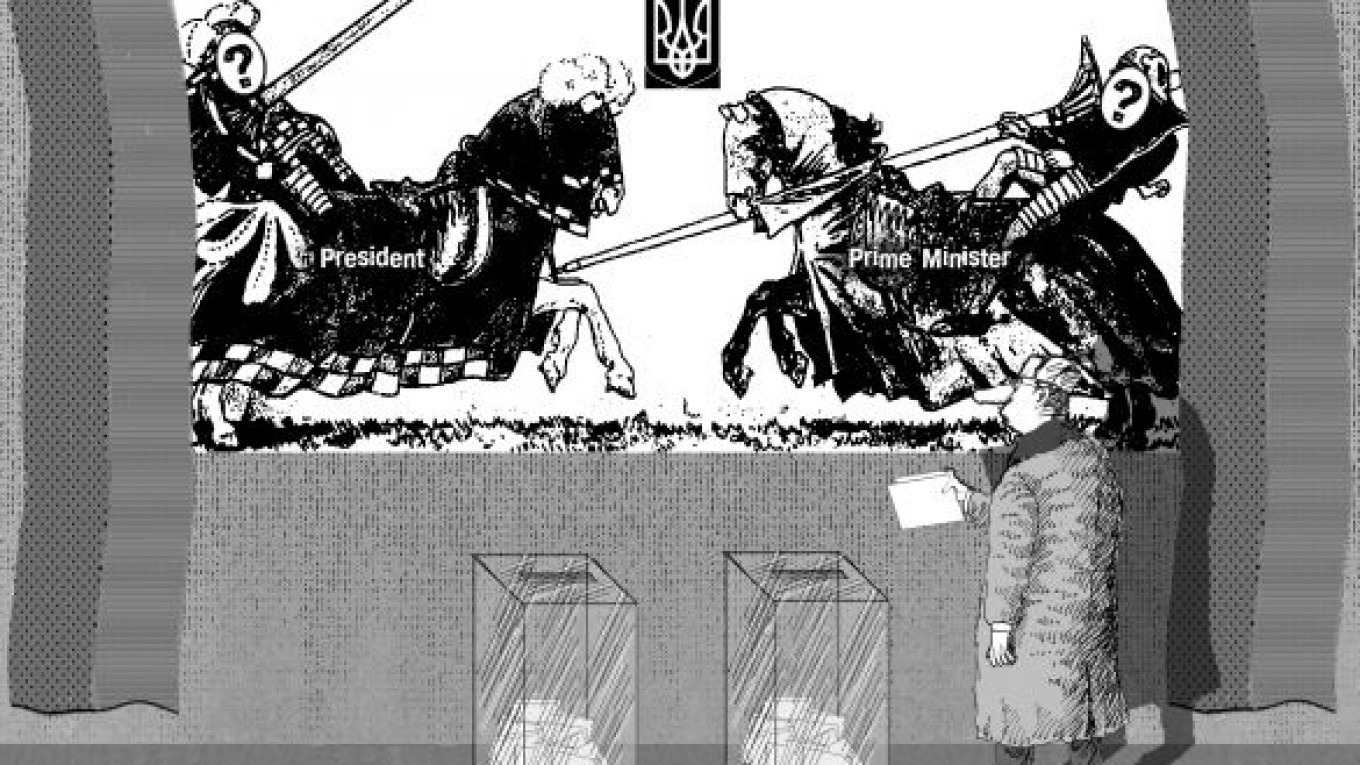
As Ukrainians go to the polls on Sunday to elect a new president, Western observers should interpret the outcome in light of how the U.S. premier political scientist distinguished between good and bad government.
Back in 1968, in his now classic work “Political Order in Changing Societies,” the late Samuel P. Huntington, best known perhaps for his “Clash of Civilizations” thesis, claimed: “The most important political distinction among countries concerns not their form of government but their degree of government. … A government with a low level of institutionalization is not just a weak government; it is also a bad government.” After all, concluded Huntington, “The function of government is to govern.”
Ukraine has been a prime example of the acuity of Huntington’s insights. Ever since the Orange Revolution of late 2004 ushered in a democratic, pro-Western government in Kiev, Ukraine has suffered from incessant infighting and deadlock that have led some observers to suggest that it has become so weak as to approximate a failed state. President Viktor Yushchenko and Prime Minister Yulia Tymoshenko, the heroes of the revolution, never fail to sabotage each other’s policies and forge alliances with the anti-Orange leader, Viktor Yanukovych. The destructive cycle of sabotage and betrayal has demoralized the population, increased corruption, strengthened the Kremlin’s position in the country and promoted “Ukraine fatigue” in the West.
The upcoming presidential election could break the cycle and place Ukraine on the path to a stronger government. Most polls and analysts suggest that Yanukovych and Tymoshenko will garner the most votes in the first round and will then face each other in a runoff three weeks later. Yushchenko’s almost certain departure from political prominence will immediately produce three stabilizing Huntingtonian effects.
First, as Ukraine’s equivalent of former U.S. President George W. Bush, Yushchenko has come to be despised even by his supporters. Things have gotten so bad that everything he touches is deemed a bad idea. Just as Bush didn’t deserve all the opprobrium that was heaped upon him in his second term, so too Yushchenko isn’t quite the incompetent leader that he’s made out to be. But perceptions matter, and his departure will refocus the public’s attention from his person to issues and policies.
Second, Yushchenko’s relationship with Tymoshenko has become self-destructive. He vetoes every one of her policies, and she counters by undermining his. Regardless of who is right and who is wrong and just why these two former allies have turned into mortal enemies, the fact is that Yushchenko’s departure will depersonalize Ukraine’s politics. This will clearly help lower the temperature in the country.
What will happen if Tymoshenko wins the second round? Her party will then control the presidency, the parliament and the Constitutional Court, giving her enormous powers. Moreover, Yanukovych will likely fall from grace and his party will almost certainly experience a deep crisis. Many Ukrainians fear that Tymoshenko, given her large personal ambitions, will try to establish a dictatorship, but their fears are greatly exaggerated. Dictators need strong and large state bureaucracies, armies and secret police in order to rule, and Ukraine has none of these. An all-powerful Tymoshenko will not be able to become a dictator, but she will also have no one to blame if she fails to fix the economy and establish a strong government.
If Yanukovych wins, he will control the presidency and the Constitutional Court, but Tymoshenko will, in all likelihood, remain the prime minister. Their power struggle will likely continue — at least until parliamentary elections give one or the other an advantage in the parliament. But their incentives to cooperate over policy will also be greater than at present. There will be no third partner to court, and whether the outcome is cold war or cold peace, some kind of detente over measures that address the economic and political crisis is likely.
Finally, whoever wins will likely change Ukraine’s constitution, which as currently constructed virtually guarantees perpetual conflicts between the president and prime minister. Experts generally agree that a presidential system is worse than a parliamentary one, but they also agree that a mixed presidential-parliamentary system such as Ukraine’s is by far the worst.
In the end, a Huntingtonian interpretation of Ukraine leads to cautious optimism about positive governmental change in the country. Establishing a strong government in Kiev will clearly be in Ukraine’s best interests, and it will also help strengthen the country’s relations with the West. The United States and Europe could help resolve Ukraine’s strategic dilemma of being located in the no-man’s land between a hostile Russia and a weak Europe, while the European Union could pursue a relationship with Ukraine that is at least as close as its relationship with Russia.
Meanwhile, before Ukraine’s next president takes the oath of office, he or she would do well to read Huntington.
Alexander J. Motyl is a professor of political science at Rutgers University-Newark.
A Message from The Moscow Times:
Dear readers,
We are facing unprecedented challenges. Russia's Prosecutor General's Office has designated The Moscow Times as an "undesirable" organization, criminalizing our work and putting our staff at risk of prosecution. This follows our earlier unjust labeling as a "foreign agent."
These actions are direct attempts to silence independent journalism in Russia. The authorities claim our work "discredits the decisions of the Russian leadership." We see things differently: we strive to provide accurate, unbiased reporting on Russia.
We, the journalists of The Moscow Times, refuse to be silenced. But to continue our work, we need your help.
Your support, no matter how small, makes a world of difference. If you can, please support us monthly starting from just $2. It's quick to set up, and every contribution makes a significant impact.
By supporting The Moscow Times, you're defending open, independent journalism in the face of repression. Thank you for standing with us.

Remind me later.