

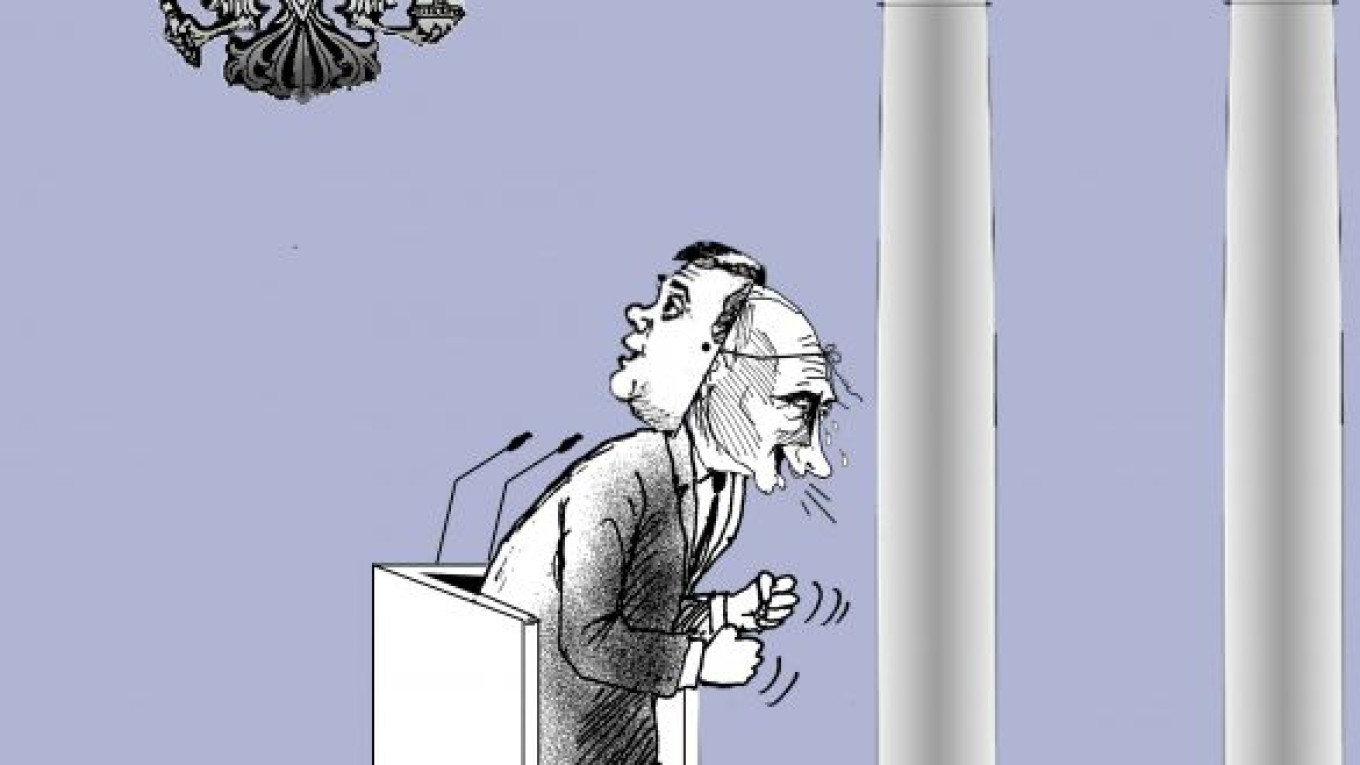
Prime Minister Vladimir Putin and President Dmitry Medvedev taught us a good lesson on truth and honesty.
The two spent the last year playing charades, trying to inject suspense and drama into the question of which tandem member might run for president. On Saturday, Putin revealed his dirty little secret during his speech at the United Russia convention: He and Medvedev had secretly agreed on the tandem switch “several years ago.” Medvedev said the pact was made before he became president in 2008. Even ministers and the two leaders’ top advisers were unaware of the deal.
?€?Every story should have its own intrigue,?€? Medvedev said with a grin at the St. Petersburg International Economic Forum in June in answer to the umpteenth question from a journalist about which tandem member might run for president next year. ?€?Otherwise life would be boring, so let?€™s enjoy it a little longer.?€?
And enjoy they did.
What a ruse the two pulled on many world leaders, analysts and, yes, journalists who took close notice of every sign of Medvedev?€™s ?€?liberalism?€? and what this might mean for the democratization and modernization of Russia. They must feel a bit foolish now, looking back at how seriously they treated Medvedev?€™s Four I?€™s, his police and judicial reforms, Skolkovo, and his battle against ?€?legal nihilism?€? and bureaucrats who ?€?terrorize?€? businesspeople.
?€?This was a slap in the face,?€? said Igor Yurgens, head of the Institute for Contemporary Development, a Kremlin-linked think tank that argued repeatedly that a second Medvedev presidential term would benefit Russia.
In addition, analysts tried to fish out any sign of a ?€?schism?€? between the tandem over the past year, looking for indications that Medvedev might replace Putin as the national leader. Putin looks fatigued after running the country for a decade, the argument went. Maybe it was time to pass on the reins of power to his protege, a younger and more liberal ?€?modernizer.?€?
The first perceived split emerged in summer 2010 over the multibillion-dollar highway through the Khimki forest, which Putin supported and Medvedev suspended. Was this Medvedev?€™s first major independent decision? Was he trying to outdo Putin? After this, many started speculating that Medvedev might make a serious bid for the 2012 race.
That August 2010 highway suspension was followed by Medvedev?€™s decision to fire Mayor Yury Luzhkov a month later and his direct contradiction of Putin regarding the second trial of Mikhail Khodorkovsky in December. When Putin was asked about Khodorkovsky during his annual televised call-in show in early December, he answered, ?€?A thief should sit in jail.?€? Two weeks later, Medvedev said: ?€?Neither the president, nor any other official in state service, has any right to express a position about this matter … before the sentence is delivered.?€?
Then, in his March speech in Magnitogorsk, Medvedev criticized the ineffectiveness of large state-controlled corporations and promised to remove ministers serving on their boards of directors. This was largely viewed as a bold attack on ?€?national champions?€? — the foundation of Putin?€™s state capitalism model ?€” as well as on Putin?€™s closest allies, such as Igor Sechin, who would be stripped of high-profile and powerful board posts.
Then there was an apparent tandem split on the NATO military action against Libya, followed by a June interview with the Financial Times in which Medvedev said he would like to run for president in 2012.
As it turns out, it was all a hoax, including the disagreements. The most distasteful aspect, however, was that Putin was not even bashful of publicly admitting during his convention speech on Saturday that the secret deal was sealed years ago. On the contrary, it appeared that he was relishing the trick he played on everyone, as if to underscore his contempt for those gullible enough to fall for it.
This behavior shows all the markings of a megalomaniac who has enjoyed uncontested power far too long. Or a con artist who outsmarted the police and everyone else and can?€™t resist boasting about it to friends and acquaintances.
Archpriest Vsevolod Chaplin, a senior official in the Russian Orthodox Church, praised Putin?€™s ?€?honest?€? return to power this week. ?€?When in the history of Russia has top government power been handed over so peacefully, properly, honestly and friendly??€? he said. ?€?This is a genuine example of kindness and morality in politics that ?€¦ citizens in the majority of countries, including those that try to lecture to us, can envy.?€?
Perhaps Medvedev came up with the best justification for the secret agreement to switch places. During his speech to the convention, he said: ?€?I hope that you will understand us. ?€¦ It was a reasonable political decision, one that followed the laws of politics that are specific to our country. But I would like to emphasize one thing: We always spoke only the truth.?€?
In most democratic countries, however, speaking this kind of ?€?truth?€? would mean the end of a politician?€™s career.
Michael Bohm is opinion page editor of The Moscow Times.
A Message from The Moscow Times:
Dear readers,
We are facing unprecedented challenges. Russia's Prosecutor General's Office has designated The Moscow Times as an "undesirable" organization, criminalizing our work and putting our staff at risk of prosecution. This follows our earlier unjust labeling as a "foreign agent."
These actions are direct attempts to silence independent journalism in Russia. The authorities claim our work "discredits the decisions of the Russian leadership." We see things differently: we strive to provide accurate, unbiased reporting on Russia.
We, the journalists of The Moscow Times, refuse to be silenced. But to continue our work, we need your help.
Your support, no matter how small, makes a world of difference. If you can, please support us monthly starting from just $2. It's quick to set up, and every contribution makes a significant impact.
By supporting The Moscow Times, you're defending open, independent journalism in the face of repression. Thank you for standing with us.

Remind me later.