

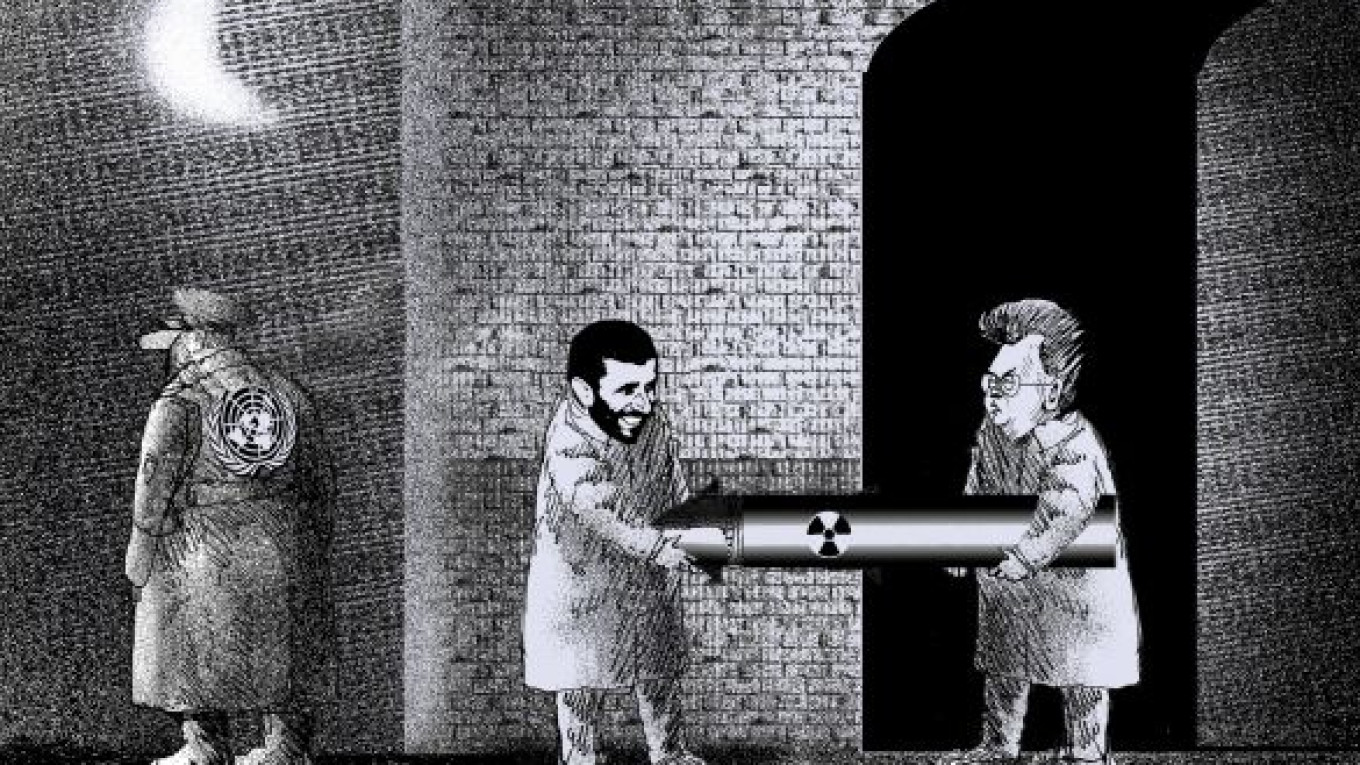
Presidents Barack Obama and Dmitry Medvedev signed the New START agreement in Prague three weeks ago, and on May 3 the Nuclear Non-Proliferation Treaty Review Conference will open in New York. These examples of nuclear arms reductions and nonproliferation are good news for everyone, everywhere. But neither the New START nor the upcoming nonproliferation conference will have much impact on today’s most perilous threat: the nuclear honeymoon between an Iran determined to acquire a nuclear weapons capacity and a North Korea willing to sell Iran much of that capacity for hard currency.
Today, more than 6,000 North Koreans work in Iran and neighboring areas of the Middle East. Many are engaged in construction and the apparel business as low-wage workers. But in Iran and Syria, there are also a growing number of specialist workers. Indeed, when Israel attacked a nuclear facility in Syria in September 2007, it was revealed that North Koreans were involved in developing the site in cooperation with the Syria National Technical Research Center.
Most North Koreans living in Iran are engaged in activities on behalf of the Korean Workers’ Party. Their mission is to propagandize the party’s ideology in the Islamic Republic. The daily life of these Koreans is constrained within a small community where the party exercises total control over all personal exchanges.
Some of these workers are directed by North Korea’s embassy in Tehran, which is primarily concerned with acting as a party watchdog over fellow citizens stationed in Iran. North Korean diplomatic attaches are required to conduct weekly and monthly self-criticism sessions. Those seen as having failed to follow party dictates in an appropriate way face severe recrimination.
In 2002, it was estimated that more than 120 North Korean nationals were working at more than 10 locations across Iran that were relevant to missile or nuclear development. While North Koreans who work in the United Arab Emirates, Qatar or Kuwait are basically cheap labor, the missile and nuclear business conducted by North Koreans in Iran serves as a cash cow, providing Supreme Leader Kim Jong Il’s regime with a pile of hard currency while forging a virtual anti-U.S. alliance. By enhancing nuclear proliferation and the transfer of essential nuclear and related technologies to the Middle East’s most radical regime, Kim hopes to shape radical Islamic fundamentalism as a bastion of pro-North Korean feeling.
Until 2009, North Korea had been responsible for the export of missiles and missile technologies to Iran through the dummy companies managed by “Office 99.” All such transactions have been conducted under the direct orders of Kim.
This is how it works: The Second Economic Committee, which is under the command of the party’s central leadership, manufactures missiles with the help of North Korea’s Second Academy of Natural Sciences. Companies under the control of Office 99 export the missiles to Iran. The foreign currency earned by the export of missiles and nuclear or other weapons goes either directly into Kim’s pocket or is used to fund further nuclear development.
Following the nuclear test conducted by North Korea in 2009, the United Nations imposed sanctions on Kim’s regime through Security Council Resolution 1874, which shut down the flow of foreign currency into North Korea. The irony is that the sanctions have made Iran an even more important partner for North Korea than it was before. So the nuclear relationship has been hardened, not disrupted, by sanctions.
According to high-level internal Workers’ Party documents brought to Japan by North Korean informants, a new front apparatus, the Lyongaksan General Trading Corporation, was created in 2010. This organization, it appears, is now intended to play the central role in managing the export of missile and nuclear technologies to Iran.
Of course, this is simply a new wrinkle on an old practice: North Korea has regularly used dummy companies to export missiles. Names, addresses and phone numbers for such companies are all nonexistent, as has been proved by the documents found when the UN confiscated illegally exported weapons under Resolution 1874.
So desperate is North Korea’s financial position that in December, the Ministry of People’s Security suspended the domestic use of foreign currency. Violations are punishable by death. Such a harsh measure suggests that even though the sanctions have hardened North Korea’s desire to export nuclear weapons and technology to Iran, the process is becoming more difficult and the regime is losing its key mechanism to earn foreign currency.
Kim will seek to maintain the relationship with Iran no matter what. If this trade is to be halted, China — through whose territory most shipments to and from North Korea pass — will need to play a more responsible role. But, given the scope of the Iranian-North Korean nuclear relationship, Asia’s democracies must start to think seriously about cooperating on regional missile defense in the way that NATO Secretary-General Anders Fogh Rasmussen has urged NATO and Russia to cooperate. When the stakes are so high, the response must be creative and bold.
Yuriko Koike, a former Japanese minister of defense and national security adviser, is a member of the opposition in Japan’s Diet. © Project Syndicate
A Message from The Moscow Times:
Dear readers,
We are facing unprecedented challenges. Russia's Prosecutor General's Office has designated The Moscow Times as an "undesirable" organization, criminalizing our work and putting our staff at risk of prosecution. This follows our earlier unjust labeling as a "foreign agent."
These actions are direct attempts to silence independent journalism in Russia. The authorities claim our work "discredits the decisions of the Russian leadership." We see things differently: we strive to provide accurate, unbiased reporting on Russia.
We, the journalists of The Moscow Times, refuse to be silenced. But to continue our work, we need your help.
Your support, no matter how small, makes a world of difference. If you can, please support us monthly starting from just $2. It's quick to set up, and every contribution makes a significant impact.
By supporting The Moscow Times, you're defending open, independent journalism in the face of repression. Thank you for standing with us.

Remind me later.