Install

Get the latest updates as we post them — right on your browser

Today's paper. Last Updated: 05/28/2012

Modernize or Marginalize

Now that the global financial crisis has abated, this is a good time to take Russia’s pulse. We have just edited a book with 12 chapters written by Russians and Americans. The consensus from the authors was clear: Russia has weathered a perfect storm of oil price decrease, reversed capital flows and political isolation following the August 2008 war with Georgia. Russia’s short-term prospects appear neither dramatic nor problematic.

Yet Russia faces serious structural challenges in the long-run. The book’s authors unanimously concluded that the current system is no longer suitable for the challenges ahead and is facing a dead end. This includes the economy, politics, the rule of law, Gazprom, the Commonwealth of Independent States, foreign relations in general, foreign economic relations and the armed forces.

This discussion is reminiscent of the one in the 1970s about how the Soviet Union would transition from “extensive” growth based on the mobilization of resources to “intensive” growth based on increased efficiency and productivity. The big difference is while reform of the Soviet economic system was not possible, reform of the current state-capitalist system is. In some cases, such as in the military, reform has already started. But if Russia is to succeed in the long run, it urgently needs more comprehensive restructuring.

The good news is that Russia has substantial assets — natural resources and human capital — and huge potential for further change. These changes are not going to be easy, but if they happen the country will be able to capitalize on the true value of its assets.

One of the most profound structural problem facing Russia’s future development is the erosion of federalism, the inevitable result of consolidating so much authority in the Kremlin under the power vertical model. Other broad areas of structural concern are the rule of law, state regulation of enterprise and innovation. Disturbingly, corruption has gotten worse since 2000. One consequence is that big companies are given an unfair advantage over small firms. This hampers the development of small businesses, which are important drivers of innovation in the West, as well as in Bangalore and other global technology centers. Apart from the software industry, Russia’s high technology is concentrated in large state corporations.

Rampant corruption is arguably the largest factor obstructing the country’s ability to develop its infrastructure. Another of Russia’s great problems is demography. President Dmitry Medvedev captured the scope of the problem when he said: “Every year there are fewer and fewer Russians, alcoholism, smoking, traffic accidents, the lack of availability of many medical technologies, and environmental problems take millions of lives. And the emerging rise in births has not compensated for our declining population.”

Important reforms are taking place in the military, where Defense Minister Anatoly Serdyukov is pushing ahead despite strong resistance from the officer corps.

In foreign policy, Russia’s current dilemma is: modernize or marginalize. It makes little sense for Russia to oppose the West. Instead, it should aspire to emulate and join the West. Russia does not have the resources to pursue a separate course. Arguably, the most important issue is whether Russia finally will be able to accede to the World Trade Organization. The country has little to gain from the development of the Customs Union with Kazakhstan and Belarus, which would instead represent Russia’s marginalization.

The current strategic outlooks of Russia and the United States vary greatly. U.S. President Barack Obama has gone out of his way to reset U.S.-Russian relations. The key line in his big speech at Moscow’s New Economic School on July 7, 2009, was: “America wants a strong, peaceful, and prosperous Russia.” The U.S.-Russian relationship has improved considerably since its low point following the war with Georgia, but its potential remains unfulfilled.

At present, the Russian leadership has a great opportunity. While it is evident that the current economic model cannot deliver sufficient growth in the next several years and the main problems are plain, the Kremlin does not face any apparent immediate internal or external threats. Therefore, the Russian government can launch reforms if it finds the political will and courage to do so.

But, of course, reforms always involve costs, not least to the insiders. The big question for the next couple of years is whether the stark analysis of Russia’s shortcomings, which have been largely overlooked by the country’s leaders, will prompt adequate reforms.

Anders Aslund and Andrew Kuchins, along with Sergei Guriev, are co-editors of the new book “Russia After the Global Economic Crisis.”


This article has 1 comment on TheMoscowTimes.com and 0 comments on Facebook.

Leave a comment


Discussion
The Moscow Times welcomes your comments and invites you to discuss topics with other readers. Your comment will be posted automatically to enable a live discussion. If you aren't familiar with our comments policy, you can read it here.

If you're a registered user, you can start typing your comment below. If not, take a moment to sign up. and then return to the article.

If your comment doesn't appear, contact us by using our web form.

Comments


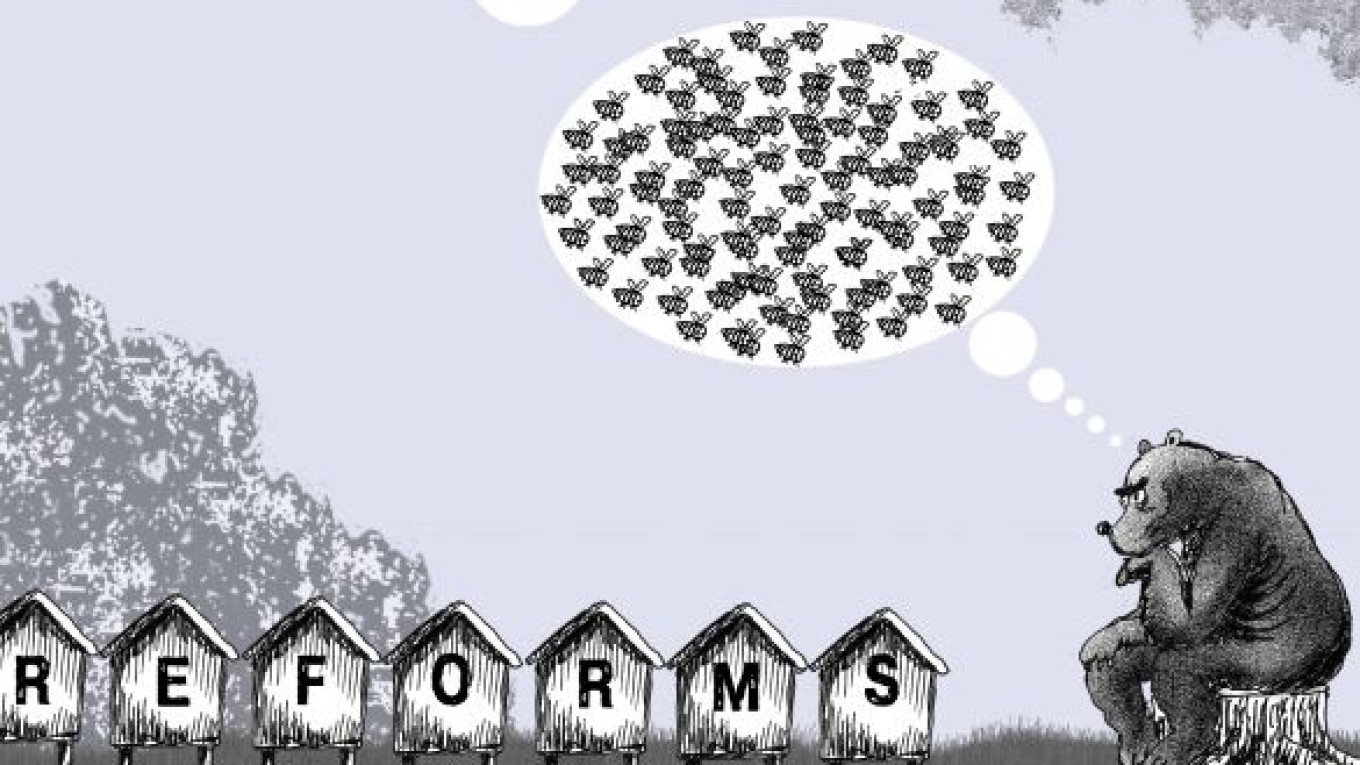
Ljubov’ pcel trudovych / The love of the worker-bees. A. Kollontay (1923) The Bear and the Bees... ??

Well you, "can´t be a prophet in your own town" , but the Swede, Anders Åslund perhaps  still plays that role in Russia. But ask then another Swede, the chairman of the BP, Henrik Svanberg (perhaps classmates at the High School of Economics) who was called up to the White House to answer to president Obama, if he believes in a world, Beyond Petro-leum ". Anders Å. put Russia in disaster,( the opinion in Sweden)  and now it´s the U.S.A: s  turn, to get down on it´s knees, when Henrik Swan(!)-berg, opened up with some 60.000  barrels of crude oil, 24 hours, enough to fill every rare pelican nib with as much oil, they can swallow. Hellraisers, and bad English-speakers, are that the global public features  of the Vikings of today ? Since Swanberg called the American  environmental  oil-victims,  " small people"  the wrong derogatory word, and a perfect mediastorm blows. (But, to whoever in the world, do the Americans pay respect ?, in Iraq, Afghanistan ? ) But take it cool, help is on its way.

Too much entrepreneurs in Sweden ? Thats the message from a wellknown labour party/ newspaper-man, Göran Greider / Newsmill.se  " The entrepreneur has in many cases  low education, is social reactionary and don´t add to the resources in a country.This deals in extreme cases often with criminal activity, mafioso, and could be:   as for exemple the U.S. bankers, that even they "torpedoed" the world economy,  with their ideas of  " special "  conditions for loans to poor people, " a quite new product !  "

The state must direct entrepreneurs to real productivity. The connections with small firms and high GDP, (USA and Sweden, etc.) show they all have a low part of small firms, the opposite to Greece, etc.  Those entrepreneurs have to be workaholics (as Moscow Times highlights today), with small incomes and problematic familylife. They ain´t a avantgarde, a spearhead,  and the term has been kidnapped by the newliberal market economists, but belongs as much to those employees, in the different branches, in large, big  enterprises, public service. etc.

Hasn´t Russia enough of "protection " firms, when the state lacks power to carry out  "the state monopoly of violence" ?   Isn´t Russia´s  perhaps dire situation, a result of all this " entrepreneurial  bullshit " - in a way ?  " The fading away  of the State," Lenin´s old dream, today reality in Russia ?  A nightmare . That must be something of  a nation´s " children´s disease " by the same author. What to do ? 

Everything will be impossible to anticipate, and instead, for the employees  " flexibility, de-regulation, and projects ", (the employers´s needs first,)  will be keywords, and very diffi-cult to plan one´s life, and how will that influence on Russia´s demography. In Sweden 90 % of the productivity-development was carried out by those employed, in the already established  enterprises  due to a study, (ITPS) the myth of the entrepreneur isn´t true, but a "Hollywood "  idealized risktaker.

It takes the dignity away from the ordinary work of the employee, and is negative to the economic democracy, (Russia mustn´t have forget that last topic ? The lack of educated, ecology-engaged,and men/ women-equality, in USA, knocked out their car-industry, but the successes of Ericsson and Nokia, (cell-telephones) is possible  only , with the state/ society, which produce well educated consuments, able to  demand, and put pressure on the corporations. 

To divide the society in a giving part  (the private enterprises, entrepreneurs !  ) and a taking part , (all we others ! ) isn´t correct, that´s why the big crisis in Sweden, concer-ning the car-industry : Volvo and Saab, when the new-liberal goverment couldn´t ´ see the real connections in the economy, (- Let Saab produce windmills instead ! ... Minister of Industry) between the public/ the state and the private enterprises, an old Keynes-maxim.


Report Inappropriate Comment


Comments via Facebook


Also in Opinion

There's Just One Nationality — Mathematician

Nationalism is an infantile disease. It is the measles of mankind."

Russia's New Propaganda Minister

After Monday's announcement that historian Vladimir Medinsky was appointed the culture minister, critics quickly labeled him the new propaganda minister. Medinsky's academic ethics and historical distortions may raise serious questions, but for the Kremlin, he has three important attributes that are much more important: He is a model United Russia leader, a firm Putin loyalist and a skilled sophist.

Spinning Medvedev's Government

Were this 2008 and not 2012 — and had Dmitry Medvedev been named prime minister without having first served a full term as president — then the composition of his new government might have created a generally positive impression.

New Government Faces Old Problems

A longstanding platitude shared by both the Kremlin as well as domestic and foreign analysts is the need for Russia to diversify its economy away from energy dependence and reduce its non-oil budget deficit.

Putin's Postman Delivers Nothing at the G8

In the mid-1990s, former President Boris Yeltsin fought hard for the right to sit as equal at the same table with the leaders of the world's seven leading democracies. Using a lot of political wrangling, Moscow finally secured permanent membership in this elite club where the real heavyweights are supposed to solve the world's most pressing problems.

Russia Stays Home

Just three days before his return to the Kremlin as president, Vladimir Putin met behind closed doors at his residence in Novo-Ogaryovo, outside Moscow, with U.S. National Security Adviser Tom Donilon, who was there to transmit President Barack Obama's renewed determination to strengthen cooperation with Russia.


print


Comments

This article has 1 comment on TheMoscowTimes.com and 0 comments on Facebook.

Leave a comment


To Our Readers

The Moscow Times welcomes letters to the editor. Letters for publication should be signed and bear the signatory's address and telephone number.

Letters to the editor should be sent by fax to (7-495) 232-6529, by e-mail to oped@imedia.ru, or by post. The Moscow Times reserves the right to edit letters.


Most Read
MarketGid
