

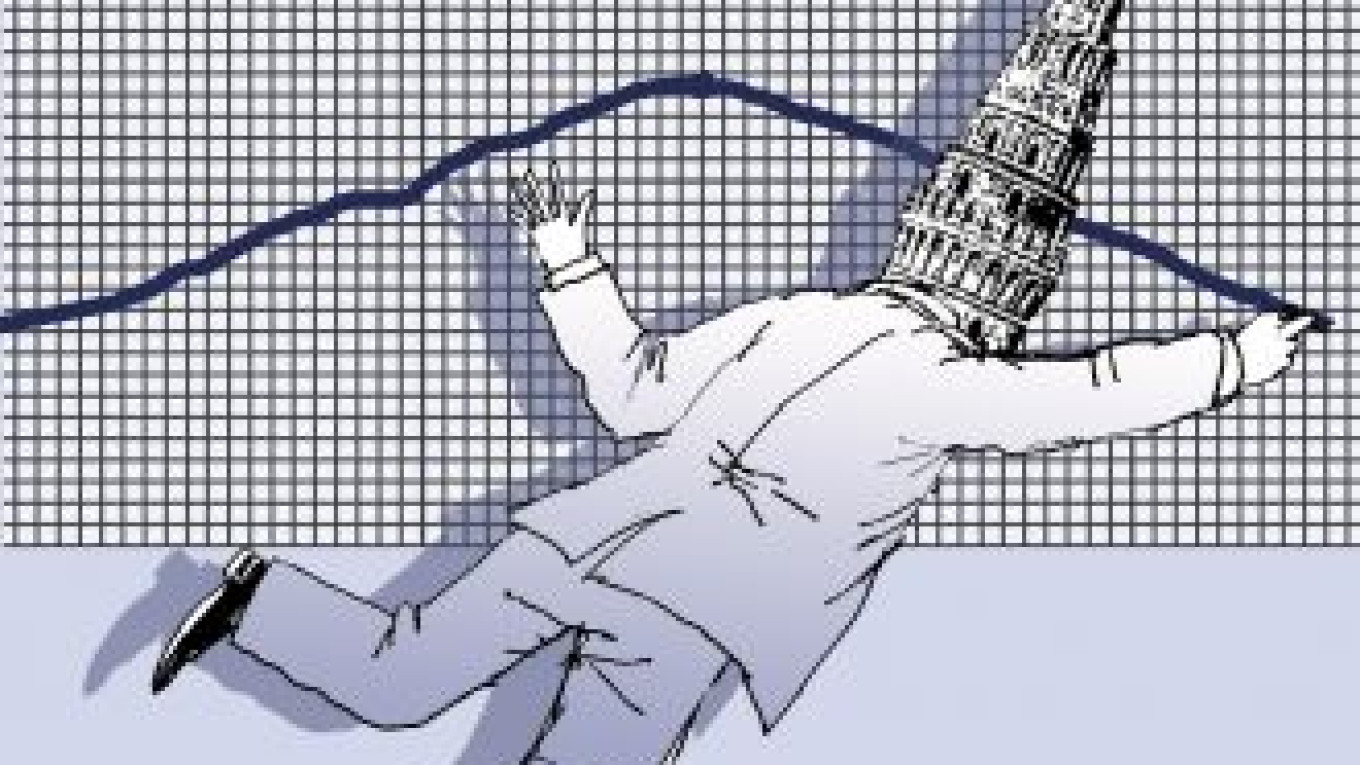
Clearly economics is a social science. Some economists would like to assume laboratory-like conditions where politics and other quirks of human behavior would not affect "rational expectations" and "efficient markets." But the period since the implosion of the Lehman Brothers investment bank in September 2008 has been an abject lesson in the risks of treating economics as being scientific at all.
If only we could abstract from politics, perhaps economics would make more sense. In fact, we would probably conclude that, just looking at recent data, the Russian economy is performing well, with reasonable prospects for 2012. But politics do interfere, and they do so in unpredictable ways. Two big political problems, one external and one internal, loom, and one or even both could cause the trajectory of the economy to underperform.
The external one that seems to refuse to subside is the euro-zone debt crisis. Clearly the economic and financial costs of whatever outcome emerges at this late stage will be huge, and it will be because of political decisions. The fundamental question torturing European politicians for the past two years is who should pay the costs of the inevitable adjustment to deleveraging from excessive indebtedness.
So far, as evidenced once again at last week's European Union summit, all member states except Britain swallowed a German diktat to pursue deflationary policies as the area slides into recession. The European elite are not certainly trying to protect the workers or taxpayers in the weaker members. When history repeats itself, economics has a tendency to produce similar outcomes. In this case, perhaps the closest historical analogy will be French Prime Minister Pierre Laval's epic attempt in 1935 to impose further austerity on a country already in depression as the seeming cost of keeping the franc strong and bankers whole. We know how that ended.
Meanwhile, in Russia an unanticipated reaction by the country's usually resigned urban middle-class voters to seemingly blatant manipulation of votes in the recent State Duma elections has been a sudden wake-up call to Russian and foreign investors alike that there may well be yet another unanticipated source of political uncertainty clouding the economic future. And this one is strictly internal, even if the Kremlin is apt to blame meddling foreigners.
There is no way to see through the veil that these political developments cast on future economic prospects for Russia. Much ink has been spilled in trying to ascertain how the European saga will end. The equity markets, for what they are worth as a predictive device, at least initially seemed to think that last week's summit could be an important step toward resolution. But the bond markets have been more pessimistic. In any case, trying to solve a debt problem — whether of European sovereign bonds or their banks — with more debt in the absence of vibrant economic growth is an obvious recipe for disaster. Sooner or later, either through default or inflation, the real value of the debt will have to be cut in most European countries.
When, not if, Europe's debt crisis reaches its climax, Russia will suffer consequences even if it is in better shape than in late 2008 when the last global financial tsunami struck. Russian banks enjoy a net creditor position, corporate debt is much lower relative to equity, the exchange rate is managed more flexibly, the external current account is positive, sovereign debt relative to gross domestic product is lowest in the Group of 20 countries and there is less speculative capital to flee.
That said, however, with Europe as the country's main trading partner and source of direct investment, a full-scale credit crunch in Europe would have an impact on Russia. Since it is difficult to predict the scale of the potential havoc in Europe and the policy actions that might be taken in response, it is also hard to envisage the scale of the potential adverse effects on Russia. A lower oil price is one of the more likely results.
Meanwhile, what will happen in terms of domestic politics, especially in the run-up to the March presidential election, is even more uncertain. Seemingly, the drop in the ruble exchange rate and the loss of foreign exchange reserves in the last week or so seem to result from an increasingly negative perception of Russia's political risks. Much will depend, in my view, on how the Kremlin decides to address the concerns expressed by those sympathetic to the protesters gathered on Bolotnaya Ploshchad on Saturday. History would again suggest that ignoring their concerns would lead eventually to more unrest, larger protests and other unintended consequences.
After more than a decade in which the Kremlin was rewarded politically for ensuring both stability and economic growth, it now appears that this formula is no longer sufficient, at least for some part of the population. Investors will be wary if stability in the future can only be provided at the cost of a halt or reversal of the modernization agenda, which would inevitably result in economic stagnation.
Both the external and internal political issues could upset an encouraging macroeconomic picture as we approach the end of 2011. After all, according to the latest numbers, Russia's macroeconomic performance is good: real GDP growth is projected by Troika Dialog at 4.8 percent, significantly better than the advanced economies of the United States, Japan, Europe or even Brazil. Inflation at an estimated 6.2 percent in 2011 will be the lowest in the 20 years of post-Soviet Russia. Unemployment is falling, according to the State Statistics Service, the budget still has a small surplus, and the external current account surplus is over 5 percent of GDP. The problem is that we have little idea as to how or how much the Russian economy will be blown off course by these political developments.
At best, even the uncertainty itself can impose costs as projects are delayed, new jobs are put on hold, financing is suspended and consumers become more prudent. Major political uncertainty — both external and internal — could sap Russia's economic strength going into the new year. How the Kremlin decides to respond to these challenges will ultimately determine whether Russia will be caught in a dual political vice or freed at least from the domestic political constraint that it has created for itself.
Martin Gilman, a former senior representative of the International Monetary Fund in Russia, is a professor at the Higher School of Economics.
A Message from The Moscow Times:
Dear readers,
We are facing unprecedented challenges. Russia's Prosecutor General's Office has designated The Moscow Times as an "undesirable" organization, criminalizing our work and putting our staff at risk of prosecution. This follows our earlier unjust labeling as a "foreign agent."
These actions are direct attempts to silence independent journalism in Russia. The authorities claim our work "discredits the decisions of the Russian leadership." We see things differently: we strive to provide accurate, unbiased reporting on Russia.
We, the journalists of The Moscow Times, refuse to be silenced. But to continue our work, we need your help.
Your support, no matter how small, makes a world of difference. If you can, please support us monthly starting from just $2. It's quick to set up, and every contribution makes a significant impact.
By supporting The Moscow Times, you're defending open, independent journalism in the face of repression. Thank you for standing with us.

Remind me later.