

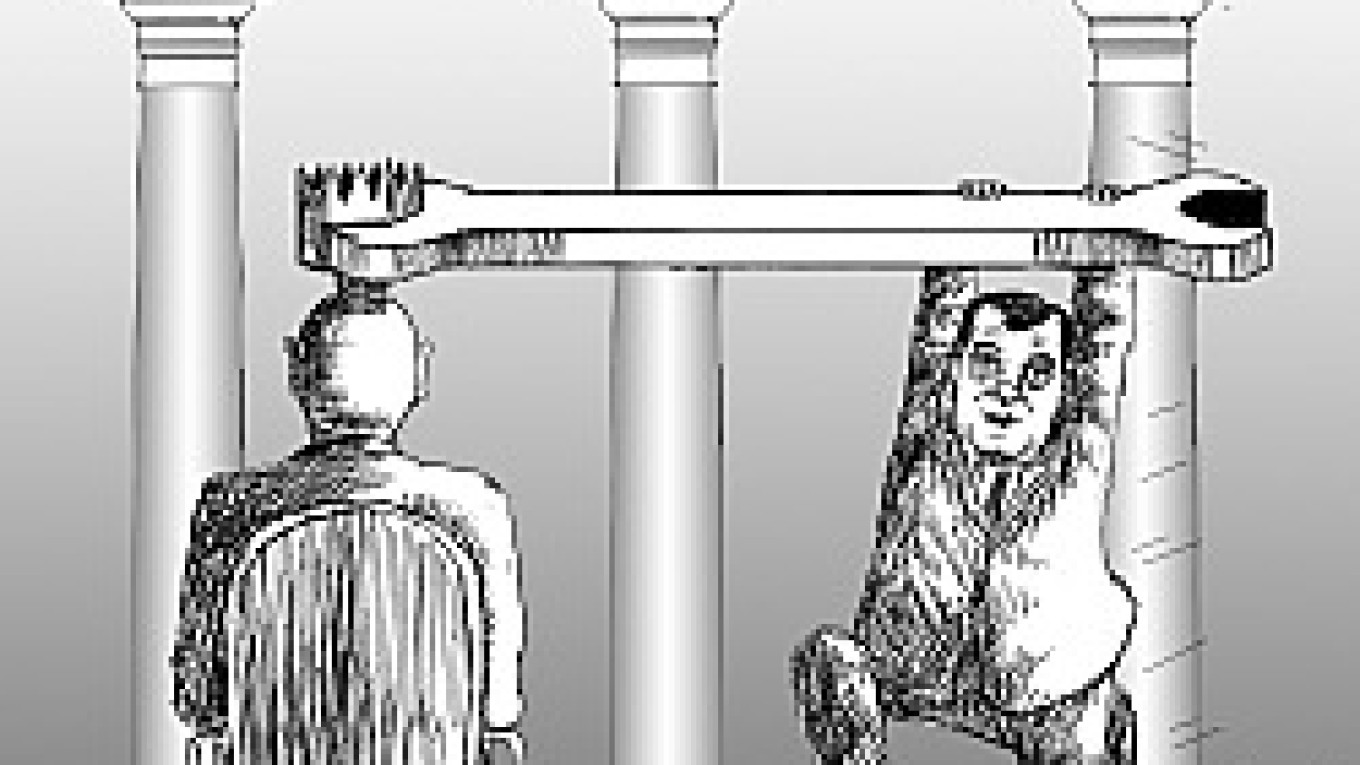
Medvedev's sudden announcement last week that he wanted to extend the presidential term to six years from the current four shouldn't have surprised anyone. In his final years as president, Putin dropped several hints that he backed a longer term because "a four-year presidency is insufficient for a country as large as Russia." At the same time, however, Putin repeatedly promised not to touch the Constitution.
Medvedev has made no such promises. Now Putin's wish to make elections an even rarer event is being granted by his hand-picked successor. The stated reason for the change is to strengthen democracy and political freedoms. The real reason, however, is to return Putin to power, and not for eight but 12 years.
 | To Our Readers |
The Moscow Times welcomes letters to the editor. Letters for publication should be signed and bear the signatory's address and telephone number. |
Sure, Putin has a history of making fast changes, such as the blitzkrieg cancelation of gubernatorial elections after the Beslan tragedy in 2004. But there is only one explanation for the mad scramble to change the Constitution: the financial crisis. Putin and his circle, it seems, are aware of the seriousness of the crisis that Russia might face next year when the financial turmoil hits home hard. Ironically, Putin's team put the country on the path toward a crisis through a series of blunders, led by a blind belief that oil prices would remain high and that companies could keep on borrowing from foreign banks.
Putin well remembers the 1998 crisis, when the Kremlin's authority collapsed over the course of several weeks and Boris Yeltsin's team only miraculously managed to hold on to power. He also remembers how quickly a deep schism among the ruling elite can occur. Against the backdrop of the crisis 10 years ago, a powerful political bloc, Fatherland-All Russia, was formed by former Prime Minister Yevgeny Primakov, Mayor Yury Luzhkov and Tatarstan President Mintimer Shaimiyev, and it immediately mounted a fierce attack against the Kremlin. Putin constantly strives to maintain a strategic advantage by guessing what might happen next and keeping all the cards in his own hands.
The constitutional amendments are a strong message to the country's elite that the Putin-Medvedev duo is determined to define the course of Russian politics for the next 10 to 15 years. The rush to pass the amendments is a way to assess the elite's loyalty during a crisis that is akin to a blazing fire. After the Duma passes the legislation, the equally submissive Federation Council will follow suit just as quickly. Then two-thirds of the regional parliaments, which are controlled by United Russia, will back the changes. By the New Year, Russia will probably have a new Constitution.
Another surprise might be waiting next year. Deciding that the main threat is no longer a Orange Revolution-style political uprising but an increase in social discontent and mass protests stemming from the crisis, Putin might try to keep a step ahead of the game once again. Using pretexts such as the new Constitution and the need to strengthen the state in the face of the crisis, he might through Medvedev announce snap presidential and parliamentary elections as early as March or April. The opposition would not be able to participate in the elections legally, and public discontent would not have reached a critical peak yet. Elections would allow Putin to again mix up all the cards, seize the initiative and deflect public attention from pressing problems.
Personally, I have no doubt that the main aim of Putin and his entourage is to hold on to the reins of power. To this end, they are ready to do almost anything, including engaging in a feckless budgetary policy in order to achieve their political goals, as has been the case in recent years. Putin's team cannot lead Russia out of the financial crisis by preserving and strengthening authoritarianism, refusing to undertake systemic structural reforms and amending the Constitution in an anti-democratic and nontransparent way. It's doing everything backward.
Vladimir Ryzhkov, a State Duma deputy from 1993 to 2007, hosts a political talk show on Ekho Moskvy.
A Message from The Moscow Times:
Dear readers,
We are facing unprecedented challenges. Russia's Prosecutor General's Office has designated The Moscow Times as an "undesirable" organization, criminalizing our work and putting our staff at risk of prosecution. This follows our earlier unjust labeling as a "foreign agent."
These actions are direct attempts to silence independent journalism in Russia. The authorities claim our work "discredits the decisions of the Russian leadership." We see things differently: we strive to provide accurate, unbiased reporting on Russia.
We, the journalists of The Moscow Times, refuse to be silenced. But to continue our work, we need your help.
Your support, no matter how small, makes a world of difference. If you can, please support us monthly starting from just $2. It's quick to set up, and every contribution makes a significant impact.
By supporting The Moscow Times, you're defending open, independent journalism in the face of repression. Thank you for standing with us.

Remind me later.